September 3, 2026
Avoid Months of Back and Forth: Yardi Locker Integration for US Operators
US operator guide to Yardi locker integration: checklist, security steps, vendor must asks, and rollout tips to avoid months of delay.

Yes, package locker and access control systems can integrate with Yardi Voyager, and the outcome is straightforward: resident credentials get provisioned, updated, and retired automatically as leases change, instead of someone in the leasing office typing that information into three different systems. The connection runs through Yardi’s partner and interface program, which exposes property, unit, and lease data via web services. Locker Solutions builds its Luxer One integrations on exactly this framework for multifamily properties across the United States.
TL;DR:
- Most Yardi locker integrations pull essential lease data, including property ID, unit number, lease dates, resident contact info, and lease status, for automatic credential management.
- Integration workflows typically include provisioning credentials when leases activate, updating them during transfers, and retiring access immediately upon lease termination to ensure security.
- Setting up the integration requires obtaining API credentials, test environment access, and clear field mappings, with a strong emphasis on security practices like credential rotation and encrypted data transport.
- Choosing a vendor involves assessing their integration maturity, operational support, security measures, and metrics like provisioning accuracy and system uptime, since not all vendors have a ready Yardi connector.
- Locker Solutions offers hardware designed specifically for Yardi Voyager, enabling quick deployment across indoor, outdoor, refrigerated lockers, and package rooms, with support for high-volume and multi-property portfolios.
Table of Contents
- How Yardi Locker Integrations Actually Move Data
- Common Integration Workflows You’ll Actually Use
- Setting Up the Integration: Requirements and Security Checklist
- What to Look For in a Locker or Access Vendor
- Locker Solutions: Built for Yardi Voyager From the Ground Up
- Field Notes: What Actually Trips Up a Locker Rollout
- Get Your Property Connected to Yardi
- Where to Go Deeper on Yardi and Locker Integration
- Sources
How Yardi Locker Integrations Actually Move Data
Yardi maintains one of the largest interface partner programs in property management software, and that program is the backbone of any locker or access control connection. Once a property grants API credentials, a locker system can query Voyager web services for the specific lease and resident fields it needs to build a working credential.
The data set is narrower than people expect. A locker integration typically pulls:
- Property ID and unit number
- Lease ID, lease start date, and lease end date
- Resident name and contact information (phone or email for pickup alerts)
- Lease status (active, notice, terminated)
Most integrations follow a predictable sync pattern: provision access when a lease goes active, update it if a resident transfers units, and retire it automatically when the lease ends. This is almost always a one-way flow, Yardi pushes data out, the locker or access platform consumes it, rather than a two-way exchange where the locker system writes back into Voyager. That limitation is intentional. It keeps Yardi as the single source of truth for lease data and reduces the risk of a third-party system corrupting resident records.
Common Integration Workflows You’ll Actually Use
Once the connection is live, day-to-day operations follow a handful of repeatable workflows rather than constant manual intervention.
- Move-in provisioning. When a lease status flips to active in Voyager, the integration creates locker and access credentials automatically, so residents can use package systems from day one without a staff member manually adding them.
- Move-out and lease-end retirement. Access and locker privileges shut off the moment a lease terminates, closing a common security gap where former residents retain building access for weeks.
- Carrier and parcel handling. Couriers scan a barcode at the kiosk, the system assigns an open compartment, and the resident gets a pickup notification, no leasing staff involved.
- Transfers and exceptions. Unit transfers update credentials rather than deleting and recreating them, and short-term holds or vendor access (maintenance, cleaning crews) typically run through a separate temporary-access layer rather than the resident credential feed.
A secure package pickup workflow built around these four events removes most of the manual credentialing work that eats up leasing staff time on turnover-heavy properties.
Setting Up the Integration: Requirements and Security Checklist
Before any locker vendor touches your Voyager instance, your IT or operations team needs to request a specific set of items from Yardi. Skipping this step is the single biggest cause of delayed go-lives.
Ask Yardi for:
- API credentials and a client ID scoped to your property or portfolio
- A documented list of allowed endpoints for your interface partner
- Access to a sandbox or test environment before touching production data
- Written field mappings so your vendor knows exactly which Voyager fields map to locker system fields
Locker Solutions’ onboarding process leans on Yardi’s own interface partner documentation to speed this up, since Yardi already maintains standardized onboarding paths for hundreds of interface partners rather than negotiating custom terms property by property.
Security deserves equal attention. Use least-privilege credentials scoped only to the data the locker system actually needs, never a full administrative key. Transport should run over TLS end to end, and every credential provisioning event should be logged so you can audit who got access and when. Rotate API tokens on a schedule rather than leaving them static indefinitely.
Pro Tip: Run your first integration cycle entirely in Yardi’s sandbox environment and manually verify at least ten test leases against expected locker credentials before flipping the switch on a live property. It catches field-mapping errors that only show up with real data, like a unit number format mismatch that silently blocks provisioning for an entire building.
Because Yardi’s interface program spans hundreds of standard integration partners, most field-mapping problems you’ll hit have already been solved by someone else, ask your vendor for their standard mapping template before building one from scratch.
What to Look For in a Locker or Access Vendor
Not every locker vendor has actually built a working Yardi connector, and the difference shows up fast during onboarding. Evaluate vendors across four areas before signing anything.
- Integration maturity: ask for a documented, already-built Yardi connector and references from properties running it live, not a promise to build one after contract signature.
- Operational support: confirm installation timelines, maintenance response SLAs, and how carrier check-in actually works at the kiosk.
- Security posture: request evidence of encrypted data transport, credential rotation practices, and any third-party security review.
- Service model fit: decide whether you want hardware-only or a fully managed package room, since staffing implications differ significantly.
- Requestable metrics: ask for provisioning accuracy rates, average time-to-credential after lease activation, and system uptime history.
A vendor that can’t answer the integration maturity question specifically is usually still building the connector on your dime.
Locker Solutions: Built for Yardi Voyager From the Ground Up
Locker Solutions deploys Luxer One hardware with integration paths built specifically for Yardi Voyager, so provisioning and retirement happen automatically as leases move through their lifecycle. The hardware lineup covers more ground than a single locker bank:
- Indoor electronic package lockers for climate-controlled common areas
- Weatherproof outdoor kiosks for properties without interior lobby space
- Refrigerated lockers for grocery and meal-kit deliveries
- Fully automated package rooms for high-volume communities
| What you get | Why it matters |
|---|---|
| Rapid deployment and custom configuration | Properties go live faster without redesigning existing mail areas |
| Ongoing maintenance and monitored package rooms | Removes recurring locker upkeep from onsite staff workload |
| AI-powered label reading and automated alerts | Cuts misdelivered packages and manual carrier logging |
| Nationwide installation support | Consistent rollout experience across multi-property portfolios |
For portfolios juggling dozens of properties, the operational payoff is fewer support tickets tied to package disputes and faster turnover between residents on move-out day.
Field Notes: What Actually Trips Up a Locker Rollout
Coordinate network drops, power runs, and physical locker placement with your construction or retrofit team before equipment arrives, not the week installation starts. Run a limited pilot at one property first: validate that Yardi field mappings translate correctly and that carriers can actually scan and deposit packages before rolling out portfolio-wide. Train leasing staff and regular carriers on the new workflow before full cutover, since confused carriers create more support calls than any software bug. Document your rollback steps and actually test them in staging, because the first time you need a rollback plan is the worst time to discover it doesn’t work.
— Locker Solutions
Get Your Property Connected to Yardi
You’ve seen how the integration works. Now here’s the part that actually matters for your property: getting from “we should do this” to a working system without months of back and forth between IT and a vendor who’s never touched Voyager before.
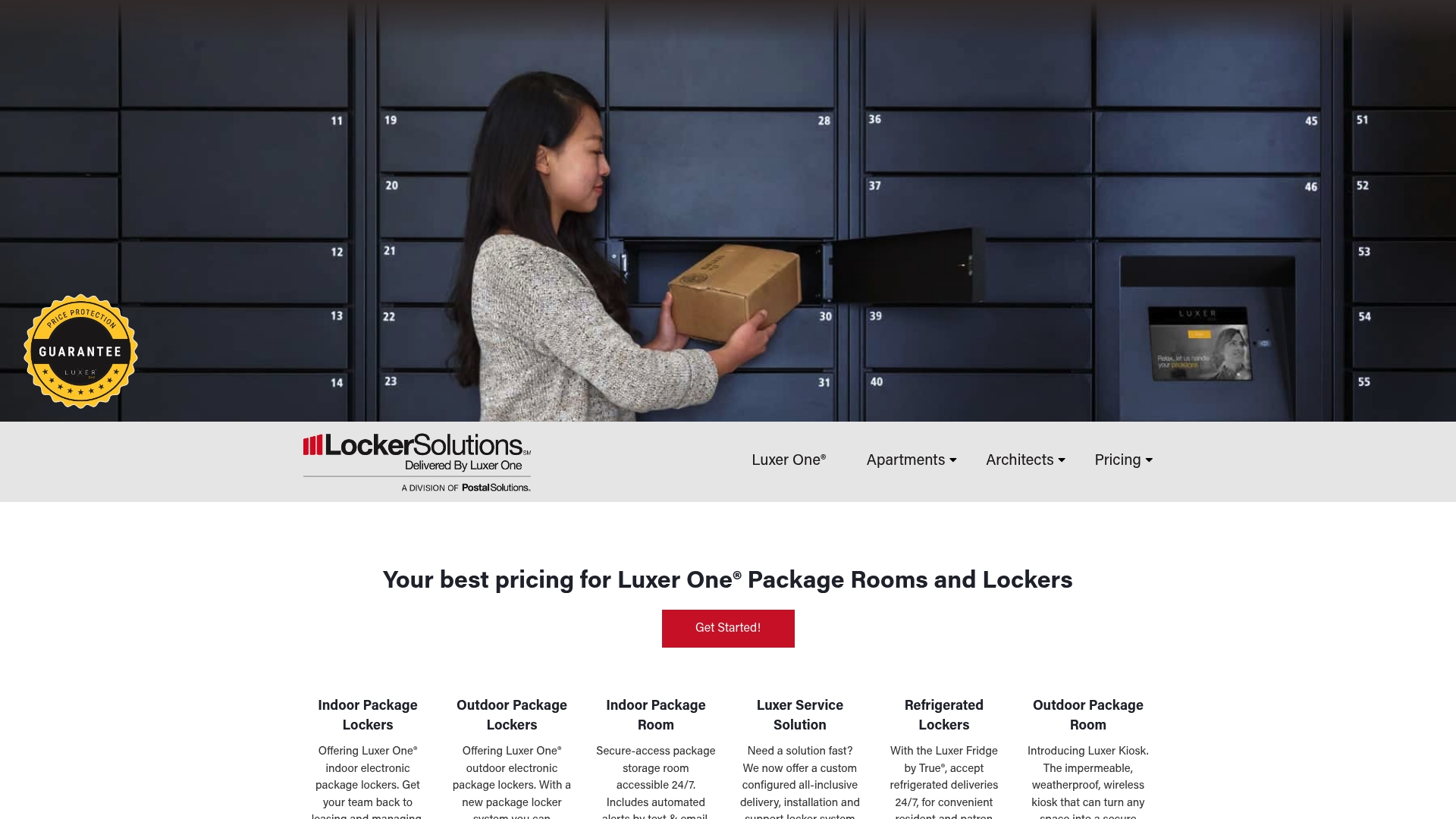
Locker Solutions handles the entire path, from site survey through pilot deployment to portfolio-wide rollout, with Yardi integration expertise baked into the process rather than bolted on afterward. The quick-start sequence is simple: a site survey to plan power and network routing, a request for Yardi API access, a single-property pilot to validate the connector, then full rollout once the mappings check out. Whether you need unified access control tied to resident leases or a fully managed package room that takes daily operations off your staff’s plate, the deployment path stays the same: survey, connect, pilot, scale. Reach out to request a demo or schedule a site survey, and get a property-specific quote before your next lease-up cycle starts.
Where to Go Deeper on Yardi and Locker Integration
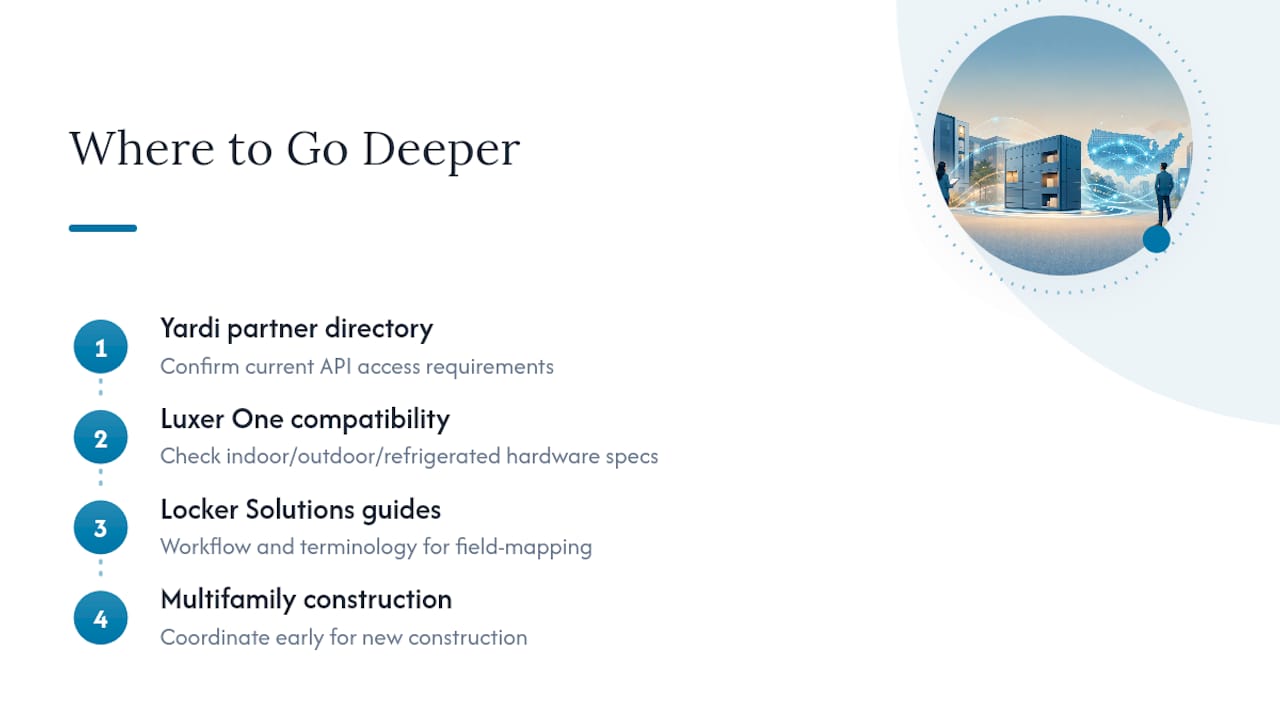
Start with Yardi’s own interface partner directory to confirm current API access requirements for your portfolio. Review Luxer One’s platform compatibility pages for hardware specifications across indoor, outdoor, and refrigerated locker types. For operational planning, Locker Solutions’ parcel handling workflow guide and terminology reference cover the field-mapping vocabulary your team will need during setup. If your rollout overlaps new construction, review coordination considerations for multifamily development projects early.
Sources
Recommended
Ready for a Luxer One® package locker quote?
Tell us your unit count and we'll send right-sized pricing with a fast response time.
Get my free quote