July 30, 2026
Why Suburban Georgia Complexes Need Lockers: ROI Guide
Discover why suburban Georgia complexes need lockers. Enhance security, save staff hours, and meet resident expectations with smart lockers.
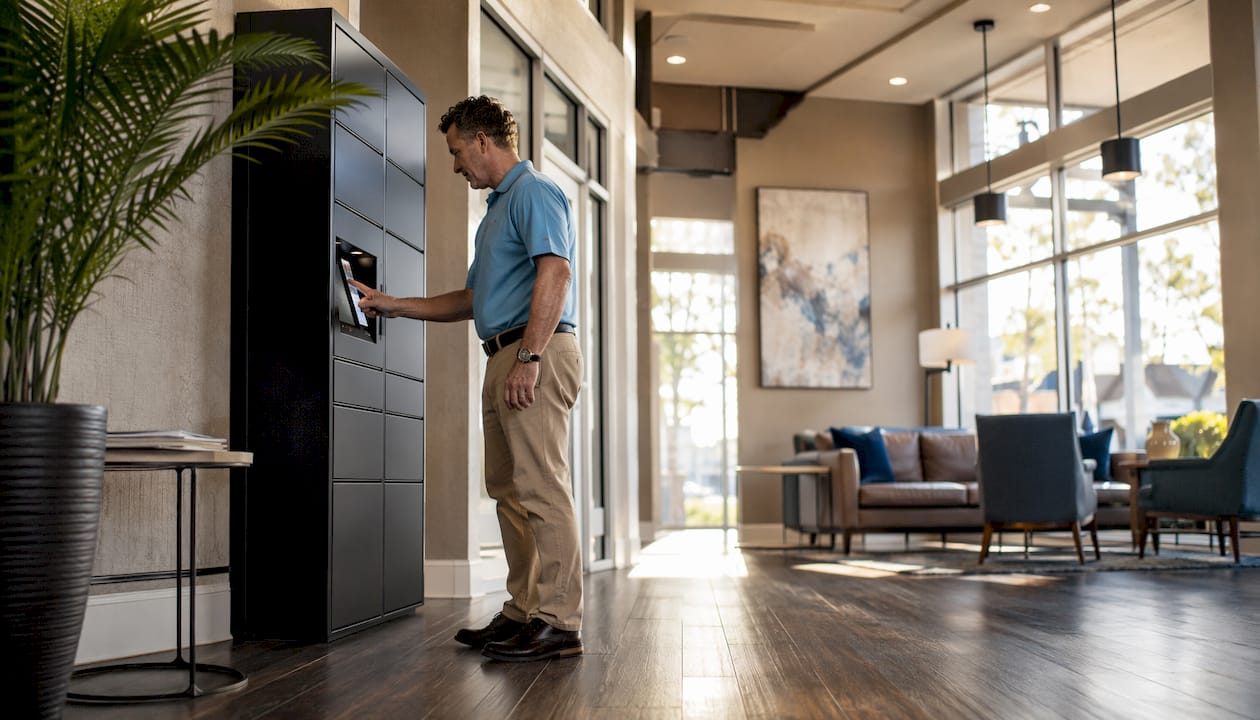
Suburban Georgia apartment complexes need package lockers. That’s the short answer. The longer one: package theft is a frequent concern for residents, and individual residents receive many packages annually, and your leasing staff is spending hours each week sorting, storing, and tracking deliveries that were never their job. A well-configured locker system fixes all three problems at once, and most mid-size communities see payback within about a year to a year and a half.
Three reasons suburban Georgia complexes should act now:
- Operational ROI: Staff hours recovered from package handling convert directly to salary savings and redeployable labor.
- Resident expectation: Smart lockers are now a standard amenity for hybrid workers and young professionals who expect 24/7 self-service pickup.
- Risk reduction: A digital audit trail with photo timestamps reduces theft claims and limits your liability exposure.
Table of Contents
- Why suburban Georgia complexes need lockers: the operational case
- Which locker types and configurations work best for suburban Georgia properties
- How the delivery-to-pickup workflow actually runs
- What suburban Georgia properties need to get right on-site
- What does a locker system actually cost, and when does it pay back?
- Questions to ask vendors before you sign anything
- What Atlanta-area installs show about real-world performance
- Key Takeaways
- The pattern we keep seeing in Georgia deployments
- Locker Solutions and Luxer One® for suburban Georgia properties
- Useful sources
Why suburban Georgia complexes need lockers: the operational case
The benefits stack up fast once you move past the headline. Here is what actually changes on the ground.
Staff time and operational savings. Package handling is a hidden labor cost. When staff spend time signing for deliveries, sorting parcels, notifying residents, and managing overflow, that time adds up to real salary dollars. Cloud-based locker management with automatic notifications eliminates most of that manual work. Before you install, track how many hours per week your team spends on packages — that number becomes your baseline ROI input.
Resident experience and retention. Residents who can pick up a package at 11 PM on a Tuesday do not file complaints. They renew leases. Communities that offer 24/7 self-service pickup report measurable improvements in resident satisfaction, and smart lockers are becoming a deciding factor in lease renewals among hybrid workers who frequently receive deliveries. Amenity parity with urban competitors matters in suburban markets where renters have options.
Security and liability. A locker system creates a timestamped, photo-documented chain of custody for every package. When a resident claims a delivery went missing, you have evidence. That audit trail reduces the number of claims that escalate to management and limits your exposure to package security liability. Package theft is a real and growing problem — porch piracy incidents have climbed alongside e-commerce volume, and a locker is the most direct countermeasure available to a property manager.
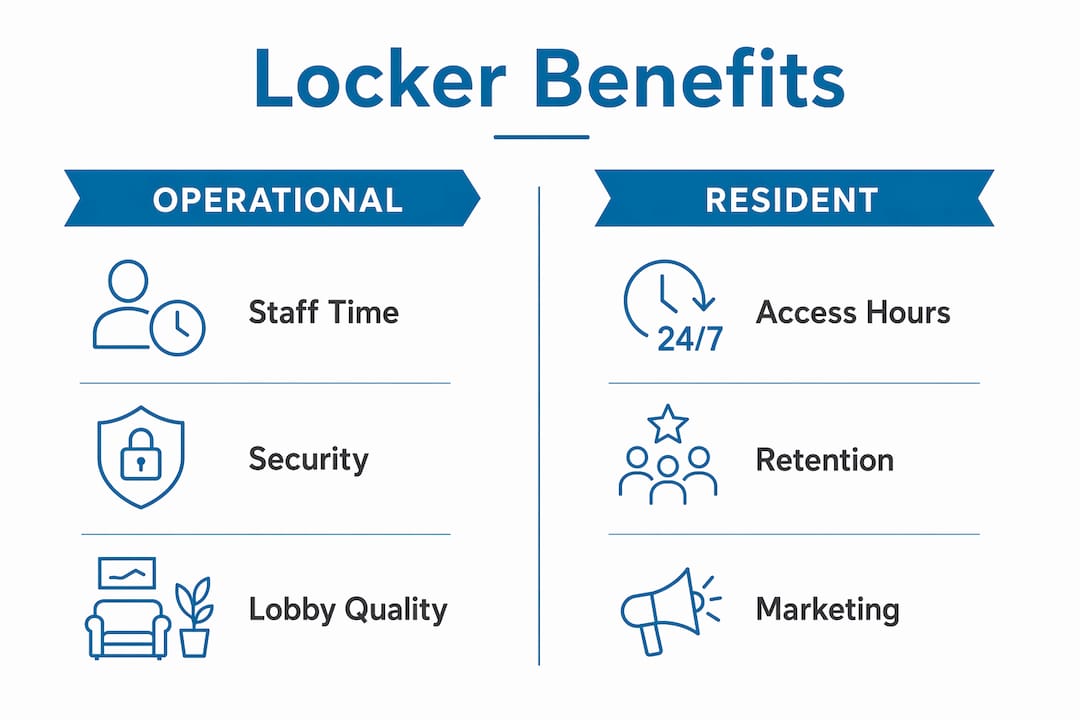
Lobby and common-area quality. Packages piled in a lobby or leasing office signal poor management to prospective renters. Lockers eliminate that visual clutter and reduce foot traffic congestion during peak delivery windows. For suburban garden-style properties competing on perceived quality, a clean lobby is not cosmetic — it is a leasing tool.
Marketing and leasing advantage. Listing “24/7 smart package lockers” in your amenity set differentiates your community from older stock that still relies on front-desk handling. That single line in a listing can tip a decision for a remote worker who orders groceries, electronics, and work supplies weekly.
Pro Tip: Before go-live, record three baseline metrics for 30 days: staff hours per week on package handling, number of package-related complaints per month, and reported theft or missing-package incidents. Those three numbers are the only ones you need to calculate your actual ROI post-install.
Which locker types and configurations work best for suburban Georgia properties
Not every configuration fits every property. The right choice depends on your building layout, resident count, and how much staff involvement you want after installation.
Indoor locker towers work well for communities with a centralized leasing office or a dedicated mail room. They are the lowest-maintenance option: climate-controlled, no weatherproofing required, and easy to expand modularly as your community grows. Best fit for low-rise buildings where residents pass through a common entry.
Outdoor weatherproof kiosks are the right call for garden-style communities where residents do not share a common interior corridor. These units are anchored, sealed against rain, and built to handle Georgia’s storm seasons. Outdoor kiosks placed near parking areas reduce missed deliveries because carriers can deposit without building access, and residents can retrieve on their own schedule.
Automated package rooms make sense for larger communities — typically 300+ units — where locker compartment counts alone cannot absorb daily volume. A package room can handle oversized items, bulk deliveries, and high-frequency periods like the holiday season. For suburban properties with a dedicated package room space, this option pairs well with a smaller locker bank for after-hours access.
Refrigerated lockers serve communities where grocery delivery and meal-kit services are popular. A single refrigerated compartment bank near the main locker cluster handles cold-chain deliveries without requiring staff involvement. Worth considering for any suburban Georgia community near a Kroger, Publix, or Whole Foods delivery zone.
Hybrid networks combine two or more of the above. A common suburban configuration: outdoor kiosk at the parking entry for carrier drop-off, indoor tower at the leasing office for oversized items, and a refrigerated unit for cold deliveries.
| Property Type | Recommended Configuration | Weather Exposure | Staffing Implication |
|---|---|---|---|
| Garden-style, mid-size units | Outdoor weatherproof kiosk | High — anchor and seal required | Minimal; carrier self-deposit |
| Low-rise with shared entry, mid-size units | Indoor locker tower | Low | Minimal; auto-notifications |
| Townhome cluster, small to mid-size units | Outdoor kiosk near mailboxes | High | None after install |
| Large suburban complex, 300+ units | Automated package room + locker bank | Moderate–High | Optional managed service |
| Any community with grocery delivery | Add refrigerated compartment bank | Varies | None |
A rough sizing rule: plan for one locker compartment per 1.5–2 residents, then add 20% for peak-season overflow. Modular systems let you add compartments without replacing the base unit, so starting conservatively and expanding is a reasonable approach.
Pro Tip: Plan your compartment count around your holiday-season peak, not your average week. November and December delivery volumes can run two to three times higher than a typical month. Undersizing at install is the most common and most avoidable mistake.
How the delivery-to-pickup workflow actually runs
The operational flow is simpler than most property teams expect.
- Carrier arrives. The delivery driver approaches the locker kiosk or indoor tower. Open-access kiosks allow any carrier to deposit without a building key or staff interaction. Credentialed systems require a carrier PIN or app authentication — useful for higher-security communities.
- Package is scanned and assigned. The system’s AI-powered label reader scans the package barcode or label, identifies the recipient, and assigns an available compartment automatically.
- Locker door opens. The driver places the package and closes the door. The system logs the deposit with a photo and timestamp.
- Resident is notified. The resident receives an automated alert — by text, email, or push notification through the property’s app — with a unique retrieval code or a mobile unlock option.
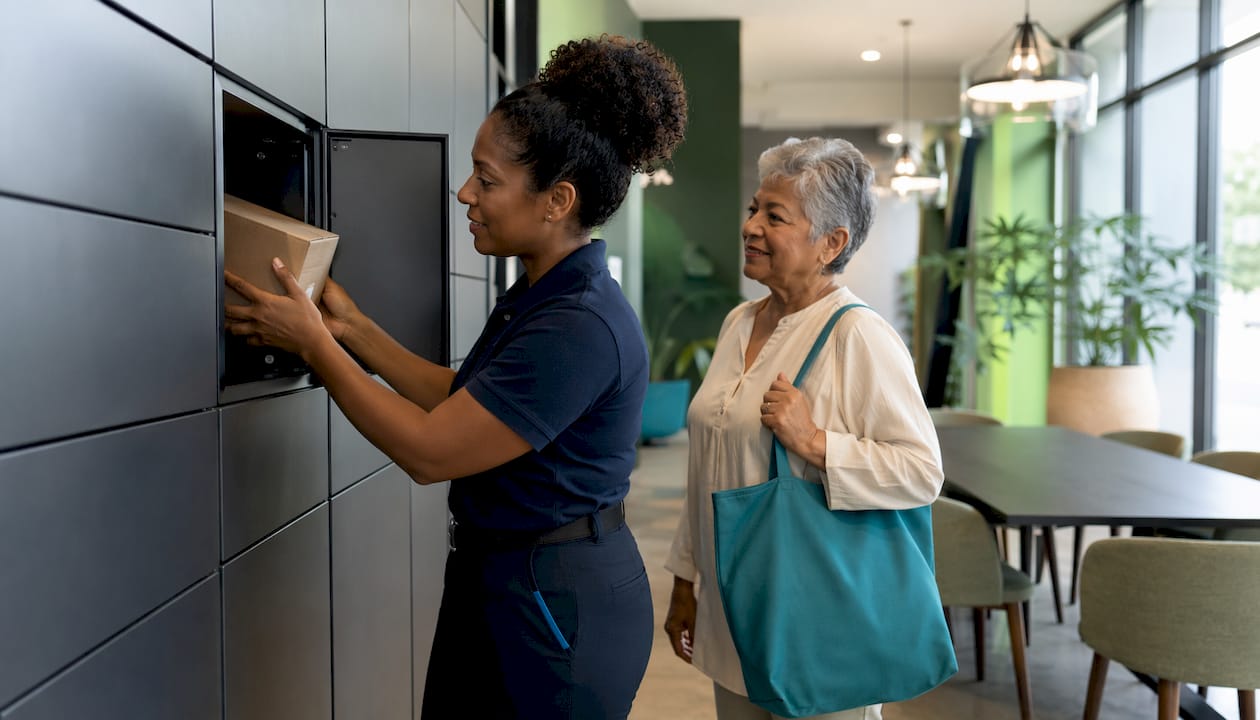
- Resident retrieves the package. At any hour, the resident enters their code or uses the mobile app at the kiosk. The correct compartment opens. The system logs the pickup.
- PMS sync. If the locker system is integrated with your property management software, the transaction record flows into your existing platform automatically.
Delivery drivers can deposit without building access on open-access kiosk systems, which is a significant advantage for suburban routes where carriers are moving fast and do not want to wait for a staff member.
Common exceptions the system handles automatically:
- Oversized items: The system flags packages that exceed compartment dimensions and routes a staff alert or holds them in a designated overflow area.
- Unclaimed packages: After a configurable hold period (typically 3–5 days), the system sends escalating reminders and can alert staff to follow up.
- Returns: Some systems support outbound return deposits, where residents place a labeled return package in a compartment for carrier pickup.
For connectivity, the system needs a power outlet and either a wired ethernet connection or a cellular data connection. Cellular failover keeps the system running during internet outages — a real consideration for suburban Georgia properties that see storm-related connectivity disruptions.
What suburban Georgia properties need to get right on-site
Georgia’s climate and suburban property layouts create a specific set of planning requirements that differ from urban high-rise installs.
Placement and visibility. Position lockers where residents naturally pass — near the parking lot entry, adjacent to the leasing office, or at the main pedestrian path. High-visibility placement deters tampering and makes the system easy to find for new residents. Avoid tucking a kiosk behind landscaping or in a low-traffic corner.
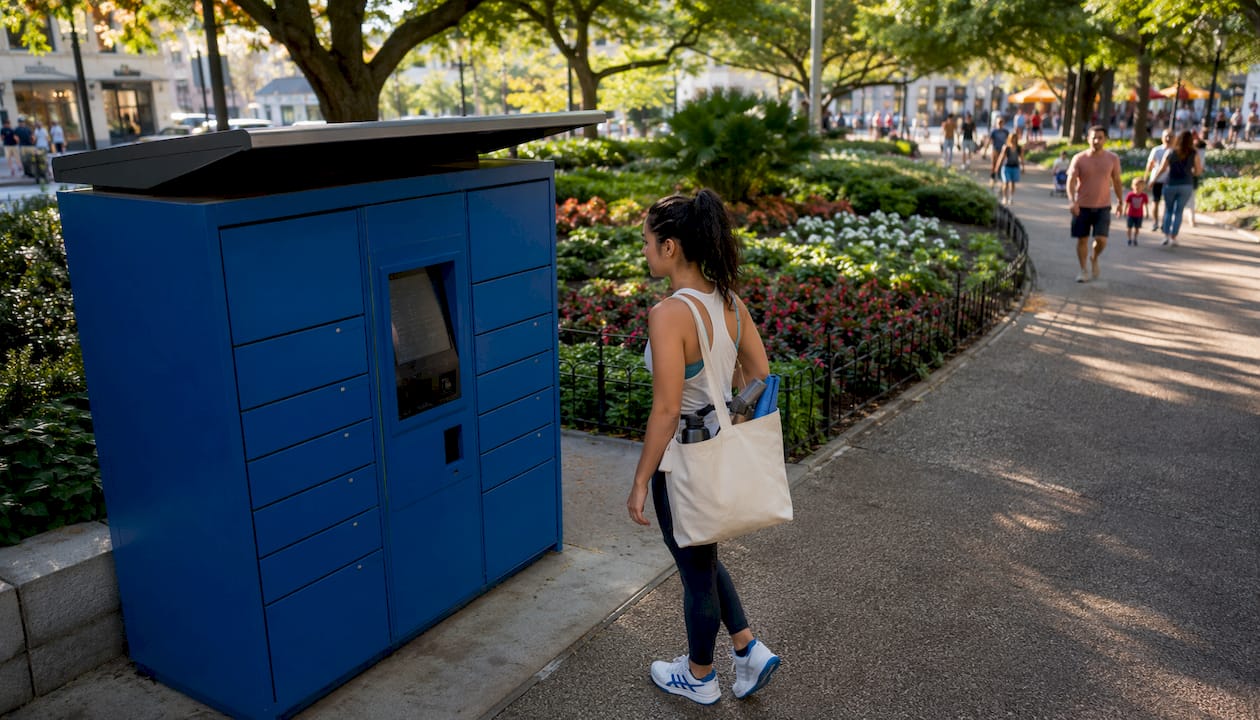
Weatherproofing for Georgia conditions. Georgia’s combination of summer heat, humidity, and storm-season rain requires outdoor units that are properly anchored, sealed, and protected. Installation partners in Metro Atlanta prioritize anchoring and roofline protection to ensure durability through storm seasons. Drainage around the base pad matters — standing water accelerates corrosion on any outdoor hardware. Locker Solutions’ weatherproof outdoor kiosks are built specifically for these conditions.
Connectivity and power. Most suburban properties have accessible power near parking structures or leasing offices. If a dedicated circuit is not available at your preferred placement, budget for electrical work during site prep. Cellular failover is worth the modest additional cost in Georgia, where thunderstorm outages are common in summer.
ADA compliance. Locker compartments must be reachable from a clear, level approach path. The lowest compartments should meet ADA height requirements, and the approach path should accommodate a wheelchair. Confirm this with your installer before finalizing placement.
Carrier credentialing. UPS, FedEx, USPS, and Amazon all have different carrier access workflows. Open-access kiosks handle all carriers without credentialing. Credentialed systems require registering each carrier’s delivery staff — a one-time setup that your vendor should walk you through. For suburban Georgia routes, where Amazon Logistics handles a large share of residential deliveries, confirm Amazon compatibility before purchase.
Maintenance and SLAs. Ask your vendor for a written service-level agreement that covers response time for hardware failures, preventive maintenance schedules, and parts availability. A system that goes offline during the holiday season is a leasing-office crisis. Local service presence in the Atlanta metro matters more than a national call center.
Pro Tip: Coordinate locker placement with your landscaping and lighting plan before concrete is poured. A well-lit, open sightline to the locker station deters theft and vandalism. Adding lighting after the fact costs more and often produces a worse result.
What does a locker system actually cost, and when does it pay back?
Installed costs for a standard suburban community run roughly $12,000–$36,000 for a 200-unit property, depending on configuration. The key variables are unit count, indoor versus outdoor placement, refrigerated compartments, and whether you add a managed package room service. Payback typically runs 12–18 months for a mid-size community when you account for labor savings and reduced complaint handling.
| Budget Line Item | Typical Range | Notes |
|---|---|---|
| Hardware (locker towers or kiosk) | $12,000–$36,000 | Varies by compartment count and type |
| Installation and site prep | — | Electrical, anchoring, concrete pad if needed |
| Software and integration | — | PMS integration, notification platform |
| Optional managed service | Market rate | Daily on-site package room management |
| Refrigerated add-on | — | Per refrigerated compartment bank |
ROI drivers to model in your financial case:
- Staff hours recovered: If your team spends 10 hours per week on package handling at an average wage, that is over $10,000 per year in recoverable labor at a modest hourly rate.
- Theft-related claims: Each resolved theft complaint costs staff time and sometimes cash. Eliminating most of those claims has a real dollar value.
- Resident retention: A single lease renewal avoided by better amenities covers a significant portion of the hardware cost, given typical turnover costs.
- Installation timeline: Standard systems go from site assessment to go-live in 1–3 days for most suburban properties. There is no extended construction window.
Financing and lease options are available through most vendors, which lets you spread the capital cost over 24–60 months and treat the system as an operating expense rather than a capital outlay.
Questions to ask vendors before you sign anything
The hardware is the easy part. The vendor relationship, software contract, and service terms are where deals go wrong.
Warranty and hardware support:
- What is the warranty period, and does it cover parts and labor or parts only?
- Is there a local service technician in the Atlanta metro, or does repair require shipping units out?
- What is the guaranteed response time for a hardware failure?
Software and integrations:
- Which property management systems does the platform integrate with natively (Yardi, RealPage, Entrata, AppFolio)?
- Who owns the resident data, and what happens to it if you switch vendors?
- Can the notification system send alerts via SMS, email, and push notification simultaneously?
Security and compliance:
- How long are photo audit trail records retained, and are they accessible to property management on demand?
- Does the system comply with Georgia data privacy requirements for resident personal information?
- What encryption standard protects resident access codes in transit and at rest?
Service and spare parts:
- What is the preventive maintenance schedule, and who performs it?
- Are spare parts stocked locally or shipped from a central warehouse?
- How does the vendor handle surge-season support (November–January)?
Red flags to watch for: A vendor who cannot name a local service contact in Georgia, who offers a warranty that covers parts only, or who cannot demonstrate a native PMS integration with your current platform. Good answers are specific — a named technician, a written SLA with hours, and a live demo of the PMS integration.
Pro Tip: Ask for a reference from a suburban Georgia property the vendor has installed in the last 18 months. A vendor with real local experience will provide one without hesitation. One who deflects to national case studies probably does not have it.
For a deeper look at procurement terminology before your RFP, the apartment package solutions terminology guide from Locker Solutions covers the key terms your team needs.
What Atlanta-area installs show about real-world performance
Suburban Georgia properties that have deployed Luxer One® locker systems through Locker Solutions report consistent patterns: staff time spent on package handling drops sharply after go-live, resident pickup rates are high because the 24/7 access removes the friction of office-hours-only retrieval, and theft-related complaints fall to near zero once the audit trail is in place.
Outdoor kiosks installed in the Atlanta metro have demonstrated durability through Georgia’s storm seasons when properly anchored and protected, confirming that weatherproofing is not optional — it is the difference between a system that lasts five years and one that requires replacement after the first major storm.
The service model matters as much as the hardware. Properties that pair locker hardware with Locker Solutions’ package room management service report the smoothest transitions, particularly during the first holiday season after install, when delivery volumes spike and staff would otherwise be overwhelmed.
Key outcomes reported across suburban Georgia installs:
- Significant reduction in weekly staff hours dedicated to package handling after system go-live.
- Near-elimination of porch-piracy and lobby-theft complaints once the photo-timestamped audit trail is active.
- Resident pickup rates above 90% within the first 30 days, driven by automated notifications.
- Carrier deposit times under two minutes per delivery on open-access kiosk systems.
Key Takeaways
Suburban Georgia apartment complexes that install smart package lockers recover staff time, reduce theft liability, and gain a leasing advantage — with most mid-size communities reaching payback within 12–18 months.
| Point | Details |
|---|---|
| Payback timeline | Most mid-size communities recover installation costs within 12–18 months through labor savings and reduced claims. |
| Right configuration matters | Garden-style and townhome properties in Georgia typically need outdoor weatherproof kiosks; larger communities benefit from hybrid locker-plus-package-room setups. |
| Baseline metrics first | Track staff hours, complaint counts, and theft incidents for 30 days before install to calculate real ROI after go-live. |
| Vendor questions are critical | Confirm local Georgia service presence, written SLAs, and native PMS integration before signing any contract. |
| Locker Solutions | Locker Solutions deploys Luxer One® systems across suburban Georgia with weatherproof outdoor kiosks, refrigerated options, PMS integration, and local installation support. |
The pattern we keep seeing in Georgia deployments
The most common mistake in suburban Georgia locker deployments is not the hardware choice — it is the compartment count. Property teams consistently underestimate how many compartments they need, especially when they are sizing for average delivery volume rather than peak. A 150-unit community that averages 40 deliveries per week can see 120 on a Monday after a holiday weekend. If your system fills up, carriers cannot deposit, residents get frustrated, and the whole value proposition collapses.
The second recurring issue is placement. Outdoor kiosks placed for installer convenience rather than resident traffic patterns get lower adoption rates. Residents will not walk an extra 200 feet to a kiosk tucked behind the dumpster enclosure. Placement near the parking lot entry or the main pedestrian path to the leasing office consistently produces higher pickup rates and faster resident adoption.
Connectivity is the third. Cellular failover is treated as optional by many property teams until the first summer thunderstorm takes out their internet for six hours and the locker system goes dark. In suburban Georgia, that is not a rare event. Budget for it from the start.
The properties that get this right share one trait: they treat the locker system as infrastructure, not an amenity add-on. That means proper site assessment, correct sizing, professional installation, and a vendor with real local service capability. When those four things are in place, the system runs quietly in the background and your staff stops thinking about packages entirely.
Locker Solutions and Luxer One® for suburban Georgia properties
Suburban Georgia property managers who are ready to move past manual package handling have a direct path forward with Locker Solutions and Luxer One®. The offering covers the full range: indoor locker towers, outdoor weatherproof kiosks built for Georgia’s storm seasons, refrigerated compartments for grocery and meal-kit deliveries, and automated package rooms for larger communities. Every system includes PMS integration, AI-powered label reading, video surveillance, and 24/7 resident access. Installation runs 1–3 days for most suburban properties, and local service in the Atlanta metro means you are not waiting on a national dispatch queue when something needs attention.
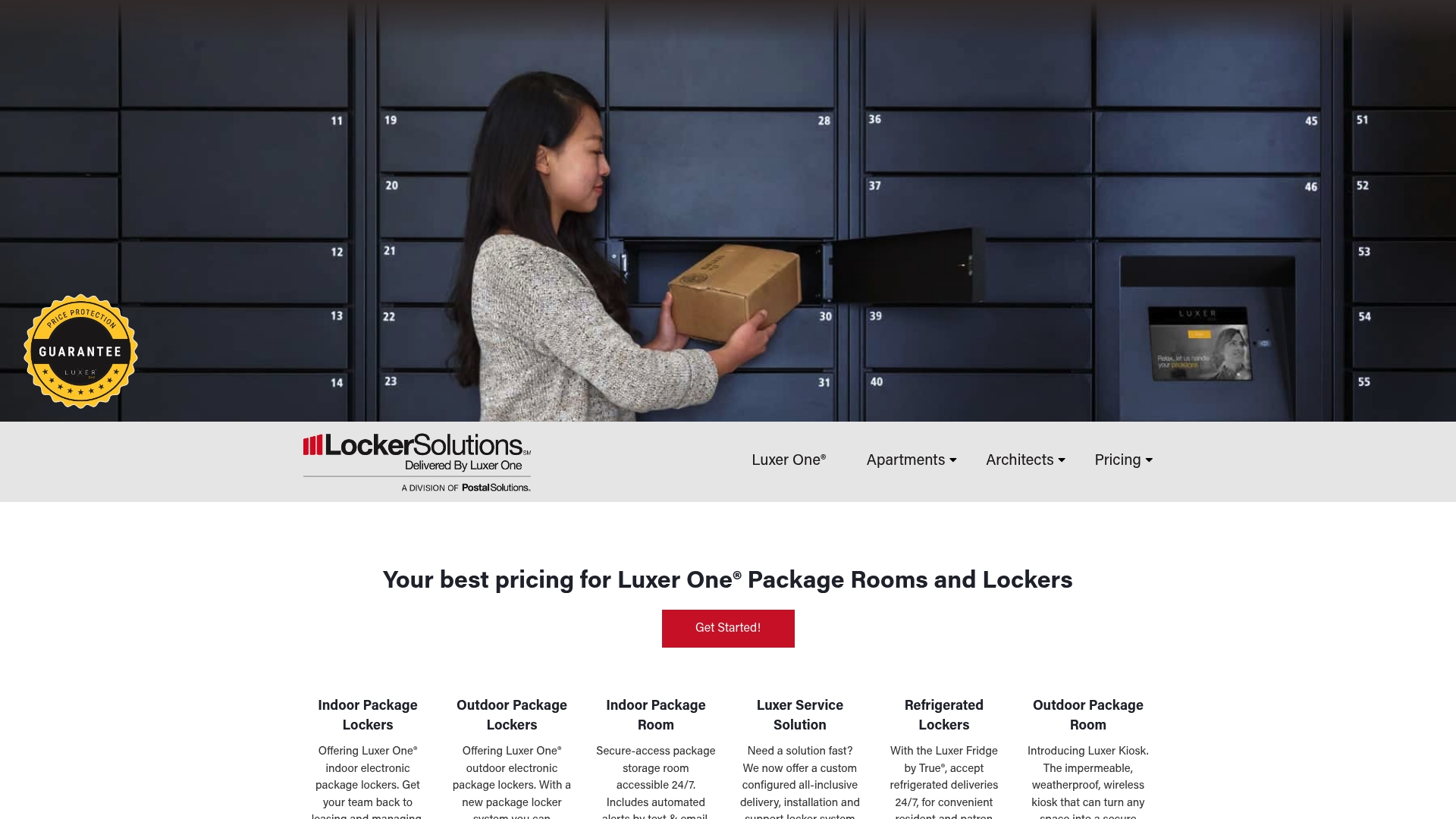
The concrete differentiator for Georgia properties is weatherproofing combined with local installation expertise. Locker Solutions’ outdoor kiosks are anchored and sealed for Georgia conditions, not adapted from a northern-climate design. If you want to understand the right configuration for your specific property, the next step is a site assessment. Request a deployment estimate and get a configuration recommendation built around your unit count, layout, and delivery volume.
Useful sources
The following sources were used in researching this article. Vendor materials are noted; independent industry analyses are listed separately.
Vendor and industry materials:
- Smart Lockers for Apartments: Benefits, ROI, and Implementation Guide — Smiota (vendor material; cost, payback, and usage statistics)
- Why Residents Now Expect Smart Package Lockers as Standard Apartment Amenities — Smiota (vendor material; resident expectation and adoption trends)
- Smart Lockers in Apartment Communities: A Complete Guide to Secure Package Management — DC Locker (vendor material; workflow and software integration guidance)
- Parcel Lockers vs Package Rooms in Apartments: 2026 Guide — Smart Package Room (vendor material; configuration comparison and carrier workflows)
- The Benefits of Amazon Hub Lockers and Why Power Access Control Is the Best Installation Partner in Metro Atlanta — Power Access Control (vendor material; Atlanta-area install practices and weatherproofing)
Independent and industry reference:
- Delivery Lockers for Apartment Buildings: Benefits for Residents and Managers — Ansvers (independent industry analysis; resident and manager benefit overview)
- Property Management Trends in 2026: What You Need to Know — Quonsapp (independent industry analysis; smart amenity infrastructure trends)
Recommended
- How Locker Access Drives Community Satisfaction — Locker Solutions Blog
- Choosing the Right Locker Company for Multifamily Properties — Locker Solutions Blog
- Single Door Locker Guide for Multifamily Properties — Locker Solutions Blog
- Home Lockers for Apartments: A Property Manager’s Guide — Locker Solutions Blog
Ready for a Luxer One® package locker quote?
Tell us your unit count and we'll send right-sized pricing with a fast response time.
Get my free quote