May 11, 2026
Automated package rooms: A guide for multifamily properties
Discover the essentials of defining automated package rooms for multifamily properties, enhancing security, convenience, and efficiency today!

Secure package rooms have evolved far beyond a locked closet near the mailboxes. Many property managers and architects still picture package management as a simple staging area where carriers drop boxes and residents eventually collect them, but that model breaks down fast when a 300-unit building receives 150 deliveries on a single Tuesday in December. The real question is not whether your property has a package room, it is whether that room operates as a fully automated amenity that protects packages, notifies residents instantly, and removes staff from the equation entirely.
Table of Contents
- What are automated package rooms? Key features and definitions
- Core components: How smart package rooms work
- Design considerations: Security, flow, and resident experience
- Planning and implementing an automated package room
- The overlooked reality: Technology matters less than process
- Explore fully integrated package room solutions
- Frequently asked questions
Key Takeaways
| Point | Details |
|---|---|
| Automated rooms differ | They go beyond secure storage by integrating tech for access, alerts, and monitoring. |
| Plan by parcel mix | Always start design with delivery volume analysis to size capacity and overflow solutions accurately. |
| Workflow beats gadgets | Process design, not just hardware, delivers resident satisfaction and efficiency. |
| Balance security and access | Integrated controls and simple self-service workflows minimize theft and frustration. |
| Expert planning pays off | Following a proven checklist avoids the most common pitfalls and creates a lasting solution. |
What are automated package rooms? Key features and definitions
The term “automated” gets misused constantly in this industry. A room with a keypad entry is not automated. A repurposed utility closet with a camera mounted in the corner is not automated either. True automation means the room itself manages the intake, storage, and retrieval process without staff intervention from start to finish.
An automated package room blends secure staging with smart access control, digital resident notifications, and video monitoring into one coordinated system. As multifamily package management research shows, automated package rooms integrate access, notifications, and self-service elements far beyond traditional closet storage. The system recognizes when a delivery arrives, logs it, alerts the resident, and grants that specific resident access for retrieval, all without a leasing agent lifting a finger.
Here is how automated package rooms compare to traditional package storage:
| Feature | Traditional room | Automated package room |
|---|---|---|
| Access control | Key or basic keypad | Unique PIN, app-based, or biometric |
| Resident notification | Staff calls or emails manually | Instant automated SMS, email, or app push |
| Package logging | Paper log or spreadsheet | Digital intake with timestamps |
| Video monitoring | Optional, rarely reviewed | Integrated, always-on surveillance |
| After-hours access | Rarely available | 24/7 resident self-service |
| Overflow handling | No system, packages pile up | Defined overflow zones with alerts |
| Staff involvement | High, daily involvement | Minimal to none |
The core efficient package room solutions that modern multifamily properties need share several non-negotiable characteristics:
- Controlled entry tied to individual resident credentials rather than a shared code
- Automated digital alerts sent at the moment of delivery, not hours later
- Video surveillance with accessible footage for dispute resolution
- Overflow management protocols that handle peak delivery surges without creating chaos
- Audit trails so property managers can track every package intake and retrieval event
“A package room without automated notifications is just an expensive storage closet. The notification layer is what transforms a physical space into a self-service amenity.”
The shift matters operationally. When residents self-serve reliably, staff spend less time fielding “where is my package?” calls, fewer packages disappear in gray-area handoffs, and the property stops losing renewal prospects who rank package management as a top-five leasing priority.
Core components: How smart package rooms work
Understanding the definition is one thing. Knowing how the internal systems interact is what separates a well-scoped installation from a frustrating, underperforming one.
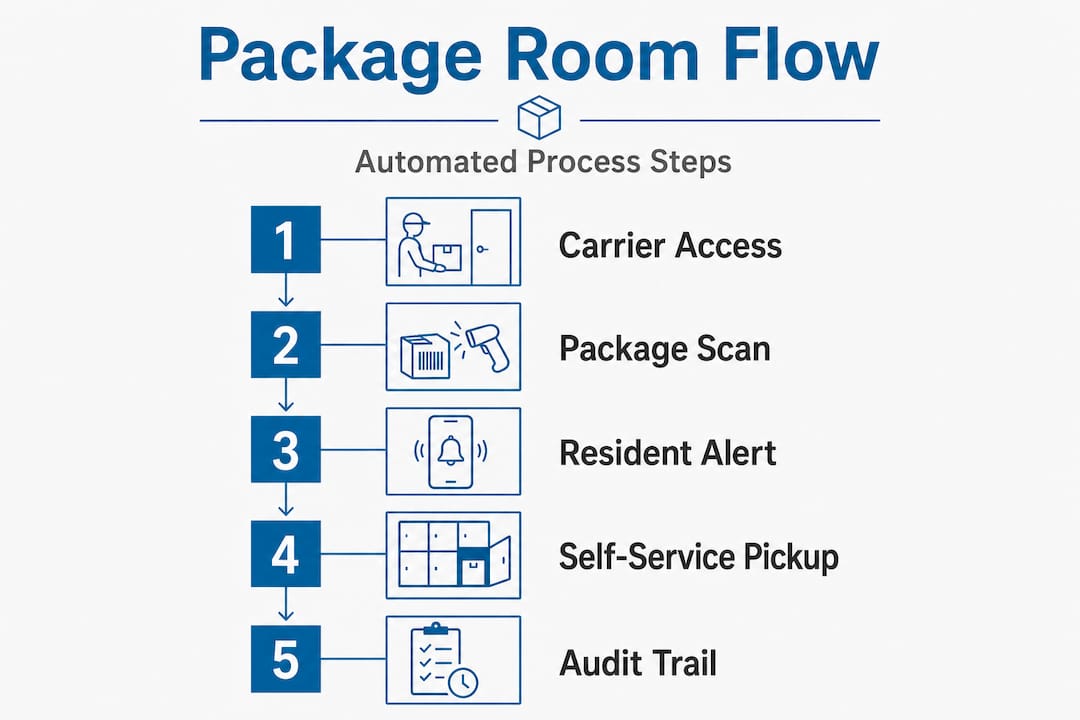
Every effective automated package room relies on five integrated components working in sequence:
-
Access control module Credentials are tied to individual resident accounts. Carriers receive a single-use delivery code, while residents use a persistent PIN, mobile app, or key fob to retrieve their packages. No shared codes. No propped doors.
-
Package intake and logging system When a carrier completes a delivery, the system logs the arrival with a timestamp and links it to the appropriate resident record. This step feeds the notification trigger and creates an auditable chain of custody.
-
Automated notification engine The automated package alerts layer sends real-time messages via SMS, email, or app push the moment a delivery is logged. Notification accuracy directly determines how quickly residents retrieve packages and how much storage turnover you get each day.
-
Video surveillance integration Cameras cover entry points and the interior storage area continuously. Footage is timestamped and stored for a defined retention period, giving property managers a clear record if a resident disputes a delivery or claims a package was missing.
-
Overflow and oversize management logic This is where many under-planned rooms fail. A well-architected room defines overflow zones for large parcels, sets alerts when capacity thresholds are reached, and triggers staff notifications before the room becomes a bottleneck.
The resident experience follows a clean, predictable sequence. A carrier arrives, enters their delivery code, deposits the package, and the room logs the event. The resident receives an alert within seconds. They arrive on their schedule, enter their credential, retrieve their package, and the system marks the event complete. No staff touchpoints. No waiting for office hours. No sticky notes on doors.
Effective property management workflow optimization demands this kind of closed-loop process, because open-ended handoffs create the most common failure points in multifamily operations.
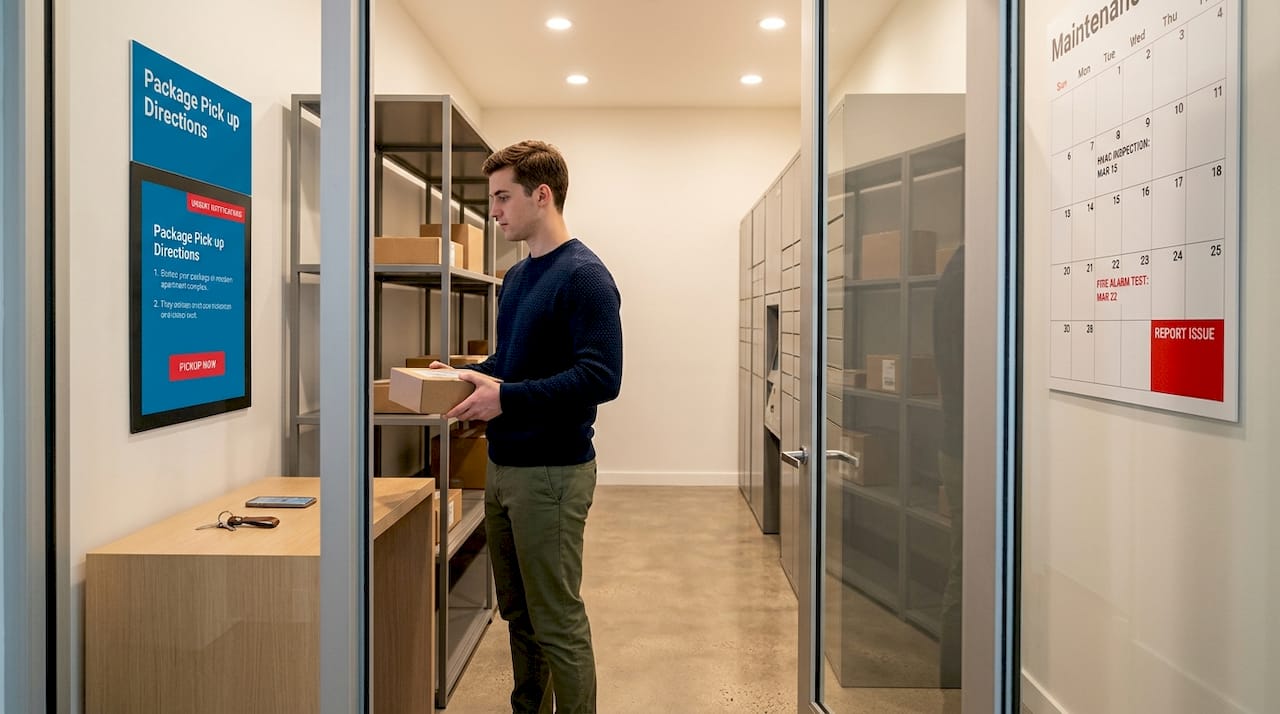
According to multifamily package management methodology, the right planning approach starts with parcel mix and delivery volume, including peak surges and oversize items, then sizes storage and flow accordingly, and finally integrates a coordinated access and notification strategy. Skipping the volume analysis phase is the single most common reason a newly installed package room underperforms within six months.
Pro Tip: When projecting delivery volume, do not rely solely on current averages. Add 40 to 60 percent to your baseline to account for holiday peak periods, new resident move-ins, and the year-over-year growth in e-commerce deliveries. A room sized for today’s volume will feel cramped by next peak season.
Use this data table as a starting benchmark when planning room capacity:
| Building size (units) | Avg. daily packages | Peak daily surge estimate | Recommended overflow buffer |
|---|---|---|---|
| 50 to 100 | 20 to 40 | 60 to 80 | 30% additional capacity |
| 101 to 200 | 40 to 80 | 120 to 160 | 35% additional capacity |
| 201 to 400 | 80 to 160 | 240 to 320 | 40% additional capacity |
| 400+ | 160+ | 480+ | 45%+ additional capacity |
Design considerations: Security, flow, and resident experience
Hardware and software are only as effective as the physical environment they operate in. A poorly designed room layout undermines even the most sophisticated access control system by creating congestion, confusion, or security gaps.
Security design should address three layers. First, perimeter access controls the who and when of room entry, using individual credentials rather than codes shared across an entire building. Second, interior surveillance eliminates the blind spots that invite package theft or tampering. Third, package authentication, meaning the process of tying each deposited item to a specific resident record, closes the gap between physical delivery and digital logging.
As multifamily package management planning confirms, an integrated access and notification strategy allows residents to reliably self-serve without creating new lobby bottlenecks or requiring front desk intervention. That reliability is the foundation of resident trust in the system.
Flow design determines how smoothly residents move through the space. Key considerations include:
- Clear visual wayfinding so residents can immediately identify their package zone or retrieval area without hunting
- Adequate aisle width to allow two residents to navigate the room simultaneously during busy afternoon windows
- Separation of delivery and retrieval paths where possible, to prevent carriers and residents from creating traffic jams at the entry point
- Lighting levels sufficient for easy label reading and camera clarity during all hours
- Signage for oversized or refrigerated items so residents with specialty deliveries know exactly where to look
Resident experience design is often treated as an afterthought, but it directly affects pickup speed and storage turnover. The longer packages sit uncollected, the faster capacity fills. Friction in the pickup process, whether from confusing layouts, unreliable notification timing, or difficult credential entry, delays retrieval and compounds storage pressure.
Secure package delivery at the property level also requires thinking beyond the interior room. Properties with outdoor drop zones or carrier-facing kiosks benefit from outdoor kiosk solutions that allow after-hours deliveries without staff involvement, extending the automated system to the building perimeter.
Any design plan also needs to account for fire safety and compliance requirements specific to your jurisdiction. Package rooms that include electrical infrastructure for access control panels, notification hardware, or refrigerated units must meet applicable code standards from the outset.
Pro Tip: Always build in a manual override process and a clear contingency plan for system downtime. Residents become frustrated fast when a notification arrives but the access system is offline. A documented backup access protocol, communicated clearly during onboarding, prevents one technical hiccup from damaging resident confidence in the entire system.
Planning and implementing an automated package room
Knowing what makes a package room effective is very different from executing a successful installation. A clear, stepwise plan prevents the most common implementation mistakes, including undersized storage, overlooked carrier workflows, and residents who never properly adopt the self-service process.
Follow this implementation sequence for a reliable outcome:
-
Conduct a volume and parcel mix analysis Audit your current delivery data, including carrier frequency, package sizes, and daily and weekly volume patterns. Use this data to establish your baseline and project your peak surge requirement.
-
Define your space and flow requirements Based on your volume data, calculate minimum storage capacity and identify the physical space that can support the required layout, including overflow zones and any refrigerated or oversized package areas.
-
Select vendors with integrated systems Choose a provider whose access control, notification, and surveillance components are built to work together natively. Bolting separate systems together creates integration failure points and complicates troubleshooting.
-
Plan your carrier and resident communication strategy Carriers need clear delivery instructions and reliable entry codes before launch. Residents need onboarding that explains exactly how to use the system, what to expect from notifications, and how to handle edge cases like missed alerts.
-
Complete installation and run a testing phase Before opening the room to live deliveries, run structured tests simulating peak volume. Check notification delivery times, access credential reliability, overflow zone triggers, and camera coverage gaps.
-
Monitor and adjust post-launch Track package retrieval speeds, storage turnover rates, notification open rates, and resident feedback during the first 90 days. Use this data to fine-tune notification timing, adjust overflow thresholds, and identify any workflow gaps.
Transitioning to package room automation is most successful when property managers treat it as an operational change, not just a hardware installation. Resident adoption and carrier compliance require active communication, not just a new room with a keypad.
As volume analysis methodology shows, starting with parcel mix and delivery volume analysis is essential to avoid undersizing storage or creating choke points during package surges. Properties that skip this step routinely find themselves retrofitting within the first year at significant additional cost.
Pro Tip: Run a simulation test during your pre-launch phase by staging packages at three times your expected daily volume. This stress test will reveal overlooked bottlenecks in your layout, overflow logic, and notification triggers before real residents experience them.
The overlooked reality: Technology matters less than process
Here is the perspective you will not find in most vendor brochures. The biggest failures in package room automation have nothing to do with the quality of the hardware. They happen because a property installs a sophisticated system and then leaves the surrounding operational workflow untouched.
You can have a state-of-the-art access control panel, perfectly calibrated cameras, and an instant notification engine, and still end up with uncollected packages filling your overflow zone by Wednesday of every week. The reason is almost always process, not technology.
What actually drives resident satisfaction is how the automated system fits into your property’s daily rhythm. Are staff trained to recognize when the notification system has an outage and respond correctly? Is your carrier onboarding process actually getting delivery codes to every carrier who services your building, or just the major ones? Have you communicated to residents what happens to packages held beyond a certain number of days?
The methodology checklist that guides effective package room planning emphasizes holistic integration, because technology is only one piece of the operational puzzle. The checklist exists precisely because hardware selection without process design produces expensive underperformance.
Building management workflow insights consistently show that properties with average technology but excellent process outperform properties with premium hardware and undefined workflows. The technology creates the capability. The process delivers the outcome.
When you are comparing package room approaches, pay as much attention to vendor support for process design and resident onboarding as you do to feature specifications. A vendor who hands you a system and disappears is selling hardware. A partner who helps you integrate the system into your operational model is delivering the outcome residents actually experience.
Explore fully integrated package room solutions
If this guide has clarified what genuine package room automation requires, the next step is finding solutions built to deliver it at scale.
Locker Solutions offers monitored package room systems powered by Luxer One® technology, designed specifically for multifamily properties that need reliable, self-service package management without burdening staff. From access control and automated resident notifications to video surveillance and overflow management, every component is engineered to work as one integrated system. Explore efficient package room solutions built for properties of all sizes, including rapid deployment options and expert installation support to get your system running right from day one.
Frequently asked questions
How do automated package rooms improve resident experience?
They reduce missed deliveries, enable 24/7 after-hours self-service access, and eliminate the need for residents to coordinate pickup times with staff. As multifamily package management guidance confirms, automated rooms allow residents to self-serve without creating new lobby interfaces or requiring staff involvement.
How much space do you need for a package room?
Required space depends on your daily delivery volume, peak surge projections, and the mix of parcel sizes you regularly receive. According to parcel volume analysis standards, you should start with a thorough parcel mix and volume assessment, including oversize items and peak surge periods, before committing to any floor plan.
What types of notifications do automated package rooms provide?
Automated rooms deliver real-time alerts via SMS, email, and app-based push notifications the moment a delivery is logged. A well-planned integrated notification strategy ensures residents can reliably act on those alerts and retrieve packages without any staff-facilitated handoff.
Can automated package rooms handle oversize or perishable deliveries?
Yes. Advanced systems include defined overflow zones for packages too large for standard storage areas and refrigerated locker options for grocery or meal kit deliveries requiring temperature-controlled storage.
How do you ensure security in automated package rooms?
Security is maintained through individual resident credentials for access control, continuous video surveillance with timestamped footage retention, and package authentication that links every deposited item to a specific resident record. As package management methodology recommends, package authentication and integrated access controls should be non-negotiable items on every planning checklist.
Recommended
Ready for a Luxer One® package locker quote?
Tell us your unit count and we'll send right-sized pricing with a fast response time.
Get my free quote