July 26, 2026
Outdoor Locker Installation Considerations: A Pro Guide
Discover essential outdoor locker installation considerations for property managers. Ensure durability, security, and compliance with our expert tips.
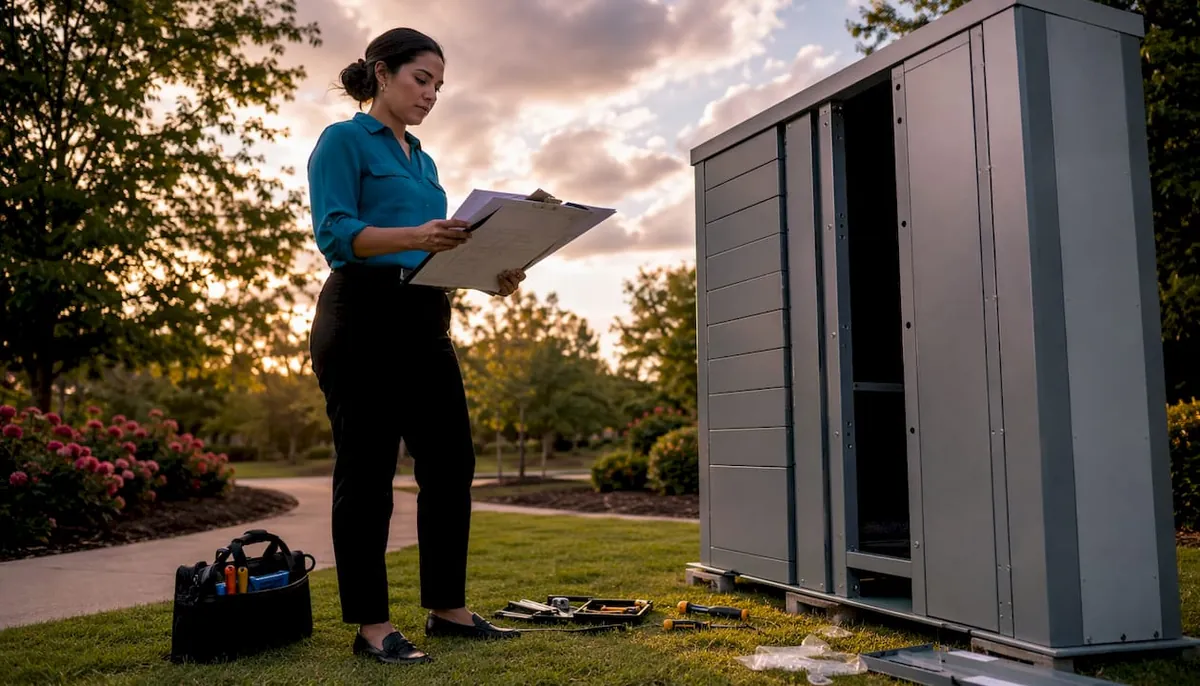
What every property manager needs to know before installing outdoor lockers
Getting outdoor lockers right comes down to six non-negotiable factors: weatherproofing rated to IP65 minimum (IP66 within 5 km of the coast), corrosion-resistant materials with certified coatings, a properly engineered concrete foundation, strategic site placement, verified security hardware, and full compliance with local building codes and ADA requirements. Miss any one of these and you’re looking at premature failure, liability exposure, or a costly reinstall.
Here’s the short version of what a successful installation requires:
- Weatherproofing: IP65 minimum rating; IP66 for coastal properties within 5 km of salt air
- Materials: Galvanized steel, powder-coated metal with C4/C5 certification, or phenolic (HPL) panels with aluminum framing
- Foundation: Concrete pad at least 4’x4’, 8 inches deep, poured to 3,000 psi compressive strength at 28 days
- Site selection: Elevated off standing water, sheltered from direct sun, clear sightlines for security
- Security: SKG-certified locks, access control integration, emergency power backup
- Compliance: Local permitting, ADA-compliant door clearances and reach ranges, applicable OSHA standards
The rest of this guide breaks each factor down with the technical specifics you need to specify, procure, and install confidently.
Table of Contents
- 1. Material and weatherproofing specs that actually hold up outdoors
- 2. Site selection: where you place lockers matters as much as what you buy
- 3. Foundation and anchoring: the part that fails silently
- 4. Security features that hold up in outdoor conditions
- 5. Cost and ROI: what the numbers actually look like
- 6. Advanced durability specs for challenging U.S. climates
- Luxer One lockers bring weatherproof parcel management to multifamily properties
- Key Takeaways
1. Material and weatherproofing specs that actually hold up outdoors
Material choice is the single decision that determines whether your lockers last two seasons or two decades. The three main options each have a distinct performance profile.
Galvanized steel is the workhorse of the industry. Hot-dip galvanization creates a zinc barrier that resists corrosion well in most U.S. climates, but it needs a topcoat in high-humidity or coastal environments. On its own, it won’t survive a Florida summer near the ocean without additional protection.
Powder-coated steel with C4 or C5 certification is the upgrade that matters. C4 covers industrial environments; C5 covers maritime conditions. These aren’t marketing labels, they’re ISO 12944 performance categories that define how long the coating resists corrosion under defined exposure conditions. If your property sits near a port, a beach, or a heavily salted road corridor, C5 is the floor, not a premium option.
Phenolic panels (HPL) with extruded aluminum framing represent the premium tier. The 3/8" phenolic construction resists water absorption, UV degradation, warping, and impact. It won’t rust because there’s no ferrous metal in the panel itself. For high-traffic outdoor environments like pool decks, transit hubs, or apartment courtyards, HPL is worth the higher upfront cost.
| Material | Corrosion Resistance | UV Resistance | Best Climate Fit | Relative Cost |
|---|---|---|---|---|
| Galvanized steel | Moderate | Low (needs topcoat) | Inland, low humidity | Low |
| Powder-coated steel (C4) | Good | Moderate | Industrial, suburban | Moderate |
| Powder-coated steel (C5) | Excellent | Good | Coastal, maritime | Moderate–High |
| Phenolic (HPL) + aluminum | Excellent | Excellent | All climates, high traffic | High |
| HDPE | Excellent | Good | Pool areas, wet zones | Moderate |
Electronic lock systems add another layer of weatherproofing complexity. Battery-operated smart locks need to function reliably across a wide temperature range. Lithium-thionyl chloride batteries handle the full operational range of -20°C to +50°C, which covers everything from a Minnesota winter to a Phoenix summer. Standard alkaline batteries fail at both extremes.
Pro Tip: Durability is more about certified coatings than raw material thickness. A thin panel with a C5-rated powder coat will outlast a thick panel with a basic polyester finish in any coastal or high-humidity environment.
2. Site selection: where you place lockers matters as much as what you buy
Even the best-built locker degrades fast in the wrong location. Site selection is where most installation mistakes happen, and they’re expensive to fix after the fact.
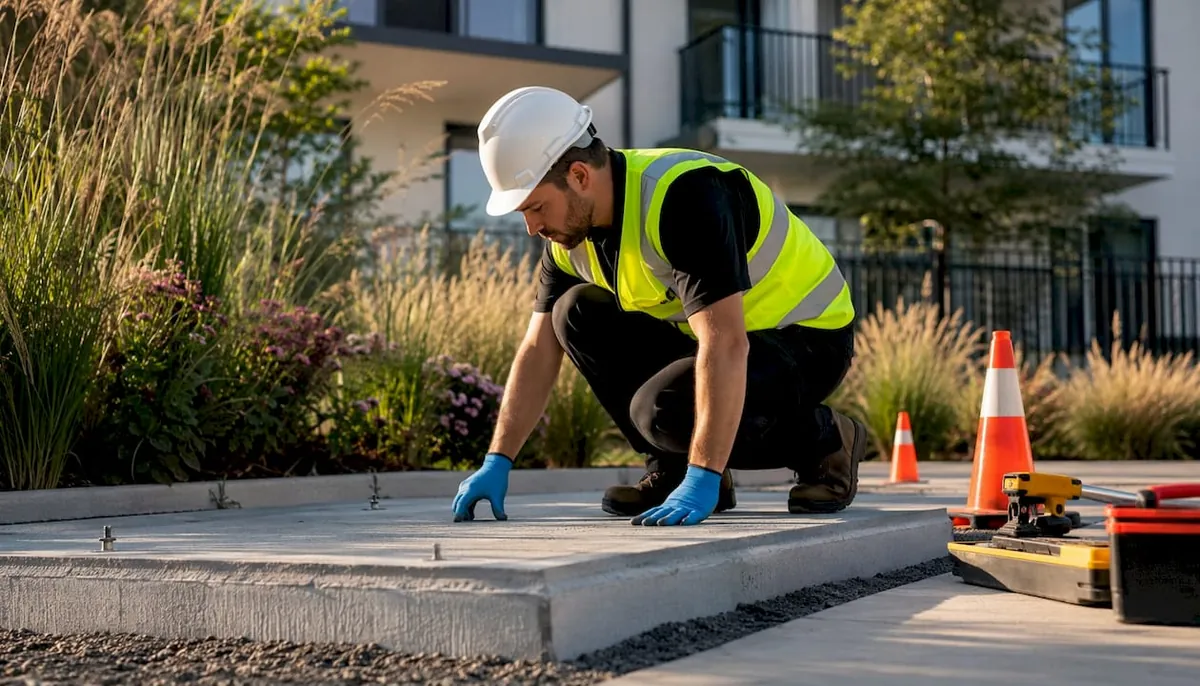
The two biggest killers of outdoor lockers are standing water and unrelenting direct sun. Standing water wicks into seams, corrodes hardware, and creates mold inside compartments. Full sun accelerates UV degradation on coatings and warps door frames over time, even on quality units. Both are avoidable with deliberate placement.
Placement do’s:
- Install on a raised base or curb so the locker base sits above the surrounding grade
- Position under a canopy, roof overhang, or shade structure where possible to reduce exposure
- Orient locker doors away from the prevailing wind direction to reduce rain ingress
- Locate near building entrances or monitored areas to deter vandalism
- Ensure proper drainage around the locker base to prevent standing water
Placement don’ts:
- Never install directly on asphalt or unprepared soil, both shift seasonally and compromise leveling
- Avoid low-lying areas where water pools after rain or irrigation
- Don’t place lockers where delivery vehicles or maintenance equipment will regularly pass within 3 feet
- Skip locations with no natural surveillance, blind corners invite break-in attempts
- Don’t position locker doors facing west in high-sun climates without shade mitigation
ADA compliance is a placement issue as well as a hardware issue. The Americans with Disabilities Act requires a 60-inch turning radius in front of locker banks, reach ranges between 15 and 48 inches for operable parts, and an accessible route from the public way. Plan the concrete pad and surrounding hardscape to accommodate these clearances before you pour.
Pro Tip: Layout directly affects your maintenance schedule. A well-drained, partially shaded installation can cut your annual hardware inspection frequency in half compared to a fully exposed, low-lying setup. Factor that into your preventive maintenance planning from day one.
3. Foundation and anchoring: the part that fails silently
A locker that tips, shifts, or pulls free from its base is a liability, not just an inconvenience. The foundation is the part of the installation that nobody sees and everybody ignores until something goes wrong.
Concrete pad foundations should be properly sized, poured over compacted gravel, and cured to meet structural durability standards appropriate for outdoor installations. For multi-unit banks, scale the pad dimensions proportionally. Existing concrete can be reused only if it’s at least 4 inches thick and free of significant cracking or spalling, anything thinner requires replacement, not patching.
Anchor hardware is where many installers cut corners. Standard zinc or carbon steel anchors will oxidize within two to three years in outdoor conditions, causing the anchor to swell and crack the surrounding concrete while losing holding strength. Stainless steel anchors or epoxy-set chemical anchors are the correct choice for any outdoor installation. They resist oxidation, maintain clamping force through freeze-thaw cycles, and keep door frames aligned over time. Misaligned doors are the most common symptom of anchor failure, and they’re usually misdiagnosed as a manufacturing defect.
Proper site preparation before pouring the pad matters as much as the concrete mix itself. Compacted base material prevents differential settlement, which is what causes pads to tilt and lockers to rack out of square. Level the pad to within 1/8 inch across its full width before anchoring any locker bank.
4. Security features that hold up in outdoor conditions
Outdoor lockers face a different threat profile than indoor units. They’re accessible around the clock, often in lower-surveillance areas, and exposed to weather that degrades lock mechanisms over time. The security spec needs to account for all three.
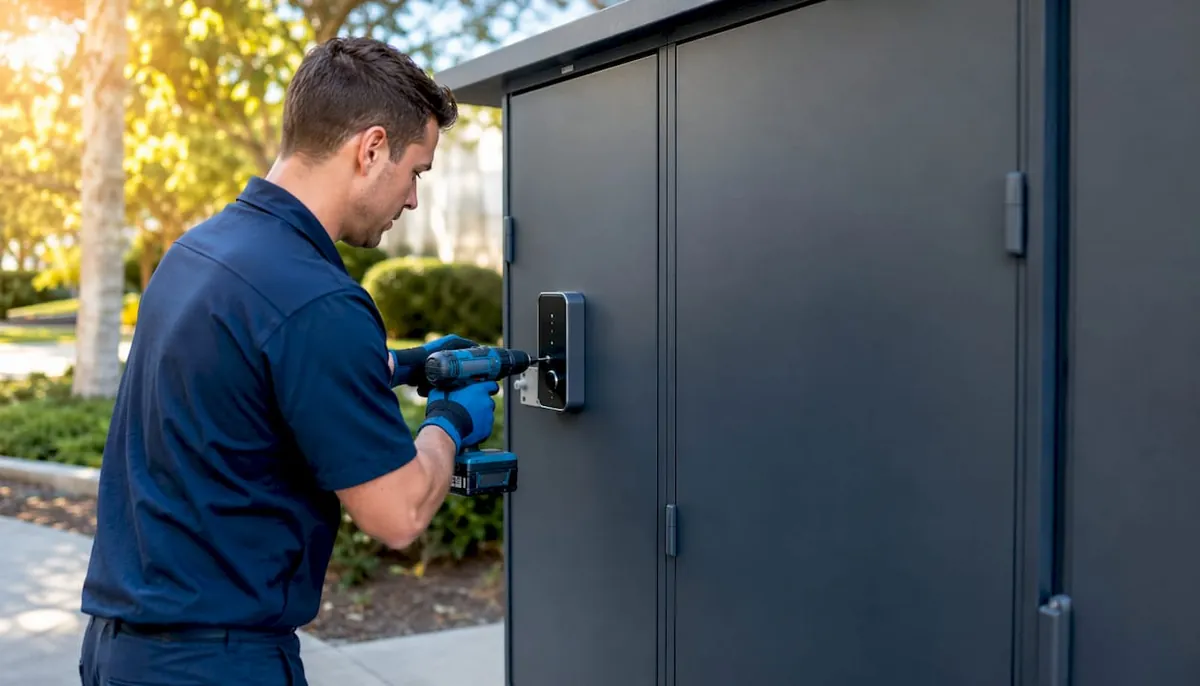
SKG-certified locks at the SKG** level are the recognized standard for break-in resistance in outdoor applications. SKG** certification means the lock has passed independent testing for drilling, picking, and forced entry, a meaningful baseline for any property where locker contents have real value.
Beyond the lock cylinder itself, the access control architecture matters:
- Keyed mechanical locks are the lowest-cost option and the easiest to maintain, but lost keys require rekeying the entire bank unless you specify a master-key system upfront
- Electronic keypad or PIN locks eliminate key management but require weatherproof keypads rated IP65 or better
- RFID locks integrate with existing resident access credentials on multifamily properties, reducing friction and improving audit trails
- Smart locks with app connectivity offer remote management, real-time alerts, and usage logs, the Matter connectivity standard is worth specifying for long-term interoperability across platforms
Emergency access is a detail that gets skipped until it’s urgent. USB-C emergency power ports and physical override keys should be standard on any electronic lock system installed outdoors. A dead battery in January shouldn’t lock a resident out of their package locker permanently. Pair emergency access provisions with a documented override procedure for your maintenance team.
Reinforced door frames, anti-pry flanges, and concealed hinges add passive resistance that complements the lock. A high-grade lock on a flimsy door frame is a false sense of security.
5. Cost and ROI: what the numbers actually look like
Outdoor locker installations aren’t cheap, and the temptation to cut costs on materials or foundation prep is real. The problem is that the savings are front-loaded and the costs are back-loaded.
| Cost Component | Budget Tier | Premium Tier |
|---|---|---|
| Expected service life | 5–8 years | 20 years |
The math on premium materials is straightforward. A budget installation that needs full replacement in six years costs more over a 15-year horizon than a premium installation that runs with minimal maintenance. Add in the soft costs, resident complaints, package theft incidents, staff time managing locker failures, and the ROI case for quality materials gets stronger.
Theft prevention is a measurable return. Package theft affects a significant share of multifamily residents annually, and a locker system that eliminates porch piracy directly reduces resident turnover risk. Properties with secure parcel management consistently report higher resident satisfaction scores, which translates to lease renewal rates that offset installation costs over time.
Budget for preventive maintenance from the start. Allocate a per-unit annual reserve for hardware inspection, coating touch-up, and lock servicing. Catching a corroding hinge in year two costs a fraction of replacing a door assembly in year five.
6. Advanced durability specs for challenging U.S. climates
U.S. climate diversity means a locker spec that works in Denver won’t necessarily hold up in Houston or Miami. Climate-specific adaptation isn’t optional, it’s the difference between a 20-year installation and a 7-year one.
Coastal environments (Florida, Gulf Coast, Pacific Coast, New England shoreline) demand IP66-rated enclosures, C5-certified coatings, and 316-grade stainless steel hardware throughout. Salt air attacks zinc and standard stainless steel (304 grade) faster than most property managers expect. For properties within 5 km of the ocean, locker systems in coastal communities require a full corrosion-resistant spec from the anchor bolts up.
High-UV environments (Southwest, high-altitude Rocky Mountain states) need UV-stabilized coatings and phenolic or HDPE panels rather than standard powder-coated steel. Coating degradation in direct sun at elevation is significantly faster than at sea level, and faded, chalking surfaces aren’t just cosmetic, they expose the substrate to moisture ingress.
Freeze-thaw climates (Upper Midwest, Northeast, Mountain West) put mechanical stress on anchors and door frames through seasonal expansion and contraction. Epoxy-set chemical anchors handle freeze-thaw cycling better than mechanical expansion anchors, which can loosen over repeated cycles. Galvanized fasteners throughout the installation prevent the differential corrosion that occurs when dissimilar metals contact each other in wet conditions.
High-humidity inland environments (Southeast, Gulf states) require ventilation slots in locker bodies to prevent moisture accumulation and mold growth inside compartments. Sealed lockers in humid climates become mold incubators within a single summer. Specify locker models with integrated ventilation designed to allow airflow without allowing rain ingress.
Advanced weatherproofing specifications for extreme environments:
- 316-grade stainless steel for all exposed hardware in coastal zones
- Epoxy-set chemical anchors in freeze-thaw regions
- UV-stabilized topcoats with minimum 2,000-hour QUV accelerated weathering test results
- Integrated roof systems or sloped tops to shed standing water
- Ventilation slots positioned to allow passive airflow while blocking direct rain entry
- Sealed cable entry points for any electronic components
Industry note: Installations that skip climate-specific anchoring and coating specifications account for a disproportionate share of early locker failures. The year-round performance standards that apply in one U.S. region often don’t transfer directly to another, spec to your actual climate, not the product’s default configuration.
Luxer One lockers bring weatherproof parcel management to multifamily properties
Property managers who’ve worked through the installation considerations above know the real challenge: finding a system that’s already engineered for outdoor conditions, not adapted from an indoor product.
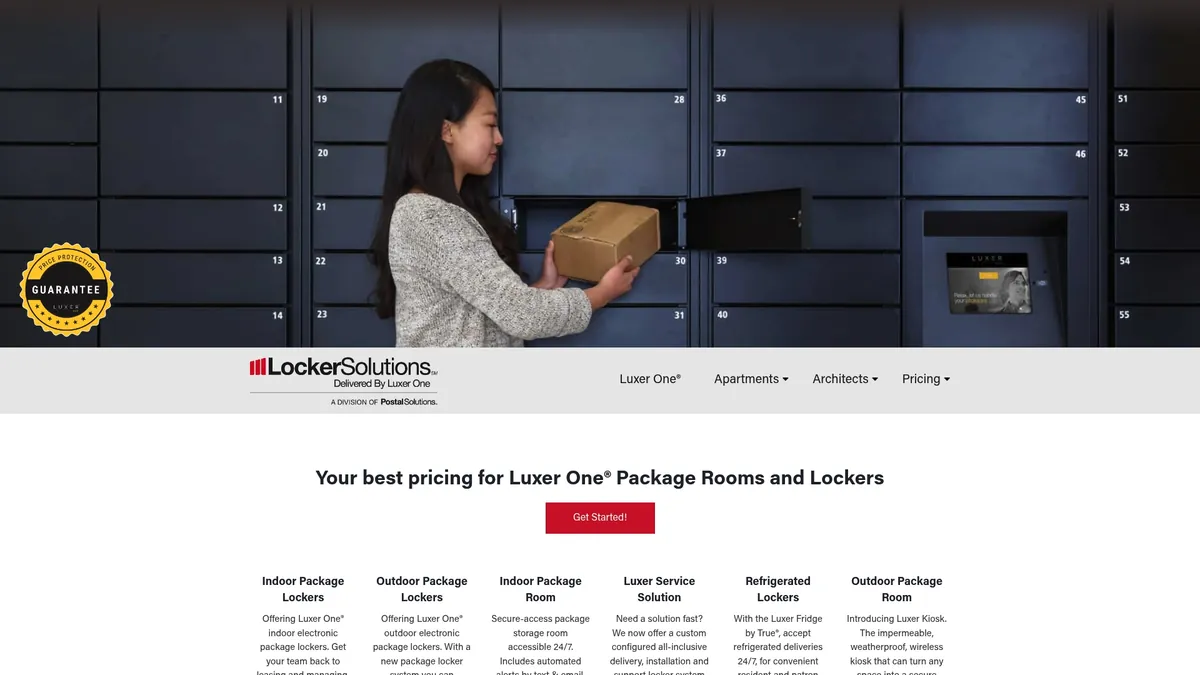
We specialize in outdoor parcel lockers built specifically for multifamily residential properties, units that arrive pre-configured for weatherproof deployment, with Luxer One® electronic access, automated resident alerts, and video surveillance built in. The difference from a generic locker purchase is that the weatherproofing, access control, and maintenance support are part of the package, not afterthoughts. For property managers who need a system that works from day one without a custom engineering project, our team offers deployment in 4-6 weeks with configurations sized to the property. Explore the full range of weatherproof locker options or contact the team directly to get a site-specific recommendation.
Key Takeaways
Successful outdoor locker installation requires climate-matched materials, a properly engineered concrete foundation, certified weatherproofing ratings, and security hardware specified for continuous outdoor exposure.
| Point | Details |
|---|---|
| IP rating is non-negotiable | Specify IP65 minimum for all outdoor lockers; IP66 within 5 km of coastal salt air environments. |
| Foundation specs are fixed | Concrete pads must reach 3,000 psi at 28 days; existing pads thinner than 4 inches require full replacement. |
| Coating certification drives longevity | C4 coatings suit industrial climates; C5 is required for maritime and coastal installations. |
| Climate dictates the full spec | Freeze-thaw zones need chemical anchors; coastal zones need 316-grade stainless hardware throughout. |
| Luxer One lockers for multifamily | We provide pre-engineered outdoor parcel lockers with built-in weatherproofing and Luxer One® access control for apartment properties. |
Recommended
Ready for a Luxer One® package locker quote?
Tell us your unit count and we'll send right-sized pricing with a fast response time.
Get my free quote