July 22, 2026
Year-Round Outdoor Locker Performance: A Facility Manager's Guide
Discover what year-round outdoor locker performance means for facility managers. Ensure secure and functional storage in any climate.
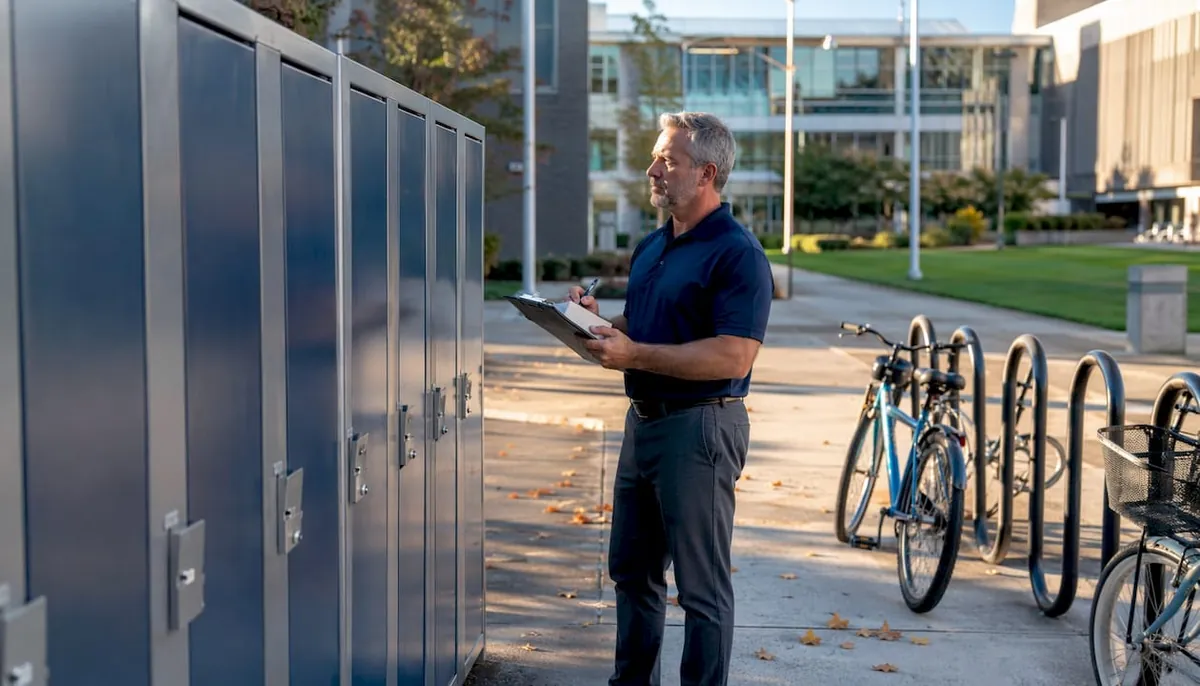
Year-round outdoor locker performance means a locker consistently delivers secure, functional storage across every season, from a humid Florida summer to a Minnesota freeze-thaw cycle, without corroding, warping, or failing its locking mechanism. It is not a marketing claim. It is a measurable outcome determined by material choice, construction method, climate suitability, and maintenance discipline. Facility managers who understand this distinction avoid the slow-motion replacement cycle that plagues properties that bought on price alone.
The core performance factors are:
- Corrosion resistance: No rust, no oxidation, no surface degradation from salt air, pool chemicals, or rain
- UV stability: Pigments and polymers that resist bleaching, brittleness, and surface cracking under prolonged sun exposure
- Thermal tolerance: Structural integrity through temperature swings from below freezing to triple-digit heat
- Moisture management: Sealed joints, sloped tops, and ventilation that prevent water ingress and mold
- Mechanical reliability: Hinges, locks, and door frames that stay aligned and functional through years of cycling
The benefits go beyond avoiding rust. Properly specified outdoor lockers reduce maintenance labor, extend replacement intervals, and protect the security of whatever residents or users store inside. Industry testing protocols, including impact resistance assessments and UV aging cycles, exist precisely because “weather-resistant” without engineering backing is just a label.
What materials and construction methods hold up year-round?
Material choice is the single biggest driver of outdoor locker durability, and the gap between the right and wrong choice compounds every year the locker sits outside.
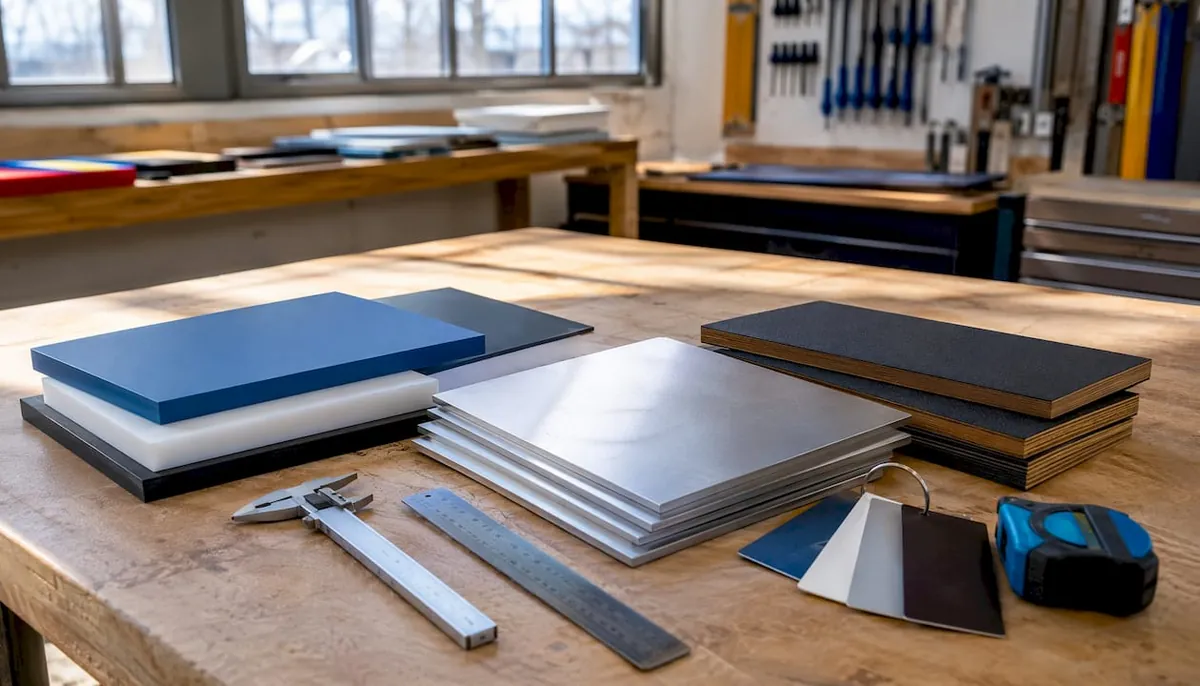
HDPE (High-Density Polyethylene) is the gold standard for fully exposed, wet environments. It cannot rust, resists both fresh and saltwater, and handles chlorine exposure without degrading. HDPE outdoor lockers carry the longest estimated lifespan of any locker material and cost less over time despite higher upfront pricing. The trade-off: HDPE is flexible rather than rigid, which can cause doors to stick in extreme heat as the material expands. Lighter-colored HDPE units reduce this problem by absorbing less solar heat.
Phenolic panels and T6-6063 aluminum represent the premium tier for semi-exposed or covered outdoor installations. These materials resist swelling, rust, and corrosion even in sub-zero temperatures, which is why manufacturers can back them with multi-year, all-season warranties. Phenolic panels are dense, non-porous, and dimensionally stable across a wide temperature range.
Fully welded steel outperforms pop-riveted steel in every outdoor metric. Welded joints at the bolt level eliminate the micro-gaps where moisture enters and rust begins. Pop-riveted construction looks identical on day one but fails faster because each rivet hole is a corrosion entry point.
Key construction features that separate durable outdoor lockers from ones that just look the part:
- Sloped tops: Shed water instead of pooling it, which prevents joint saturation and accelerates drainage
- UV-stabilized pigments: Color that won’t bleach or fade under years of direct sun exposure
- Corrosion-resistant fasteners: Stainless steel or coated hardware throughout, not just on visible surfaces
- Sealed or seamless surfaces: No grime traps, no salt accumulation points, no moisture channels
- Heavy-duty locking hardware: Cam locks or padlock hasps rated for outdoor humidity and temperature cycling
- Ventilation channels: Passive airflow that prevents interior moisture and odor buildup without creating water entry points
Pro Tip: When comparing steel locker specs, ask the vendor specifically whether joints are fully welded or pop-riveted. That single construction detail predicts corrosion timeline better than any coating specification.
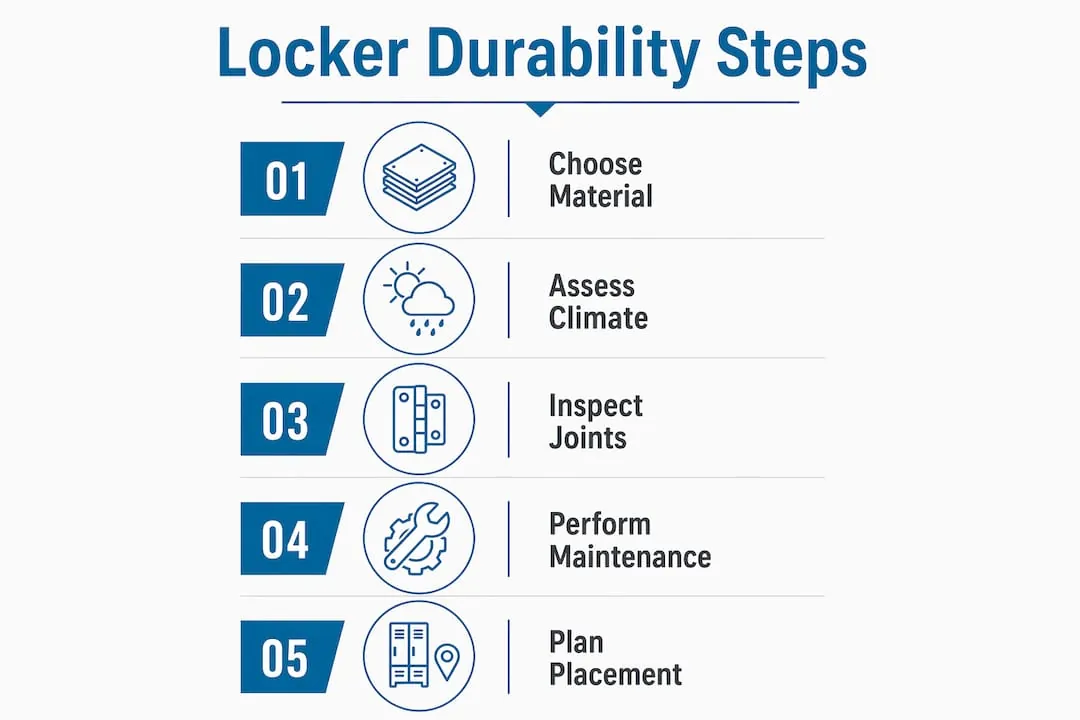
How U.S. climate variability affects outdoor locker durability
The United States runs the full spectrum of climate stress. A locker specified for a Phoenix parking structure faces completely different threats than one installed at a Seattle ferry terminal or a Miami apartment complex. Single-specification approaches fail because they optimize for one threat while ignoring three others.
| Climate Zone | Primary Threats | Key Locker Risk |
|---|---|---|
| Coastal (Southeast, Pacific) | Salt air, humidity, UV | Corrosion, surface degradation |
| Northern/Alpine | Freeze-thaw cycles, snow load | Cracking, door seizing, joint failure |
| Desert Southwest | Extreme heat, UV, low humidity | Thermal expansion, brittleness, fading |
| Humid Midwest/South | Humidity, temperature swings | Mold, warping, lock misalignment |
| Pacific Northwest | Constant rain, mild temps | Moisture ingress, mold, surface staining |
Coastal installations demand salt-resistant materials above everything else. Traditional steel lockers corrode rapidly in salt-heavy air, often within a few years of installation. HDPE or phenolic panels are the only sensible choices within a few miles of the ocean. The true weather resistance required in these zones goes beyond basic water resistance: it means the entire material matrix, fasteners included, tolerates salt-laden air without degrading.
Freeze-thaw cycles in northern climates create a different failure mode. Water that enters a joint or seam expands when it freezes, widening gaps incrementally with each cycle. Over a winter season, this process can crack panels, misalign door frames, and seize locking mechanisms. Freeze-resistant materials like phenolic panels and properly sealed HDPE handle this stress because they do not absorb water in the first place.
Desert heat presents a subtler problem. UV radiation degrades polymer chains in unstabilized plastics, making them brittle and prone to cracking under impact. Thermal expansion in dark-colored HDPE can cause doors to bind during peak afternoon temperatures. Facilities in the Southwest should prioritize UV-stabilized materials and lighter color palettes.
Humid climates, particularly in the Southeast and Midwest, accelerate mold and bacteria growth inside lockers with poor ventilation. Non-porous surfaces and passive airflow channels are not optional features in these regions. They are the difference between a locker that smells clean after two years and one that requires chemical treatment monthly.
What engineering standards and testing actually validate outdoor lockers?
The phrase “weather-resistant” appears on marketing sheets for lockers that would fail within eighteen months in a real outdoor environment. Validated outdoor locker performance requires specific engineering practices and, ideally, third-party testing that backs the manufacturer’s claims.
Meaningful engineering indicators include:
- Fully welded steel construction with no pop-riveted joints at stress points
- Corrosion-resistant fasteners throughout, not just on exterior-facing hardware
- Passive ventilation design that moves air without creating water entry paths
- UV-stabilized material formulations verified by the material supplier, not just claimed by the locker manufacturer
- Sloped roof or top panel with a minimum pitch that sheds water reliably
- Impact resistance sufficient to withstand repeated physical contact from users and equipment
Testing protocols that matter for outdoor lockers include UV aging cycles (which simulate years of sun exposure in accelerated laboratory conditions), salt spray testing for coastal suitability, and thermal cycling tests that verify dimensional stability across the temperature range the locker will actually experience. Impact resistance testing confirms structural integrity under repeated physical stress.
All-season warranties from manufacturers are a useful proxy for confidence in their own product, but they require scrutiny. A warranty that covers manufacturing defects but excludes “environmental damage” offers little protection for an outdoor installation. The warranty language should explicitly cover performance in the climate conditions relevant to your facility. Verify that the warranty period aligns with the expected service life of the material, and ask whether it covers replacement or only repair.
For facilities in challenging environments, altitude-rated and climate-specific testing standards provide additional validation beyond standard manufacturer claims.
Practical placement, maintenance, and upgrades that extend locker life
Even the best-specified outdoor locker underperforms when installed in the wrong location or maintained poorly. Placement decisions made at installation determine how much environmental stress the locker absorbs every day for its entire service life.
Avoid placing lockers under direct afternoon sun or in low spots where water pools after rain. Afternoon sun is the most intense, and sustained heat exposure accelerates UV degradation and thermal expansion even in UV-stabilized materials. Water pooling at the base saturates the ground around anchor points, promotes corrosion on any exposed metal hardware, and creates conditions for mold growth on locker exteriors.
Practical placement checklist:
- Orient locker banks so prevailing winds do not drive rain directly into door gaps or ventilation channels
- Ensure ground drainage slopes away from the locker base on all sides
- Provide overhead cover where possible, even a simple canopy, to reduce direct UV and rain exposure
- Maintain clearance around the locker bank for cleaning access and airflow
- In coastal zones, position lockers to minimize direct salt-wind exposure, using buildings or landscaping as natural buffers
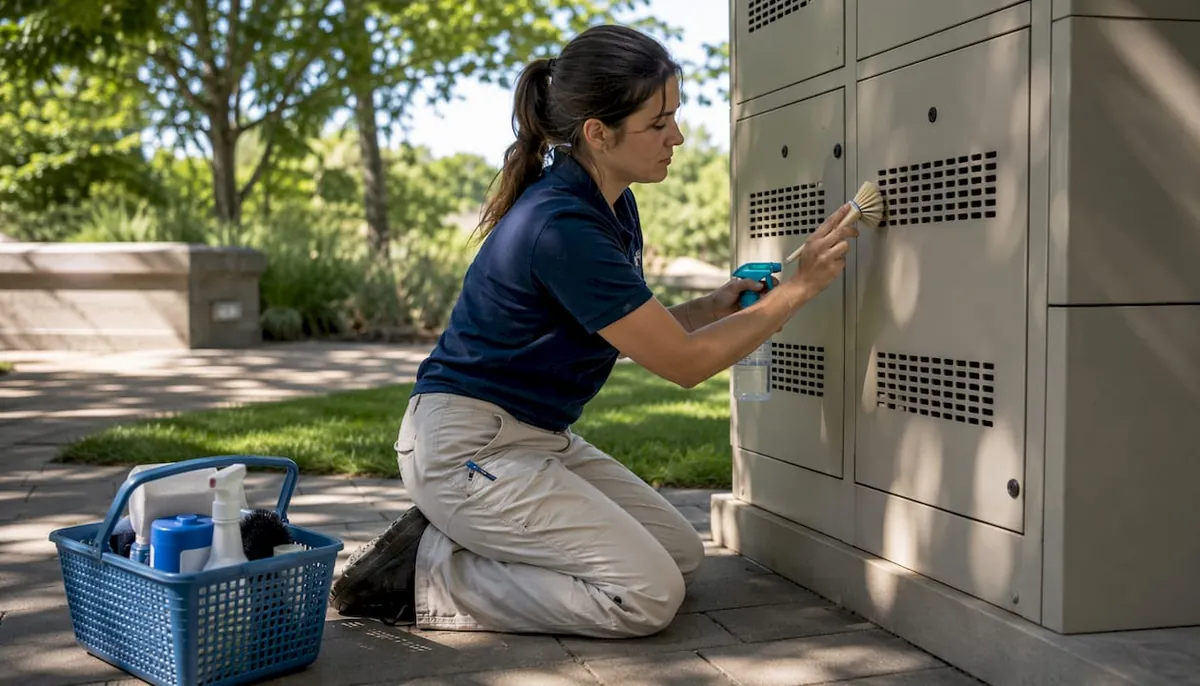
Maintenance for well-specified outdoor lockers is genuinely minimal, but it is not zero. The core routine involves rinsing contaminants, lubricating hinges and locks, and clearing ventilation paths on a regular schedule. In coastal or pool environments, rinse frequency increases because salt and chlorine accumulate faster. A preventive maintenance program built into your facility calendar prevents the small issues, a stiff hinge, a partially blocked vent, from becoming the expensive ones.
For smart outdoor lockers with electronic access controls, the control unit requires additional attention. Passive ventilation inside the electronics housing prevents heat buildup that degrades circuit boards and batteries. Modular, hot-swappable components mean a failed part can be replaced on-site without pulling the entire locker bank offline.
Pro Tip: Schedule a full locker inspection at the end of each winter and each summer. Those two transition points reveal freeze-thaw damage and heat-season expansion issues before they compound into structural failures.
Common myths about weather-resistant outdoor lockers
The outdoor locker market runs on imprecise language, and facility managers pay for it when a “weather-resistant” product fails in the second year.
Myth: “Weather-resistant” means waterproof and corrosion-proof in any environment. It does not. “Weather-resistant” is an unregulated marketing term. A locker can legitimately carry that label while using fasteners that rust in coastal air or panels that crack in freeze-thaw cycles. True weather resistance requires environment-specific material selection and construction, not just a coating applied to a standard indoor design.
Myth: Higher price always equals better durability. Price correlates with features, not always with the right features for your climate. An expensive locker with premium aesthetics but standard steel fasteners will fail faster in a coastal installation than a mid-range HDPE unit with stainless hardware throughout. Match the specification to the environment, not the price point to your budget ceiling.
Myth: Any plastic locker handles outdoor conditions equally well. HDPE and ABS behave differently under outdoor stress. HDPE is naturally rustproof and handles chemical exposure well, but expands in extreme heat, causing door sticking. ABS offers better structural rigidity and maintains tighter tolerances in heat, which is why it performs better in applications where dimensional precision matters. Neither is universally superior: the right choice depends on the specific climate and use case.
Myth: UV resistance is only about color fading. UV degradation does far more than fade paint. It breaks down polymer chains in unstabilized plastics, making them brittle and prone to cracking under impact. A locker that looks fine after two years of sun exposure may shatter under a moderate impact that a new unit would absorb without damage. UV-stabilized pigments and material formulations address both the cosmetic and structural effects of prolonged sun exposure.
Myth: A covered installation eliminates the need for outdoor-grade specifications. Covered does not mean protected. A locker under a canopy still experiences humidity, temperature cycling, wind-driven rain, and reflected UV from surrounding surfaces. Semi-exposed installations warrant outdoor-grade materials even if they are not fully open to the sky.
How to evaluate and select outdoor lockers for dependable year-round performance
Selection starts with the environment, not the product catalog. Before reviewing any locker specification, document the climate conditions your installation will face: average temperature range, humidity levels, proximity to salt water, UV intensity, and precipitation patterns. That profile drives every subsequent decision.
Evaluation checklist for year-round outdoor locker performance:
- Material suitability: Does the primary material (HDPE, phenolic, aluminum, welded steel) match the dominant climate stress at your facility?
- Construction method: Are joints fully welded or pop-riveted? Are fasteners stainless or coated steel throughout?
- UV stabilization: Is UV resistance built into the material formulation, or is it a surface coating that can chip or wear?
- Warranty scope: Does the warranty explicitly cover all-season outdoor performance, and what does it exclude?
- Ventilation design: Does the locker manage interior moisture passively without creating water entry points?
- Lock and hardware rating: Are locking mechanisms rated for the humidity and temperature range of your climate zone?
- Lifecycle cost: Compare total cost over the expected service life, including maintenance and replacement frequency, not just purchase price
When assessing vendors, ask for installations in climates similar to yours and request performance data or references from those sites. A manufacturer confident in their product’s outdoor durability will provide this without hesitation. Vendors who deflect to marketing materials instead of real-world performance data are telling you something.
For outdoor locker installations at multifamily properties, the evaluation should also include access control compatibility, resident-facing usability in weather conditions, and integration with package management systems. A locker that performs structurally but frustrates residents with stiff doors in cold weather or unresponsive electronics in heat fails the performance standard in a different way.
Consider the indoor vs. outdoor storage comparison when deciding whether an outdoor installation is the right solution at all. Some facilities are better served by a weatherproof indoor package room than by fully exposed outdoor lockers, depending on property layout and resident traffic patterns.
Expert perspectives on locker materials and design innovations
The material debate in outdoor lockers has moved well past HDPE versus steel. Facility managers now have access to engineered material systems that address specific failure modes rather than just general weather resistance.
HDPE versus ABS for outdoor applications: HDPE remains the preferred choice for environments with chemical exposure, pool chemicals, or constant moisture. Its rustproof, non-porous surface handles these conditions without degrading. ABS offers better structural rigidity and maintains tighter dimensional tolerances in heat, which matters for modular locker banks where door alignment across multiple units is critical. For most commercial outdoor applications, ABS provides a better balance of aesthetics, rigidity, and weather performance. HDPE remains the right call where chemical resistance is the primary requirement.
Phenolic panels occupy a different tier: dimensionally stable, non-porous, and capable of supporting multi-year all-season warranties because they simply do not absorb moisture or swell. They are the material of choice for high-end recreational and aquatic facilities where appearance and longevity both matter.
Emerging design priorities in outdoor locker engineering:
- Passive ventilation systems that use pressure differentials rather than powered fans, eliminating a mechanical failure point while maintaining airflow
- Modular smart controls with hot-swappable electronic components, so a failed access control unit does not take the entire locker bank offline
- Climate-controlled electronics housings for smart lockers in extreme climates, protecting batteries and circuit boards from heat and cold that would otherwise shorten their service life
- Integrated drainage channels in the locker base that direct water away from anchor points and prevent pooling
Pro Tip: For smart locker installations in climates with temperature extremes, specify a unit with a climate-controlled electronics compartment separate from the storage compartment. The cost difference is modest; the reduction in electronic component failures over a five-year period is not.
Color selection is a design decision with real engineering consequences. Darker locker colors absorb more solar radiation, raising interior temperatures and accelerating material stress in non-UV-protected units. In sunny climates, lighter colors reduce interior heat buildup and reduce thermal expansion in HDPE panels. High-quality outdoor lockers use UV-stabilized pigments that allow color selection without compromising lifespan, but in very hot regions, lighter shades still provide a measurable thermal advantage regardless of UV stabilization.
The humidity resistance guide for facility managers covers the intersection of ventilation design and material choice in detail, particularly for properties in the Southeast and Gulf Coast where both heat and moisture are persistent stressors.
Ready to specify outdoor lockers that actually last?
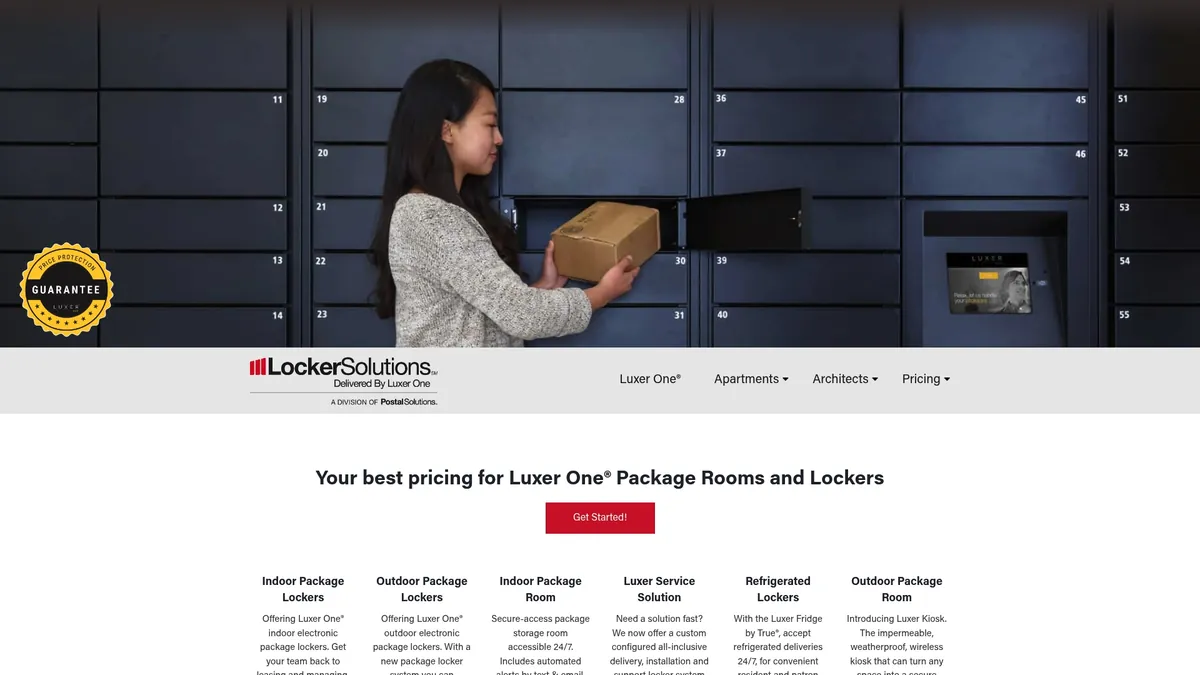
We specialize in weatherproof outdoor lockers engineered for the full range of U.S. climates, from coastal salt-air environments to alpine freeze-thaw conditions. The Luxer One® outdoor locker line combines UV-stabilized construction, corrosion-resistant hardware, and integrated smart access controls in configurations designed for multifamily residential properties.
If your property needs a package management solution that performs through every season without constant maintenance intervention, explore our outdoor options and request a configuration matched to your specific climate and property layout.
Key Takeaways
Year-round outdoor locker performance depends on matching material, construction, and maintenance to the specific climate stressors at your facility, not on buying the most expensive unit in the catalog.
| Point | Details |
|---|---|
| Material drives longevity | HDPE offers the longest outdoor lifespan and costs less over time despite higher upfront pricing; phenolic panels and aluminum suit covered high-end installations. |
| Construction method matters | Fully welded steel joints outperform pop-riveted designs by eliminating corrosion entry points at every seam. |
| Climate specificity is required | Coastal, alpine, desert, and humid zones each demand different material and hardware specifications. |
| Warranty language needs scrutiny | All-season warranties signal manufacturer confidence but must explicitly cover your climate’s stressors. |
| Placement extends service life | Avoiding afternoon sun exposure and water pooling at installation reduces material stress from day one. |
Recommended
Ready for a Luxer One® package locker quote?
Tell us your unit count and we'll send right-sized pricing with a fast response time.
Get my free quote