July 10, 2026
Freeze-Resistant Locker Materials for Cold Climates
Discover the role of freeze-resistant locker materials for cold climates. Choose the right materials for durability and reduce repair costs.
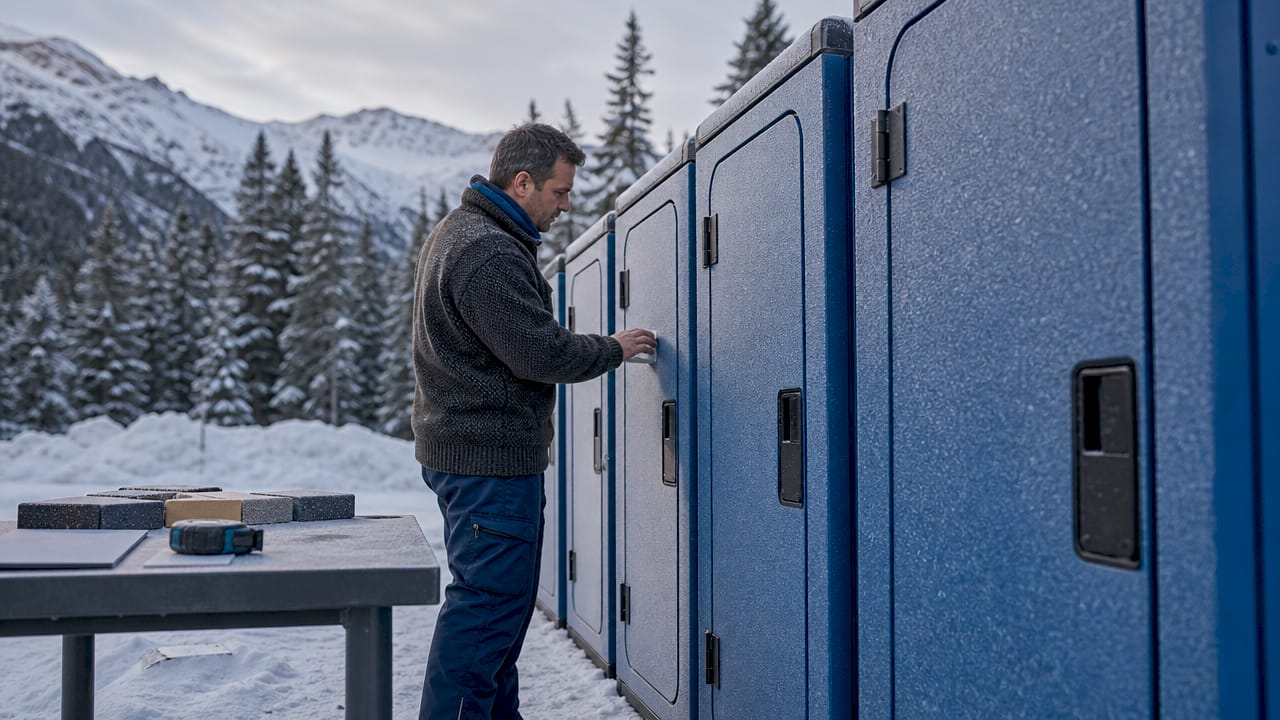
Freeze-resistant locker materials are defined as those engineered to maintain structural integrity across extreme temperature swings without cracking, warping, or absorbing moisture. The role of freeze-resistant locker materials is straightforward: they keep outdoor lockers functional through freeze-thaw cycles that destroy standard steel and untreated polymers. For property managers and facility operators in cold climates, the choice of material directly determines whether a locker system lasts one winter or twenty. High-density polyethylene (HDPE), phenolic composites, and ABS plastics are the three material categories that consistently outperform standard steel in sub-zero conditions. Getting this decision right at procurement saves significant repair and replacement costs over the life of the installation.
What material properties make locker materials freeze resistant?
Freeze resistance is not a single property. It is a combination of thermal behavior, surface chemistry, and structural response to repeated stress.
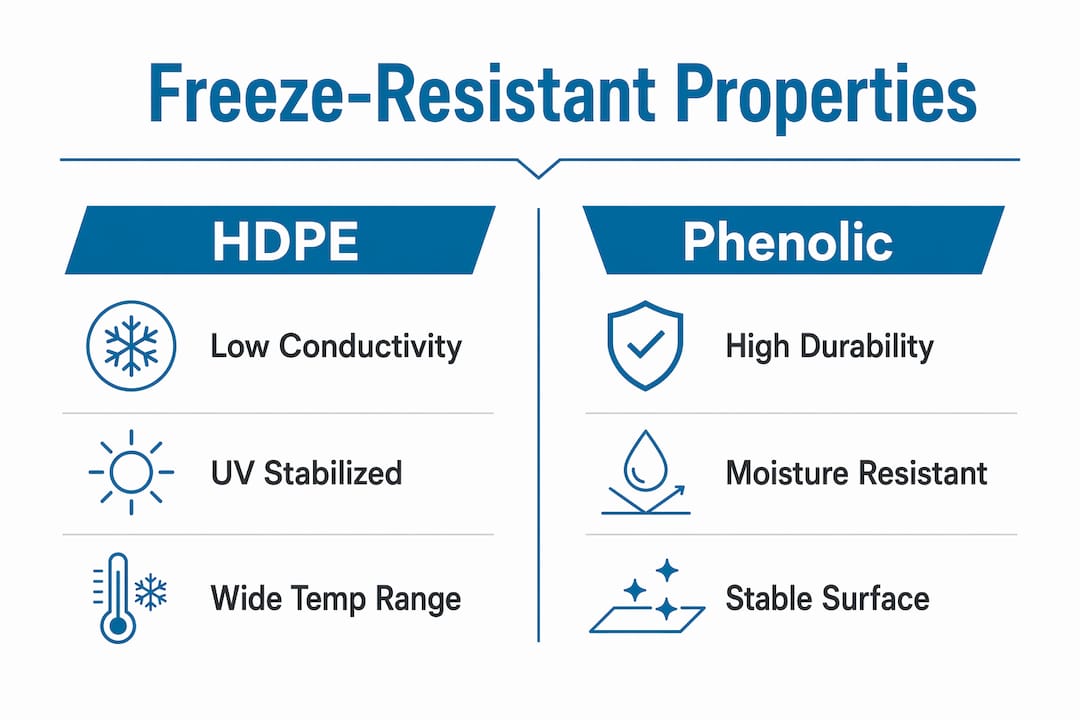
The most critical property is low thermal conductivity. Materials like HDPE and phenolic composites transfer heat slowly, which reduces the temperature differential between the locker’s interior and exterior during rapid weather changes. That slower transfer prevents the sudden contraction that causes cracking. Standard steel lockers have high thermal conductivity, which makes them vulnerable to condensation buildup and cold-induced brittleness in winter.
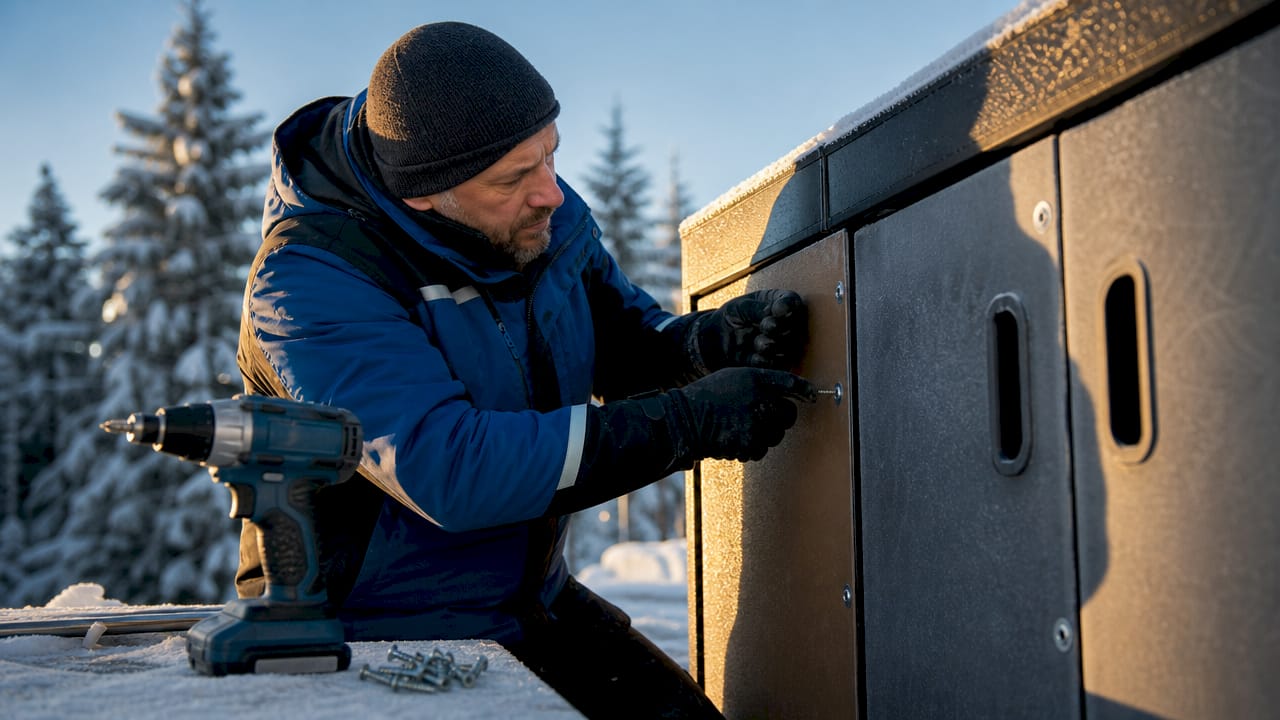
Non-porous surfaces are equally important. When moisture penetrates a porous material and then freezes, the expanding ice creates pressure that fractures the material from the inside. HDPE and phenolic panels resist moisture absorption at the surface level, stopping this process before it starts. UV stabilization matters too, because ultraviolet exposure degrades polymer chains over time, making materials brittle even before winter arrives.
Key material properties to evaluate when specifying freeze-proof locker materials:
- Low coefficient of thermal expansion: Limits dimensional change during temperature swings, preventing door binding and seam gaps.
- Non-porous surface: Blocks moisture absorption and eliminates internal ice formation.
- UV stabilization: Preserves polymer integrity through summer heat before winter cold arrives.
- Impact resistance at low temperatures: Prevents shattering when lockers are struck in freezing conditions.
- Chemical resistance: Protects against de-icing salts and cleaning agents used in winter maintenance.
HDPE locker materials are rated for use in temperatures ranging from -40°C to 80°C. That range covers virtually every cold climate in North America, including northern Canada and high-altitude mountain regions.
Pro Tip: Specify UV-stabilized HDPE or phenolic panels rather than standard polymer grades. The UV stabilization additive costs little at procurement but prevents premature embrittlement that would otherwise appear within two to three winters.
How do temperature changes impact outdoor locker materials and performance?
Every outdoor locker faces a mechanical problem: materials expand when warm and contract when cold. The faster and more extreme that cycle, the more stress accumulates in joints, seams, and fasteners.
Thermal expansion and contraction cause door binding, seam separation, and fastener loosening. A locker door that closes perfectly in october may stick or gap by january if the material expands and contracts at a rate the frame cannot accommodate. Freeze-thaw cycles compound this. Each cycle adds micro-fatigue to the material. Over dozens of cycles per winter, micro-fatigue becomes visible cracking at corners and seams.
Condensation is a less obvious but equally damaging force. When warm interior air meets a cold locker surface, moisture condenses inside joints and seams. That moisture freezes overnight, expands, and forces the joint apart. Effective freeze-resistant systems manage moisture with gaskets and roof kits alongside material selection. Material choice alone does not solve the condensation problem.
| Material | Cold-weather behavior | Key risk |
|---|---|---|
| Standard steel | High thermal conductivity, rapid contraction | Condensation, brittleness, rust |
| Aluminum | Moderate conductivity, lightweight | Thermal expansion causes door misalignment |
| HDPE polymer | Low conductivity, flexible at low temps | Dark colors expand more, causing door binding |
| Phenolic composite | Low conductivity, dimensionally stable | Requires compatible hardware and fasteners |
| ABS plastic | Moderate conductivity, good dimensional tolerance | Less impact-resistant than HDPE at extreme cold |
Dark-colored HDPE panels absorb more solar heat, which increases thermal expansion and can cause sticking doors. Lighter colors or ABS plastics maintain better dimensional tolerance across temperature swings. This is a detail most procurement specs miss entirely.
Pro Tip: If your property uses dark-colored lockers for aesthetic reasons, specify ABS plastic or lighter-toned HDPE rather than standard dark HDPE. The color choice directly affects door performance in winter.
What design and construction features complement freeze-resistant materials?
Material selection sets the foundation. Design and construction determine whether that foundation holds over years of cold-weather use.
The most effective cold-climate locker designs combine freeze-resistant panels with aluminum structural profiles. Composite or phenolic lockers paired with aluminum profiles maintain squareness and functionality better than single-material designs in cold climates. The aluminum backbone resists warping while the composite panels handle moisture and temperature cycling. Neither material alone delivers the same result.
Four construction features that protect outdoor lockers in freezing conditions:
- Sloped tops: Sloped locker tops prevent snow and ice from accumulating on the roof surface. Flat tops collect standing water that freezes, expands, and forces its way into seams. A slope of at least 15 degrees sheds snow and directs meltwater away from seals.
- Cold-rated seals and gaskets: Door seals must remain flexible at low temperatures. Standard rubber gaskets harden below freezing and lose their seal. Specify EPDM or silicone gaskets rated for sub-zero use.
- Compatible hardware and fasteners: Locker hardware for phenolic or plastic panels requires specific threaded inserts and backing plates. Standard steel fasteners fail when used with phenolic or plastic panels because differential thermal expansion loosens the connection over time.
- Anchoring systems rated for frost heave: Ground anchors must account for frost heave in cold climates. Inadequate anchoring allows lockers to shift as the ground freezes and thaws, stressing the entire structure.
Pro Tip: Request a full hardware specification sheet from your locker supplier before installation. Verify that every fastener, hinge, and lock mechanism is rated for your local minimum temperature. A single incompatible component can compromise the entire system.
How should property managers choose freeze-resistant locker materials for outdoor installation?
The right material for your property depends on three factors: climate severity, exposure level, and total cost of ownership over the expected service life.
Climate severity means more than average winter temperature. It includes the number of freeze-thaw cycles per year, typical minimum temperatures, and snowfall load. A property in Minneapolis faces different stresses than one in Denver, even though both experience freezing winters. Fully exposed installations, such as those in open parking lots, face more extreme conditions than sheltered installations under a covered entry.
Facility professionals who use a total cost of ownership approach favor polymers and composites over steel to avoid costly rust and freeze damage maintenance. The upfront cost of HDPE or phenolic lockers is typically higher than steel. The five-year maintenance cost is consistently lower because these materials do not rust, do not require repainting, and do not crack under normal freeze-thaw cycling.
Key criteria for selecting materials for outdoor locker design:
- Local minimum temperature: Confirm the material is rated below your recorded minimum. HDPE rated to -40°C covers most North American climates.
- Freeze-thaw cycle count: High-cycle climates demand materials with low fatigue accumulation, favoring phenolic composites over standard polymers.
- Warranty terms: Premium outdoor-rated lockers carry tiered warranties, with outdoor-specific coverage often shorter than general product warranties. Verify what the outdoor warranty covers and for how long.
- Aesthetic requirements: UV-stabilized materials retain color better over time. Confirm the color and finish are UV-stabilized, not just surface-coated.
- Maintenance access: Choose materials your maintenance team can clean and inspect without specialized tools or chemicals that could damage protective surfaces.
For a practical overview of snow-resistant locker design principles, Locker Solutions publishes detailed guidance for property developers working through cold-climate specifications.
What are common pitfalls and maintenance tips for freeze-resistant outdoor lockers?
The most common mistake property managers make is treating freeze resistance as a property of the panel material alone. Freeze resistance is a system property. The best HDPE panel fails if the gaskets harden, the fasteners loosen, or snow accumulates on a flat roof and forces moisture into the seams.
Common pitfalls to avoid:
- Using incompatible hardware: Steel fasteners in phenolic or plastic panels expand and contract at different rates than the panel material. Over time, this loosens connections and creates entry points for moisture.
- Ignoring seal condition: Seals and gaskets degrade faster than panel materials. Inspect them every fall before the first freeze and replace any that show cracking or hardening.
- Skipping sloped-top maintenance: Even sloped tops accumulate ice in heavy snowfall. Clear ice buildup manually to prevent seal compression damage.
- Using harsh cleaning chemicals: De-icing salts and strong solvents degrade protective coatings on polymer and phenolic surfaces. Use pH-neutral cleaners and rinse thoroughly.
- Deferring seasonal inspection: Schedule a dedicated pre-winter inspection each year. Check fasteners, seals, drainage paths, and anchoring systems before temperatures drop.
Preventive maintenance for lockers in cold climates follows a seasonal rhythm. Fall inspection and preparation is the highest-value maintenance activity of the year. Catching a failing seal in october costs far less than repairing a cracked panel in february.
Pro Tip: Keep a small stock of replacement gaskets and fasteners on-site before winter. Lead times for specialty hardware extend in winter months, and a failed seal in january can leave lockers unusable for weeks if parts are not available.
Key Takeaways
Freeze-resistant locker materials prevent structural failure in cold climates by combining low thermal conductivity, non-porous surfaces, and compatible hardware into a system that resists cracking, moisture intrusion, and mechanical fatigue across repeated freeze-thaw cycles.
| Point | Details |
|---|---|
| Material choice is foundational | HDPE and phenolic composites outperform steel in cold climates by resisting moisture absorption and embrittlement. |
| Design amplifies material performance | Sloped tops, EPDM gaskets, and aluminum profiles extend locker life beyond what panel material alone can achieve. |
| Color affects thermal behavior | Dark HDPE expands more under solar heat, causing door binding; specify lighter colors or ABS for better dimensional stability. |
| Total cost of ownership favors composites | Higher upfront cost for polymer and phenolic lockers is offset by lower maintenance and replacement costs over five or more years. |
| Freeze resistance is a system property | Panel material, hardware, seals, and anchoring must all be rated for cold-climate use to deliver reliable performance. |
What I’ve learned about freeze-resistant lockers after years in the field
The property managers who get this right are the ones who stop thinking about locker material as a single specification line and start thinking about it as a system decision. At Locker Solutions, we see the same pattern repeatedly: a facility installs a quality HDPE panel locker, then specifies standard steel hinges and flat-top configuration because those were the defaults. By the second winter, the hinges have loosened and the flat top has channeled meltwater directly into the door seam.
The trend toward hybrid locker systems combining composite panels with aluminum structural backbones reflects a hard-won industry lesson. No single material handles every stress that a cold-climate outdoor installation creates. The hybrid approach distributes those stresses across materials chosen specifically for each function.
My recommendation for any facility operator facing a cold-climate locker procurement: require a written cold-weather performance specification from your supplier, not just a general weather-resistance claim. Ask specifically about minimum rated temperature, freeze-thaw cycle testing, and hardware compatibility. The suppliers who can answer those questions in detail are the ones who have actually engineered for cold climates rather than simply marketing to them.
— Locker Solutions
Locker Solutions’ outdoor locker systems for cold climates
Property managers who need outdoor lockers that hold up through harsh winters have a clear path forward with Locker Solutions.
Locker Solutions’ outdoor parcel lockers are built for cold-climate performance, with weatherproof construction, compatible cold-rated hardware, and configuration options that include HDPE and phenolic panel materials. Each system comes with maintenance support and warranty coverage designed for outdoor installations. Whether your property sits in a northern urban market or a high-altitude mountain community, Locker Solutions offers custom configurations to match your climate severity and exposure level. Contact Locker Solutions to review specifications and find the right outdoor locker system for your property.
FAQ
What makes HDPE a good material for outdoor lockers in cold climates?
HDPE is rated for use in temperatures from -40°C to 80°C, giving it the thermal range to handle virtually any North American winter. Its non-porous surface also blocks moisture absorption, which prevents internal ice formation and cracking.
Are freeze-resistant lockers necessary for all outdoor installations?
Freeze-resistant materials are necessary for any outdoor locker exposed to temperatures below freezing, particularly in climates with multiple freeze-thaw cycles per winter. Standard steel or untreated polymers develop condensation, brittleness, and seam failure under repeated cold stress.
How does locker color affect freeze resistance?
Dark-colored HDPE absorbs more solar heat, which increases thermal expansion and can cause door binding in cold weather. Lighter colors or ABS plastics maintain better dimensional tolerance across temperature swings and are the better choice for cold-climate installations.
What is the most overlooked factor in cold-climate locker performance?
Hardware compatibility is the most overlooked factor. Steel fasteners used in phenolic or plastic panels expand and contract at different rates than the panel material, loosening connections over time and creating moisture entry points that accelerate freeze damage.
How often should outdoor lockers be inspected in cold climates?
A dedicated pre-winter inspection every fall is the minimum standard for cold-climate locker maintenance. Facility operators should check seals, fasteners, drainage paths, and anchoring systems before the first freeze of the season.
Recommended
- Snow-Resistant Locker Design: A Guide for Developers — Locker Solutions Blog
- Outdoor Locker Humidity Resistance: A Guide for Facility Managers — Locker Solutions Blog
- Altitude-Rated Outdoor Locker Equipment: A Facility Manager’s Guide — Locker Solutions Blog
- Weatherproof lockers for smarter multifamily package management - Luxer One Locker Solutions
Ready for a Luxer One® package locker quote?
Tell us your unit count and we'll send right-sized pricing with a fast response time.
Get my free quote