September 14, 2026
4 Smart Locker Financing Paths for Property Managers: SLA Checklist
Compare four smart locker financing models, learn how each affects CAPEX and OPEX, and get utilization models plus an SLA checklist to compare quotes.
Four financing paths cover almost every smart locker deployment: outright purchase, financial lease (hire purchase), operational lease or lease-to-own, and revenue-share arrangements sometimes marketed as Locker-as-a-Service. Owners who plan to hold the property long term and want a depreciating asset on the books usually buy. Cash-constrained operators or new developments often start with a revenue-share or short lease to prove utilization before committing capital. Builders and short-hold investors typically prefer a lease with a defined exit. The rest of this guide breaks down costs, contract terms, underwriting, and a checklist for comparing quotes.
TL;DR:
- Revenue-share and short-term leasing options are suitable for operators with limited capital or uncertain demand, offering low upfront costs and flexibility.
- Purchase and financial lease models treat lockers as assets on your balance sheet, affecting your leverage and requiring detailed accounting and depreciation considerations.
- Site conditions like power, connectivity, and signage significantly influence deployment success and utilization, making upfront site assessment crucial.
- Comparing quotes requires detailed breakdowns of costs, clear exit terms, and verification of assumptions, especially regarding maintenance, software updates, and utilization forecasts.
- Starting with pilots or short-term arrangements and obtaining written utilization projections helps manage risk and ensures contractual clarity before scaling deployment.
Table of Contents
- What Are the Main Smart Locker Financing Models?
- How Does Financing Affect CAPEX, OPEX, and Your Balance Sheet?
- What Do Lenders and Financing Partners Look For?
- What Do Typical Contract Terms Look Like?
- What Can Real Deployments Teach You About Financing Fit?
- How Do You Compare Quotes and Negotiate Terms?
- Why Pilots Beat Big Commitments Early On
- Ready to Compare Financing Options for Your Property?
- Further Reading on Locker Financing and Deployment
- FAQ
What Are the Main Smart Locker Financing Models?
Every smart locker deal boils down to who owns the hardware, who carries the risk, and how the bill gets paid. Here’s how the four common structures break down.
- Outright purchase: You pay for hardware, installation, and often a software license upfront. You own the asset, control upgrade timing, and typically pay less over a five-to-ten-year horizon, but you absorb maintenance costs and technology risk once any warranty period ends.
- Financial lease (hire purchase): Structured like a loan, this spreads the purchase price over fixed monthly payments with an option to take title at the end. It behaves like ownership for accounting purposes in most cases, which means the asset and the liability both show up on your balance sheet.
- Operational lease / lease-to-own: You pay a recurring fee that usually bundles hardware, software, and maintenance, without the intent (or sometimes the option) to own the equipment at term end. This keeps monthly outlays predictable and often keeps the commitment off the balance sheet as a straightforward operating expense.
- Revenue-share / Locker-as-a-Service: A provider funds the deployment in exchange for a cut of transaction or subscription revenue, minimizing upfront cost. Industry versions of this model generally require clear utilization tracking and payout statements to work fairly for both sides.
Maintenance, PMS integration, surveillance, and installation labor get bundled differently across these four models, so read the fine print on what’s actually included before comparing monthly numbers side by side.
How Does Financing Affect CAPEX, OPEX, and Your Balance Sheet?
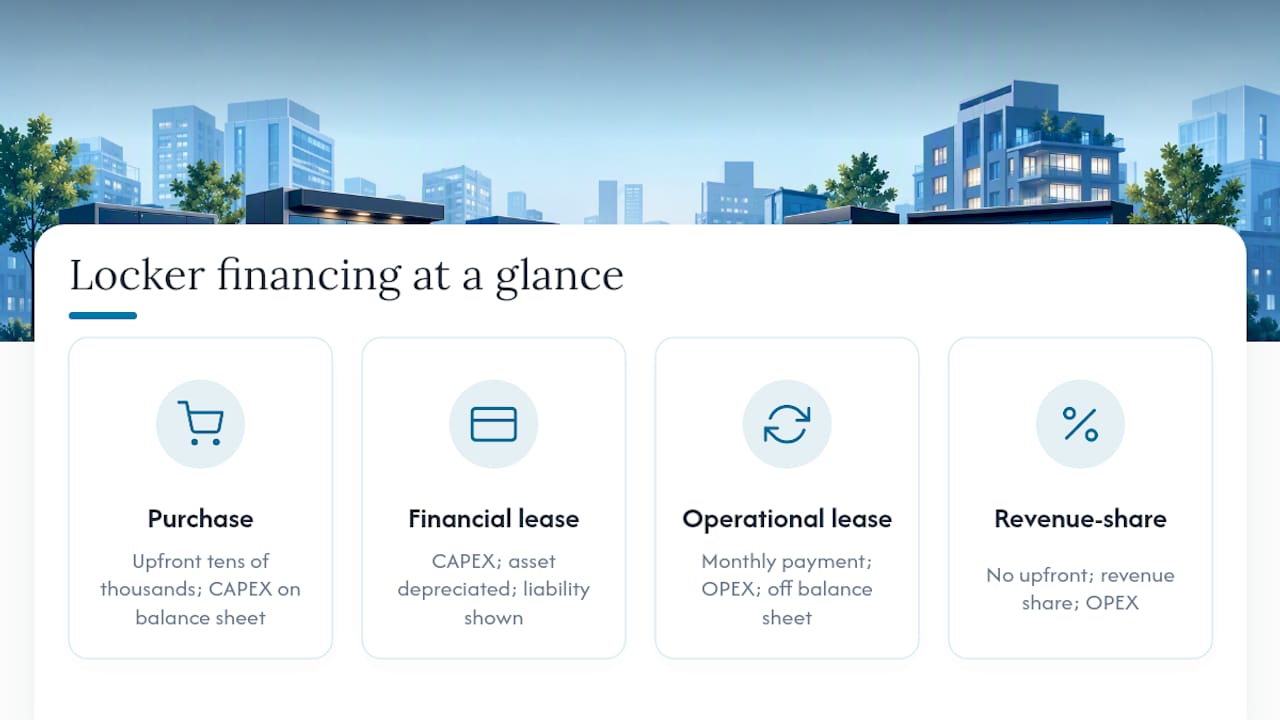
Purchase and financial-lease deals are capital expenditures, or CAPEX. The locker system becomes an asset you depreciate over its useful life, and the associated debt or lease liability typically appears on your balance sheet. Operational leases and revenue-share arrangements are usually treated as operating expenses, or OPEX, which keeps them off the balance sheet in many jurisdictions and preserves borrowing capacity for other projects.
That distinction affects loan covenants, debt-to-equity ratios, and how a lender views your next financing request. The specific accounting treatment depends on lease term, ownership transfer clauses, and your local accounting standard, so loop in an accountant before signing anything long-term. A useful comparison of rental property leverage applies here too: locker financing changes your effective leverage the same way a mortgage does.
For a rough illustration: a mid-size property might see purchase costs land in the tens of thousands upfront versus a monthly lease payment in the hundreds to low thousands, depending on locker count and features. A zero-CAPEX approach trades that upfront number for a revenue split instead.
What Do Lenders and Financing Partners Look For?
Whether you’re applying for a financial lease or pitching a revenue-share deal, the underwriting process looks at similar fundamentals. Lenders and locker providers want proof the deployment will generate enough activity, and enough goodwill, to justify the terms.
- Financial documentation. Expect requests for a basic profit-and-loss statement, balance sheet, and sometimes a project pro forma if this is new construction.
- Site suitability. Reviewers check power availability, wired or cellular connectivity, and carrier access procedures before approving equipment placement, points detailed in Locker Solutions’ contactless delivery guidance.
- Utilization projections. Revenue-share and lease-to-own proposals hinge on realistic package volume forecasts. Overly optimistic numbers are the fastest way to get a deal rejected or repriced later.
- Operational responsibility allocation. Clarify upfront who pays for repairs, connectivity fees, and software updates. This single line item shifts total cost more than almost any other variable.
Pro Tip: Bring site photos and a one-page utilization estimate to your first conversation with any finance partner. It speeds approval and signals you’ve done homework most applicants skip.
What Do Typical Contract Terms Look Like?
Contract length varies by model, and mismatched expectations here cause more disputes than pricing does. Trial or revenue-share pilots often run around a year. Operational leases commonly span two to five years. Financial leases can extend over multiple years, reflecting the useful life of the hardware.
- Monthly payments typically bundle amortization of the equipment cost, software licensing, maintenance coverage, and sometimes payment-processing fees for resident transactions.
- At the end of the term, you’ll usually choose among four options: buy out the remaining value, renew at a new rate, return the equipment, or purchase at a pre-agreed residual value.
- Maintenance responsibility shifts by model. Purchases often leave you sourcing your own service contract, while leases and revenue-share deals frequently fold maintenance into the base fee.
- Software updates and hardware refreshes should be spelled out explicitly rather than assumed, since “included maintenance” means different things to different vendors.
Ask for the residual-value formula in writing if a buyout option matters to you. Vague language here tends to surface as a surprise year into the contract.
What Can Real Deployments Teach You About Financing Fit?
Deployment data from actual multifamily properties tells a more useful story than any brochure. Locker Solutions’ own case work points to a consistent pattern: properties that pair financing with the right operational support see measurable gains in resident convenience and staff time saved, largely because maintenance and monitoring stop competing with leasing staff’s other duties, as outlined in the publisher’s locker business model analysis.
- Bundled inclusions matter. 24/7 support, video surveillance, and PMS integration are often folded into many financing arrangements rather than billed separately, which simplifies budgeting for property managers.
- Power and connectivity checks come first. Sites with confirmed wired or cellular access tend to see fewer installation delays and fewer disputes over “who pays for the fix” later.
- Signage drives utilization. Properties that invest in resident onboarding and clear signage tend to hit their forecasted usage faster than those that install and hope.
- Realistic assumptions protect everyone. Utilization models built on conservative package-volume estimates hold up better under revenue-share terms than optimistic ones.
Pro Tip: Request a written utilization model and a service-level agreement (SLA) from any financing partner before signing, not after. Locker Solutions’ package room management service shows what a fully specified operational inclusion looks like on paper.
How Do You Compare Quotes and Negotiate Terms?
Match the financing model to your actual constraints before you request quotes. If you want an asset and have the capital, purchase makes sense. If cash is tight but you’re confident in demand, a lease with manageable monthly payments works better. If you’re unsure about volume at all, a short revenue-share pilot lets the data decide before you commit further.
- Ask each vendor to itemize the monthly fee: hardware amortization, software, maintenance, and processing costs, listed separately, not lumped together.
- Confirm who pays for connectivity and power upgrades if your site needs them.
- Request a sample utilization scenario showing what package volume the deal assumes.
- Check the exit provisions: early termination penalties, renewal pricing, and residual buyout formulas.
- Watch for red flags: vague maintenance language, undefined “software updates,” or utilization assumptions that seem detached from your property’s actual foot traffic.
Why Pilots Beat Big Commitments Early On
Most successful smart locker rollouts we’ve seen didn’t start with a full purchase. They started small: a short lease or revenue-share pilot that proved out utilization before anyone signed a longer commitment. That sequencing protects your budget and gives you real data instead of a vendor’s projection.
If you take one thing from this guide, make it this: get the utilization model and the SLA in writing before the pilot starts, not after it succeeds.
— Locker Solutions
Ready to Compare Financing Options for Your Property?
Companies in this industry work directly with property managers and developers to structure purchase, lease, and managed-service arrangements around actual budgets and site conditions, not one-size-fits-all packages.
Whether you’re weighing a straight purchase against a package-room management contract, evaluating outdoor weatherproof lockers for a harsher climate, or trying to figure out if unified access control belongs in the same financing package, our team can walk through the numbers with you. We’ll help you build a realistic utilization model and put SLA terms in writing before you commit to anything. Request a tailored quote through our Luxer One locker solutions page and get financing terms that actually match your property’s traffic, not a generic estimate.
Further Reading on Locker Financing and Deployment
Readers who want more detail on specific product lines or the accounting side of these decisions can start here:
- Smart Lockers for Property Managers: 2026 Guide
- Automated Package Rooms: A Guide for Multifamily Properties
- Rental Property Leverage Explained for Investors
- Package Room Management Service for Apartments
FAQ
What Is the Cheapest Way to Finance Smart Lockers?
Revenue-share or zero-CAPEX models minimize upfront cost since a provider funds the deployment in exchange for a share of transaction revenue, though total cost over time depends heavily on utilization.
Should I Lease or Buy Smart Lockers?
Buy if you plan to hold the property long term and want the asset on your books; lease if you want predictable monthly costs and bundled maintenance without a large upfront outlay.
How Long Are Typical Smart Locker Financing Contracts?
Trial or revenue-share pilots often run about a year, operational leases typically span two to five years, and financial leases can extend up to seven years.
Does Locker Financing Affect My Balance Sheet?
Purchases and financial leases usually count as CAPEX and appear on the balance sheet, while operational leases and revenue-share deals are commonly treated as OPEX and kept off it, though your accountant should confirm the treatment for your specific structure.
What Should I Ask a Locker Financing Partner Before Signing?
Request an itemized breakdown of the monthly fee, a written utilization model, a service-level agreement, and clear terms on who pays for connectivity, maintenance, and end-of-term buyout.
Recommended
Ready for a Luxer One® package locker quote?
Tell us your unit count and we'll send right-sized pricing with a fast response time.
Get my free quote