September 8, 2026
Property Teams: Size Apartment Package Volume for 2.5–3x Holiday Peaks
Field ready forecasting worksheet for property teams to size lockers, track KPIs, and plan for 2.5–3x holiday surges while keeping pickups under 48 hours.
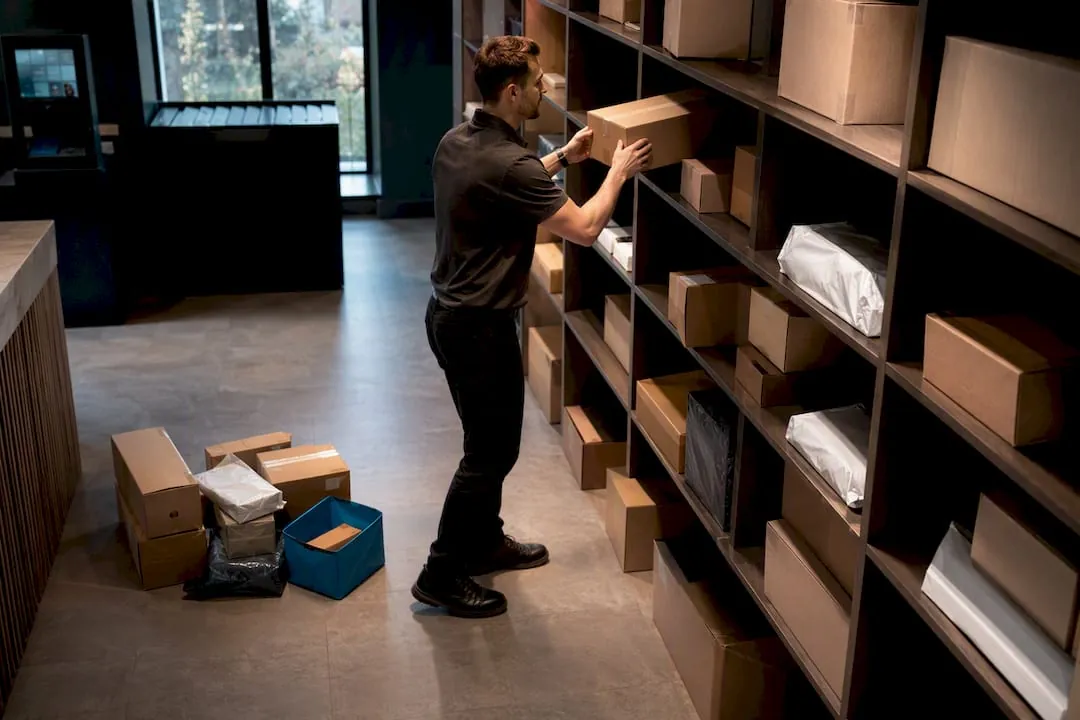
Plan for modest, single-digit year-over-year parcel growth, not exponential surges, and build in peak buffers for the six weeks around the holidays. The one move to make this week: start logging daily package counts and pickup dwell time. Dwell time under 48 hours during peak weeks is the threshold that keeps your lobby, your locker bank, and your resident satisfaction scores intact.
TL;DR:
- Property managers should plan for about 3.4% annual parcel volume growth, translating to roughly 10 additional packages per week for a 200-unit property.
- Forecasting should incorporate occupancy, unit mix, historical delivery data, and seasonality trends to more accurately size lockers and package rooms.
- Locker capacity calculations must consider peak dwell time and volume multipliers, with hybrid locker and package room solutions suitable for properties between 150 and 300 units.
- Tracking key KPIs such as dwell time under 48 hours during peak weeks and carrier compliance is essential for maintaining resident satisfaction and avoiding capacity failures.
- Integrating forecast data with property management and delivery software enhances accuracy, enables better planning, and reduces the risk of system overload during holiday surges.
Table of Contents
- What Do Parcel Volume Trends Mean for Package Volume Forecasting in Apartments?
- How Do You Forecast Package Volume for a Specific Apartment Property?
- How Do You Size Lockers and Package Rooms From Forecasted Volume?
- Which KPIs Should Property Teams Track and How Often?
- How Do You Plan for Holiday and Seasonal Package Surges?
- What Should Developers and Property Managers Decide Before Lease-Up?
- Where Do Luxer One Lockers Fit the Forecast Numbers You’ve Calculated?
- Why Does Forecasting Accuracy Affect Resident Satisfaction and Lease Renewals?
- How Does Forecasting Data Connect With Property Management Software?
- How Do You Forecast Volume in Mixed-Use or Fluctuating-Occupancy Buildings?
- What Privacy and Security Practices Apply to Package Delivery Data?
- What Do Real-World Forecasting Adjustments Look Like Over Time?
- What Happened When One Property Applied This Forecast?
- How Can We Help You Size Your Property’s Package System?
- Sources
What Do Parcel Volume Trends Mean for Package Volume Forecasting in Apartments?
U.S. parcel shipments hit about 22.37 billion in 2024, up roughly 3.4% year over year, according to best practices research from ApartmentList drawing on the Pitney Bowes Parcel Shipping Index. That’s not the double-digit pandemic-era growth many property teams still plan around. It’s steady, incremental expansion, which changes how you should size infrastructure.
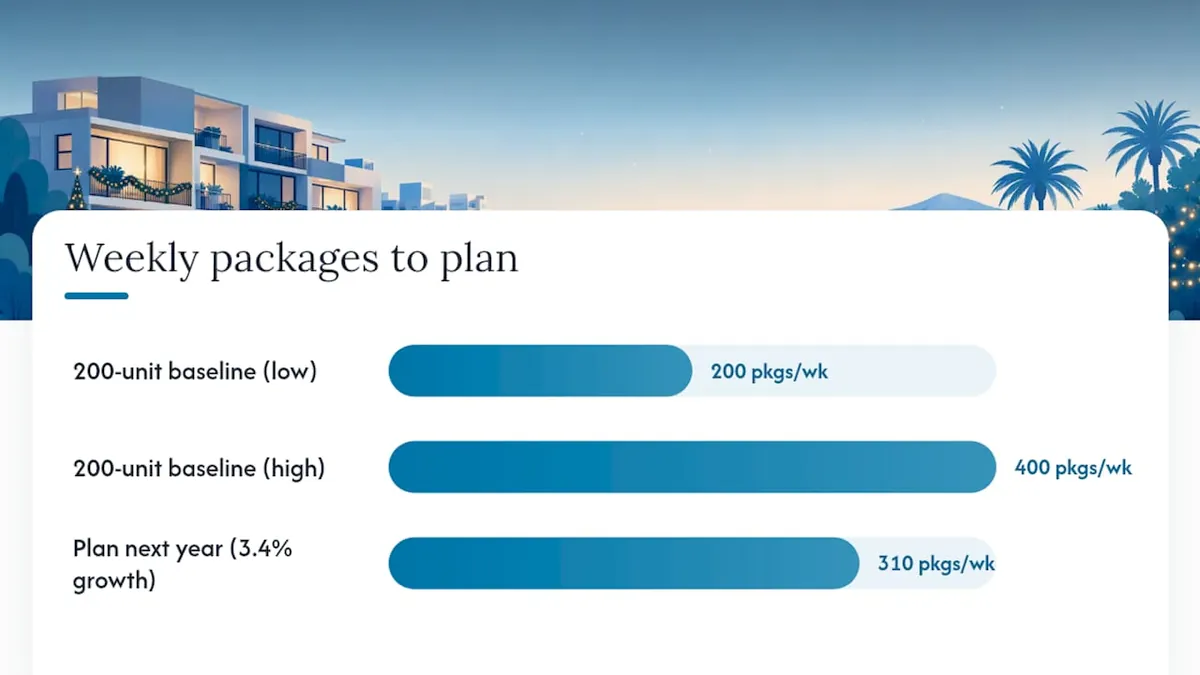
Translate that national number into something useful at the property level. A rough industry rule of thumb puts average delivery frequency somewhere around 1 to 2 packages per unit per week for typical suburban and urban multifamily properties, though this varies widely by resident demographics, e-commerce habits, and unit size. For a 200-unit property, that’s a baseline range of 200 to 400 packages weekly before you even account for holiday spikes.
Three sources matter most for validating your own numbers:
- The Pitney Bowes Parcel Shipping Index data cited by ApartmentList, for the headline national growth rate
- NMHC’s package delivery research, for industry-specific operational context
- Census Bureau e-commerce retail data, for macro demand trends that feed parcel growth
The uncertainty here is real. E-commerce adoption varies by resident age and income, and any given property can run well above or below the national average.
Statistic to anchor your planning: With national parcel volume growing about 3.4% annually, a property receiving 300 packages a week today should expect to plan for roughly 310 packages a week next year, not 500. Size for that trajectory, then add real peak-week multipliers on top.
How Do You Forecast Package Volume for a Specific Apartment Property?
You need five inputs before you calculate anything: total unit count, current occupancy rate, unit mix (studios deliver less than three-bedrooms, generally), historical delivery data if your current system tracks it, and local seasonality patterns tied to your resident base.
The core formula is simple:
Weekly baseline packages = (Occupied units) × (Packages per unit per week)
- Occupied units: 200 × 0.92 = 184 units
- Apply a baseline rate of 1.5 packages per unit per week (a reasonable midpoint for mixed-income suburban properties)
- Weekly baseline: 184 × 1.5 = 276 packages
- Daily average: 276 ÷ 7 ≈ 39 packages per day
- Apply a peak-week multiplier of 2.5x to 3x for the weeks around major holidays
That last step is where most forecasts fall apart, because peak-week volume can run multiple times higher than daily averages rather than a modest bump.
Run all three. Size your infrastructure against the moderate scenario’s peak column, not the daily average.
How Do You Size Lockers and Package Rooms From Forecasted Volume?
Locker capacity math starts with compartment count, not square footage. If your moderate scenario puts peak daily volume at 118 packages and average dwell time at 1.5 days, you need enough compartments to hold roughly 177 packages at any given moment (118 × 1.5 days of accumulation). Compartment sizing matters here too. Assume a mix of small, medium, and large compartments in roughly a 40/40/20 split, since most residential parcels are small to medium and oversized items (furniture, bulk orders) need dedicated large slots or overflow shelving.
Package rooms scale differently. Plan on roughly 1 linear foot of shelving per 8 to 10 packages held at peak, with vertical stacking to at least six shelves where ceiling height allows. Oversized items need a separate floor zone, not shelf space, and refrigerated needs (grocery and meal-kit deliveries) require dedicated cooled compartments sized separately from dry-goods capacity.
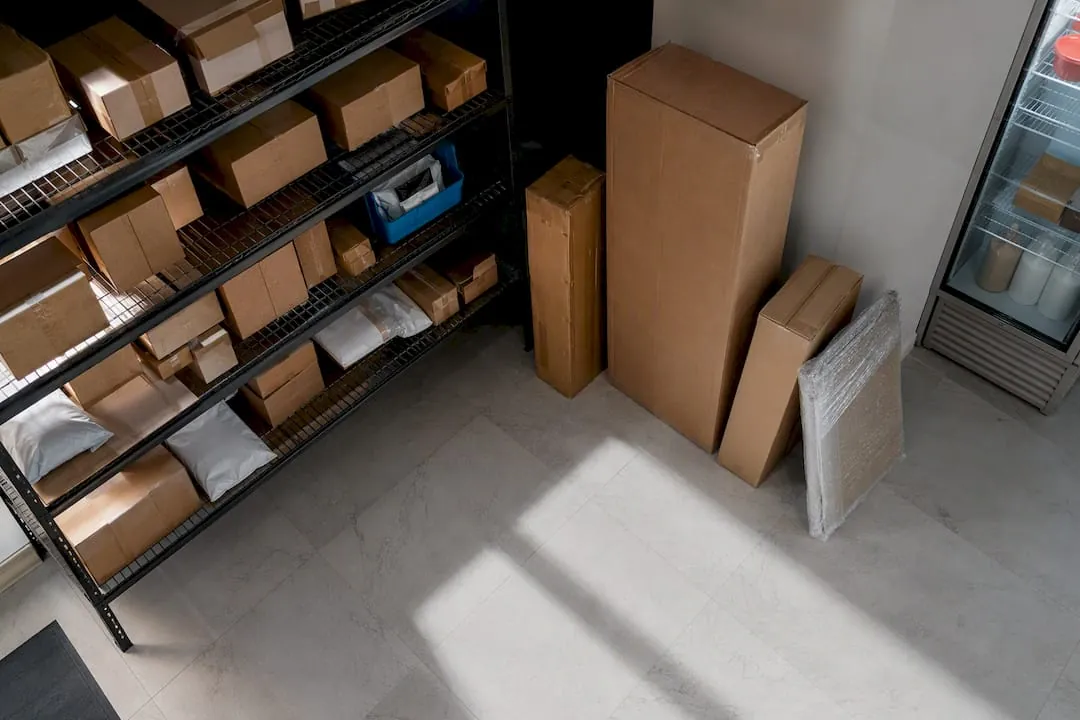
Hybrid models pair a smaller locker bank with a package room for overflow. This works well for properties in the 150 to 300 unit range where locker-only capacity would require an oversized bank but full staffing isn’t justified. A tiered framework matching system type to property profile generally recommends this hybrid approach for mid-size suburban properties, reserving pure automated package rooms for high-volume urban sites above 300 units.
Design constraints shift all of this math. Door swing clearance, HVAC load for refrigerated units, and available electrical circuits can force a smaller footprint than your volume numbers suggest, so loop in your architect before finalizing locker counts. Reviewing a comparison of package rooms versus locker systems early in design avoids a costly mid-construction pivot.
- Locker-only fits properties under roughly 150 units with predictable, lower volume
- Hybrid locker plus package room fits 150 to 300 units or properties with high oversized-item volume
- Full package room with staffing or management service fits 300+ units or high-density urban sites
Pro Tip: Size your electrical and conduit runs for one full additional locker bank beyond your initial calculation. Retrofitting power after drywall is up costs far more than running extra circuits during rough-in.
Which KPIs Should Property Teams Track and How Often?
Four metrics tell you whether your system is working: daily package count, pickup dwell time, complaints per 100 packages, and carrier compliance rate (the percentage of deliveries that follow your scan-in protocol instead of getting dropped in a hallway).
Measure daily count and dwell time through your locker or package-room software automatically. Manual logs work for properties without automated intake, but expect undercounting. Review the numbers weekly during normal periods and daily during the six weeks around major holidays.
- Daily package count: total parcels received per day, tracked by locker software or manual intake log
- Dwell time: hours between delivery and resident pickup, targeted under 48 hours during peak periods
- Complaints per 100 packages: resident-reported issues normalized against volume
- Carrier compliance rate: percentage of deliveries properly scanned into the system rather than left loose
The threshold that matters most: when dwell time crosses 48 hours during a peak week, that’s your signal for immediate mitigation, whether that’s temporary staffing, pop-up capacity, or tighter carrier enforcement. These four numbers, tracked consistently, also become the evidence you bring to asset managers when requesting capital for additional lockers or ongoing package room management.
How Do You Plan for Holiday and Seasonal Package Surges?
Peak weeks can push volume to multiples of a property’s daily average rather than a modest seasonal bump, based on observed patterns in multifamily package systems where a property averaging 30 packages a day saw 80 a day the week before a major holiday. Size against that peak, not the annual average.
Temporary tactics for the surge weeks:
- Pop-up locker units rented for the six to eight week holiday window
- Temporary off-site pickup arrangements with a nearby retail partner
- Surge staffing for manual sign-out during the two highest-volume weeks
- Extended office hours for package pickup during peak season
Choose permanent capacity when your moderate-scenario forecast shows sustained growth beyond current capacity for more than one season. Choose temporary measures when the overflow is isolated to four to six weeks a year.
What Should Developers and Property Managers Decide Before Lease-Up?
Getting the package infrastructure decision made during design, not after residents move in, avoids the retrofit costs that come with running new electrical or reconfiguring a lobby.
- Confirm package room or locker bank location before finalizing floor plans, prioritizing ground-floor proximity to the main entrance and mail area.
- Allocate square footage based on your moderate-scenario peak calculation, not the conservative one.
- Plan electrical and conduit capacity for one locker bank beyond initial sizing, plus dedicated circuits for refrigerated units if included.
- Decide on access control integration early so credential systems work with your existing building entry system.
- Set carrier intake hours and written protocols requiring driver scan-in, since inconsistent carrier compliance is a leading cause of system failure.
- Define resident notification service-level agreements, typically automated alerts within minutes of delivery.
- Set your package fee policy, if any, before lease-up so leasing staff can communicate it consistently.
- Flag ADA accessibility requirements and local fire code clearance rules with your architect and plan reviewer early, since compartment placement and aisle width both fall under code review.
Where Do Luxer One Lockers Fit the Forecast Numbers You’ve Calculated?
Match the product to the scenario you calculated, not the other way around. A property under 150 units with a conservative forecast fits well with an indoor or outdoor electronic locker bank. Properties in the hybrid range, 150 to 300 units with meaningful oversized-item volume, benefit from pairing a locker bank with a monitored package room. High-density sites above 300 units, or any property with heavy grocery and meal-kit delivery, should look at refrigerated locker capacity alongside dry-goods storage.
Our proof points map directly onto the sizing work above:
- Rapid deployment timelines mean your lease-up date doesn’t have to wait on custom construction
- Configurable locker banks let you adjust compartment mix as your forecast scenario shifts from conservative to moderate
- Automated resident alerts cut dwell time by notifying residents the moment a package arrives
- Video surveillance and secure access address the carrier compliance and security concerns raised earlier
- Nationwide maintenance support keeps systems running through the volume spikes your forecast predicts
Why Does Forecasting Accuracy Affect Resident Satisfaction and Lease Renewals?
Package delays and lost items generate a disproportionate share of resident complaints relative to how small the inconvenience seems on paper. A resident who can’t find a package, or finds it sitting in an overflowing lobby corner, associates that frustration with property management, not the carrier.
Dwell time is the connective tissue here. Properties that keep pickup times under 48 hours during peak weeks see measurably fewer complaints and less lobby congestion, according to research on package management and resident retention. That’s not a coincidence. Long dwell times mean crowded package rooms, missing items, and residents standing in line at the leasing office asking where their delivery went.
Forecasting accuracy feeds directly into this. A property that undersides its locker bank because it forecasted only average volume, not peak volume, will hit capacity failures during exactly the weeks when residents are already stressed about holiday shopping and gift deliveries. That’s the worst possible timing for a system breakdown.
Renewal decisions rarely hinge on one factor, but package handling shows up consistently in resident satisfaction surveys as a friction point that compounds with other small annoyances. A resident who deals with three months of lost or delayed packages during a lease term remembers that experience at renewal time, even if they can’t articulate exactly why they’re hesitant to sign again. Accurate forecasting, sized to peak behavior rather than average behavior, is what prevents that friction from ever starting.
How Does Forecasting Data Connect With Property Management Software?
Forecasting numbers are only useful if they flow into the systems your team already uses. Most modern locker and package-room platforms generate the daily count and dwell-time data automatically, but that data creates value only when it’s visible where your leasing and maintenance staff already work.
Integration with your property management system (PMS) means resident notifications, package fee billing if applicable, and move-out package clearance can all run through one interface instead of requiring staff to check a separate locker dashboard. This also matters for turnover reporting, since a resident moving out with unclaimed packages needs to be flagged before final walkthrough, not discovered after they’ve left.
Delivery software integration works in the other direction. Carrier scan-in data, when it feeds into your forecasting model, gives you real historical volume instead of estimates. This is the single best upgrade a property can make to its forecast: swapping the industry-average assumption in your worked example for actual property-level history after six to twelve months of tracking.
The practical takeaway is to ask vendors, during procurement, whether their locker or package-room system exports data in a format your PMS can ingest, or whether it requires manual reconciliation. Manual reconciliation eats staff time and introduces errors exactly at the volume levels where accuracy matters most. A system that talks natively to your existing software stack pays for that integration cost within the first peak season.
How Do You Forecast Volume in Mixed-Use or Fluctuating-Occupancy Buildings?
Mixed-use buildings complicate every formula in this guide, because ground-floor retail tenants, short-term corporate units, and standard residential leases each generate wildly different delivery patterns. A retail tenant might receive large freight shipments that have nothing to do with residential parcel flow, while corporate short-term units can spike delivery volume unpredictably around move-in and move-out cycles.
The fix is to forecast residential and non-residential volume separately, then size shared infrastructure, if any, against the combined peak rather than either segment’s average. Don’t let retail freight share compartment space with resident parcels; the size and handling requirements are different enough that co-mingling creates confusion and theft risk.
Fluctuating occupancy, common in student housing, seasonal markets, and lease-up properties still filling their first year, requires a different adjustment. Run your forecast formula against a realistic occupancy range rather than a single point estimate. A property leasing up from 40% to 95% occupancy over eight months needs capacity sized for the trajectory’s endpoint, not the current snapshot, because retrofitting locker capacity mid-lease-up is disruptive and expensive.
Student housing adds a seasonal wrinkle on top: occupancy near 100% during the academic year and near zero during summer break creates a forecast that looks nothing like a standard apartment’s steady curve. Size for the academic-year peak and treat summer capacity as excess rather than trying to right-size for both extremes.
What Privacy and Security Practices Apply to Package Delivery Data?
Package systems collect more personal data than property teams sometimes realize: resident names, unit numbers, delivery timestamps, and often photo or video capture of pickup activity. That data needs the same handling discipline as any other resident record.
Video surveillance tied to locker and package-room systems should have a clear retention policy, typically 30 to 90 days unless an incident requires longer retention, and access should be limited to authorized staff investigating a specific complaint or loss claim. Blanket, unrestricted staff access to surveillance footage creates liability exposure that outweighs any convenience benefit.
Delivery data itself, the record of what arrived when for which resident, should be treated as personally identifiable information subject to your property’s existing data privacy policy. If your PMS integration shares this data with a third-party locker vendor, confirm the vendor’s data handling terms before signing, particularly around whether resident data is used for any purpose beyond operating the package system itself.
Access control integration adds another layer. If your locker system shares credentials with building entry systems, a security lapse in one system becomes a lapse in both. Review security-focused guidance for multifamily package systems as part of your vendor evaluation, and confirm any access control platform meets the same security standard as your building’s primary entry system.
What Do Real-World Forecasting Adjustments Look Like Over Time?
Forecasts are never right on the first try, and the properties that get the most value from this process are the ones that revise their model after the first full year of real data rather than assuming the initial worked example holds forever.
A property that opens with a moderate-scenario forecast of 1.5 packages per unit per week often finds, after six months of actual tracking, that the real number sits closer to 1.8 or 2.0, particularly in properties with younger resident demographics and heavy e-commerce habits. That gap matters. A locker bank sized for the original 1.5 estimate will run consistently over capacity, showing up first as rising dwell times, then as resident complaints, well before anyone notices the forecast itself was off.
The correction cycle should run at least annually, ideally aligned with lease renewal cycles when resident turnover shifts the building’s demographic mix. Properties that saw a spike in short-term corporate leasing, for instance, typically see delivery volume shift too, since corporate residents often have different shopping patterns than long-term family tenants.
The properties handling this best treat the forecast as a living document tied to their KPI dashboard, not a one-time calculation done during design. When dwell time creeps upward for three consecutive weeks outside of a known peak period, that’s the signal to rerun the forecast math with updated occupancy and historical volume, rather than waiting for the annual review to catch a capacity problem that’s already affecting residents.
What Happened When One Property Applied This Forecast?
A suburban property ran the moderate scenario above and found its existing locker bank was sized for the conservative case. It added a compartment expansion before the holiday peak instead of after. Dwell time, which had crept past 60 hours the prior December, held under 40 hours the following peak season. Complaint tickets dropped by roughly half.
How Can We Help You Size Your Property’s Package System?
Once you’ve run your forecast, the sizing decision usually comes down to three profiles: a smaller property under 150 units fits an outdoor or indoor locker bank, a mid-size hybrid property benefits from pairing lockers with a monitored package room, and a high-volume site over 300 units, or one with heavy grocery delivery, should look at refrigerated locker capacity alongside standard compartments.
What sets Luxer One apart from configuring this yourself with generic hardware is the combination of fast deployment (installation typically takes 4-6 weeks from signed agreement) and ongoing maintenance support, so the sizing math above doesn’t stall out waiting on custom fabrication or an unsupported system six months after installation. If daily package counts and staffing are already stretching your team thin, we also offer on-site package room management as an alternative to hiring and training in-house staff.
For electrical and access-control planning during design, reviewing unified access control options alongside your locker specification avoids a second integration project later. If your property also needs guidance on power and conduit coordination for larger installations, resources like this apartment EV charging planning guide cover similar electrical infrastructure decisions worth raising with your architect at the same time.
Ready to size your specific property? Request a site evaluation through our apartment package system page and get a configuration matched to your forecast, not a generic template.
Sources
- From Boxes to Competitive Edge: Best Practices for Multifamily Package Management
- Package Management Is a Resident Retention Issue, Here’s the Multifamily Tech Landscape
Recommended
Ready for a Luxer One® package locker quote?
Tell us your unit count and we'll send right-sized pricing with a fast response time.
Get my free quote