August 11, 2026
How to Prioritize Package-Management Upgrades Across Your Portfolio
Learn effective strategies for regional property upgrade prioritization to enhance package management and boost ROI in high-density areas.
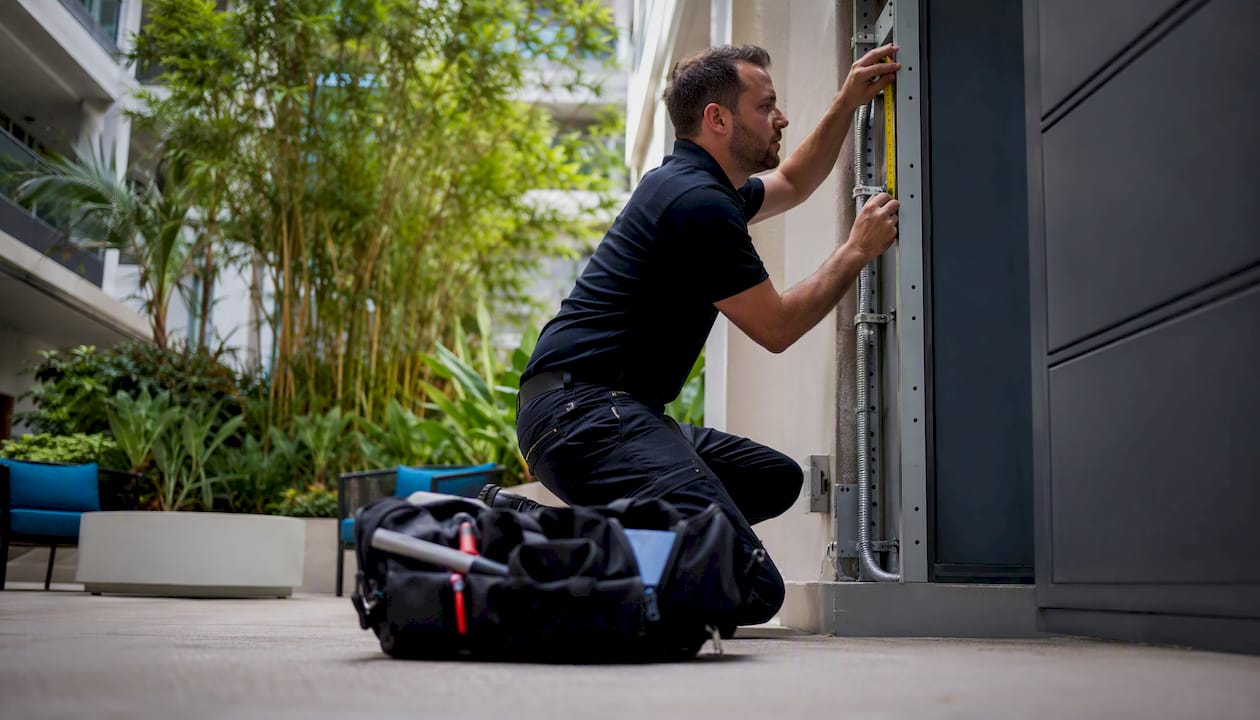
Upgrade the properties with the highest daily package volume, active theft or loss incidents, and the least staff coverage first. Those three conditions together create the fastest, most defensible ROI, and they show up most often in high-density urban communities above 200 units with limited front-desk hours.
Quick-verdict priority order:
- Tier 1: High-volume sites (50+ packages/day) with documented theft or loss and no after-hours pickup option
- Tier 2: Mid-size properties (150–200 units) where staff spend more than two hours daily on package intake
- Tier 3: Sub-150-unit properties with resident satisfaction complaints tied directly to delivery failures
One-line scoring example: A 220-unit property logging 65 packages/day, three theft incidents last month, and 2.5 staff hours on intake scores near the top of any weighted matrix before you add a single strategic factor.
Key Takeaways
Prioritize properties with the highest daily package volume, active theft incidents, and the least staff coverage first — those three conditions together produce the fastest, most defensible ROI across a regional portfolio.
| Point | Details |
|---|---|
| Score before you spend | Use a weighted matrix (volume —, staff hours 20%, theft 20%) to rank every property before committing capital. |
| Pilot at mid-high scores | Choose a pilot property scoring 3.8–4.5 with a clear baseline and a site-ready footprint. |
| Size for peak, not average | Model locker capacity at 1.5× your measured peak-day volume to avoid overflow within the first holiday season. |
| Tie every cost to an NOI lever | Model staff savings and theft reduction as dollars-per-unit-per-month to accelerate budget approval. |
| Locker Solutions for rollout support | Locker Solutions provides site surveys, pilot installs, managed package rooms, and nationwide installation across your portfolio. |
Table of Contents
- How should you prioritize regional property upgrades for package management?
- What data do you need to collect before scoring each property?
- How does the scoring model work, and what weights should you use?
- How do you pick a pilot property and sequence rollout waves?
- What does the budget look like, and which ROI drivers matter most?
- How do you manage operations and change management during rollout?
- What does the site survey and procurement checklist cover?
- What risks should you track, and which KPIs matter after deployment?
- Worked example: scoring and three-wave rollout for a 10-property portfolio
- Compliance and regulatory considerations for package-management system upgrades
- What regional deployments actually teach you
- Locker Solutions supports your portfolio rollout from pilot to full deployment
- Sources
How should you prioritize regional property upgrades for package management?
The right starting point is matching solution type to property constraints, not defaulting to the largest hardware footprint you can justify. Multifamily package management solutions research confirms that notification software fits low-volume staffed sites, secure package rooms suit self-managed properties, full locker banks belong at high-volume sites, and hybrid models often work best for sub-200-unit properties.
Core criteria, ranked by operational consequence:
- Average daily package volume and peak spikes — the single strongest predictor of staff burden and resident friction
- Staffing model and coverage hours — a 24/7 unstaffed lobby changes the math entirely
- Theft and loss incidents per month — each incident carries a direct cost and a resident-retention risk
- Resident CSAT scores tied to delivery — low scores here signal churn risk before it shows in renewals
- Retrofit complexity and available square footage — space constraints determine which solution is even viable
- Climate and exposure — outdoor or refrigerated lockers require weatherproofing and drainage planning
- Property type and density — garden-style versus mid-rise versus high-rise each has different carrier-access patterns
- Strategic market positioning — a lease-up property in a competitive submarket weights resident experience higher than a stabilized cash-flow asset
Pro Tip: Before ordering hardware, walk the property and identify two or three real staging locations. Properties without a viable locker footprint need a package room or hybrid solution first, regardless of volume.
What data do you need to collect before scoring each property?
Collect a minimum dataset for every property before you score anything. Seven days of observation, plus one holiday-week check, gives you enough signal to rank reliably.
| Metric | Source | Collection method |
|---|---|---|
| Avg. daily packages | PMS reports, courier logs | 7-day count |
| Peak-day packages | Security camera logs, front-desk log | Holiday-week audit |
| Oversized package share | Onsite log | Tally during 7-day count |
| Theft/loss incidents per month | Incident reports, security logs | 30-day pull |
| Resident pickup window gaps | Leasing survey, PMS data | Short resident survey |
| Staff hours on package intake | Timesheet or manager estimate | Weekly average |
| Available sq. ft. for lockers/room | Physical measurement | Walk-through |
Using hyper-local, portfolio-specific data matters here because technology performance varies by market. Labor costs, resident expectations, and vacancy trends diverge even within a single metro, so zip-code-level analysis prevents buying unnecessary capital expenditure.
How does the scoring model work, and what weights should you use?
Build a composite score for each property using these criteria and example weights. Adjust weights based on portfolio strategy: growth-market lease-ups should weight resident satisfaction and market positioning higher; stabilized cash-flow assets should weight staff savings and loss reduction more heavily.
Composite score formula: Multiply each criterion score by its weight, then sum. A property scoring 4.2 out of 5. belongs in Wave 1. Scores of 3.–4.1 go into Wave 2. Below 3.— goes on hold or receives a lighter-touch solution.
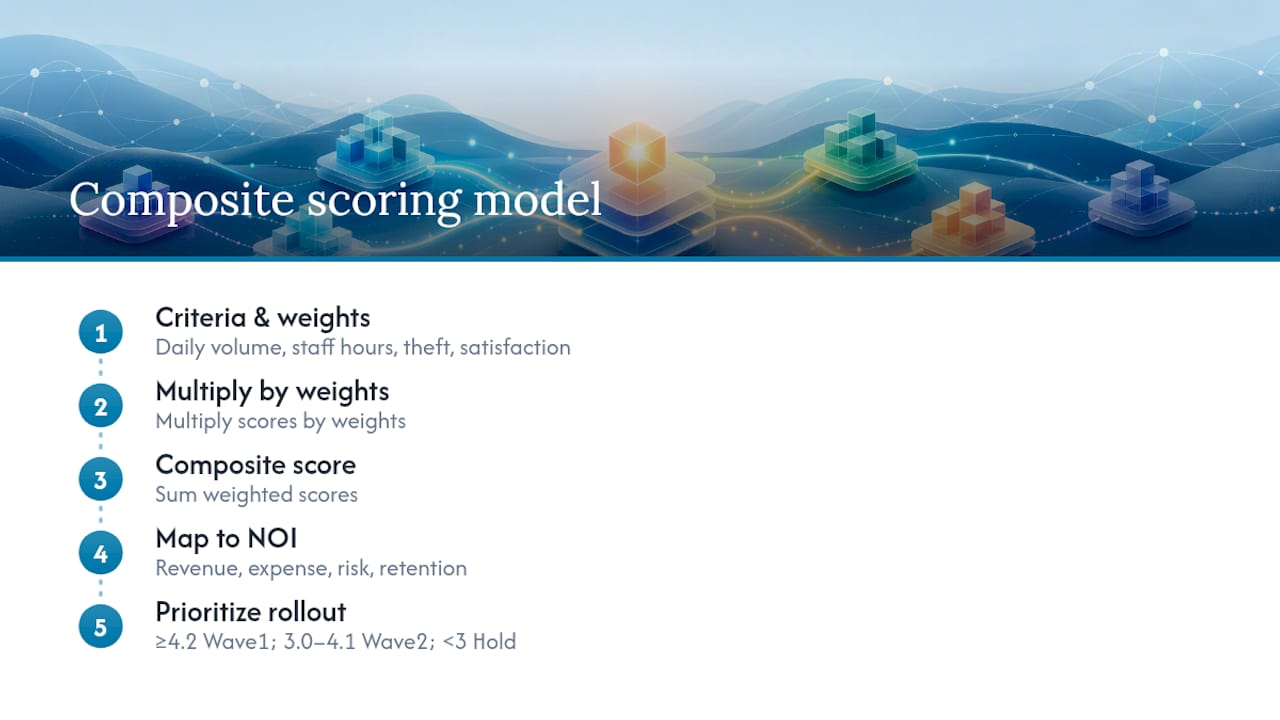
Evaluations should focus on measurable NOI impacts and operational metrics rather than vendor feature lists. Map each criterion to a specific NOI lever: revenue uplift, expense reduction, risk reduction, or resident retention.
How do you pick a pilot property and sequence rollout waves?
Pilot selection criteria:
- Composite score in the 3.8–4.5 range (high enough to show impact, not so extreme it’s unrepresentative)
- Clear metrics baseline already collected
- Site-ready: viable space, adequate electrical, carrier access confirmed
- Onsite manager who is engaged and willing to track results
- Varied carrier mix (UPS, FedEx, USPS, Amazon) to stress-test compliance
Wave sizing by portfolio scale:
- 10–30 properties: Run a single-property pilot for 60–90 days, then deploy Wave 1 to 3–5 properties simultaneously. Measure for 30 days before Wave 2.
- 50+ properties: Pilot 2 properties in different submarkets, run parallel 60-day measurement windows, then deploy in waves of 8–10 with 30-day gates between each.
Rollout timeline (10-property example):
- Weeks 1–2: Complete data collection and scoring for all properties
- Week 3: Select pilot, confirm site readiness, order hardware
- Weeks 4–6: Install pilot, train staff, notify residents
- Weeks 7–14: Measure pilot KPIs (packages processed, staff hours, theft incidents, resident pickup times)
- Week 15: Score results against baseline; confirm Wave 1 properties
- Weeks 16–20: Deploy Wave 1 (next 3–4 properties)
- Week 21+: Measure Wave 1, then proceed to Wave 2
Carrier compliance and standardized carrier communication are the primary operational levers at every wave. Build carrier training into the pilot timeline, not as an afterthought after go-live.
What does the budget look like, and which ROI drivers matter most?
Cost line items to model:
- Capex: Hardware (locker units, kiosks, refrigerated modules), installation labor, permitting fees
- Opex: Software subscription fees, maintenance contracts, monitoring, part-time attendant staffing if applicable
- One-time rollout costs: Carrier training sessions, resident signage, staff training time
Primary ROI drivers:
- Staff hours saved on package intake (convert to annual dollar savings at local labor rates)
- Reduction in theft and loss incidents (use average replacement cost per incident)
- Resident retention lift (even a 1% improvement in renewal rate at a 200-unit property has measurable NOI impact)
- Optional package-fee revenue (some operators charge $5–$10/month per unit)
Sample ROI calculation approach: A 200-unit property saving 2 staff hours/day at $18/hour saves roughly $13,140/year. Add two prevented theft incidents at $300 average replacement cost each, and you are at $13,740 before any retention benefit. Model this as dollars-per-unit-per-month ($5.73/unit/month) when presenting to finance.
Tie each budget line item to a specific NOI lever and model dollar-per-unit-per-month impact. Budget approvals move faster when finance sees consolidation evidence alongside the NOI math.
How do you manage operations and change management during rollout?
Resident communication timeline:
- 14 days pre-install: Email notice explaining the new system, pickup process, and go-live date
- Day of install: Lobby signage and a second email with step-by-step pickup instructions
- Go-live day: Text or app notification with locker access instructions
- Day 7 post-go-live: Short resident survey (3 questions maximum)
Staffing and training checklist:
- Reassign front-desk intake time to leasing or resident-service tasks once the system is live
- Train front-desk staff on overflow procedures and how to handle carrier non-compliance
- Send carriers a pictorial SOP at deployment. Standardized carrier communication significantly reduces non-compliance during peak periods.
- Schedule a 30-day check-in with the onsite manager to catch early friction
For detailed operational best practices, the apartment building manager guide covers change-management workflows specific to multifamily teams.
What does the site survey and procurement checklist cover?
Walk every property before procurement. Space constraints determine which solution is viable, and discovering a wiring problem after hardware ships is expensive.
| Checklist item | Threshold / requirement | Red flag |
|---|---|---|
| Electrical capacity | Dedicated 20-amp circuit per locker bank | No available circuit nearby |
| Network connectivity | Wired Ethernet or strong Wi-Fi at install location | Dead zone, no IT access |
| Floor space | Minimum 4 ft × 8 ft clear for entry-level bank | Less than 40 sq. ft. usable |
| ADA clearance | Approach path minimum per ADA standard | Obstructed or non-compliant path |
| Carrier access | Carriers can reach location without resident escort | Gated access with no carrier code |
| Refrigeration (if applicable) | Floor drain within 10 ft, 20-amp dedicated circuit | No drain, shared circuit |
| Permitting | Check local building department for commercial equipment permits | HOA or municipality restrictions |
For legacy buildings, retrofit planning guidance covers structural and wiring considerations specific to older multifamily stock. Contracts with vendors should specify maintenance SLAs, carrier compliance tooling, and a documented expansion path.
What risks should you track, and which KPIs matter after deployment?
Common risks and immediate mitigations:
- Carrier non-compliance: Deploy pictorial SOPs at go-live; track non-delivery events weekly
- Undersized capacity: Model peak-day volume at 2× average before ordering; add overflow SOP
- Oversized package overflow: Designate a staffed overflow area with a 24-hour pickup window
- Resident confusion: Post QR-code instructions at the locker bank; send a how-to video at go-live
- Vandalism or theft: Confirm video surveillance coverage before install; review footage weekly for the first 30 days
Post-deployment KPI dashboard:
| KPI | Target | Reporting cadence |
|---|---|---|
| Packages processed per day | Baseline + 10% within 60 days | Weekly |
| Peak utilization rate | Under full capacity during peak | Weekly during first 90 days |
| Average resident pickup time | Under 18 hours | Monthly |
| Staff hours saved on intake | 1.5+ hrs/day vs. baseline | Monthly |
| Theft/loss incidents | Zero within 60 days of go-live | Monthly |
Worked example: scoring and three-wave rollout for a 10-property portfolio
Scoring steps:
- Enter raw metrics for each property into the scoring matrix weights from Section 4.
- Multiply each criterion score by its weight and sum to get the composite.
- Properties scoring 4.2 and above (Elmwood Court, Ashford Place, Harborview, Birchwood Flats) form Pilot + Wave 1.
- Properties scoring 3.—–4.1 (Glenpark, Cedar Ridge, Junction 44) form Wave 2.
- Properties below 3.— (Dunmore Arms, Fairview Lofts, Ironwood) go on hold or receive notification-only software until conditions change.
Decision trigger: If a Wave 2 property records two or more new theft incidents before Wave 2 deploys, it moves up to Wave 1 immediately. A hold property that crosses 40 packages/day re-enters scoring.
Compliance and regulatory considerations for package-management system upgrades
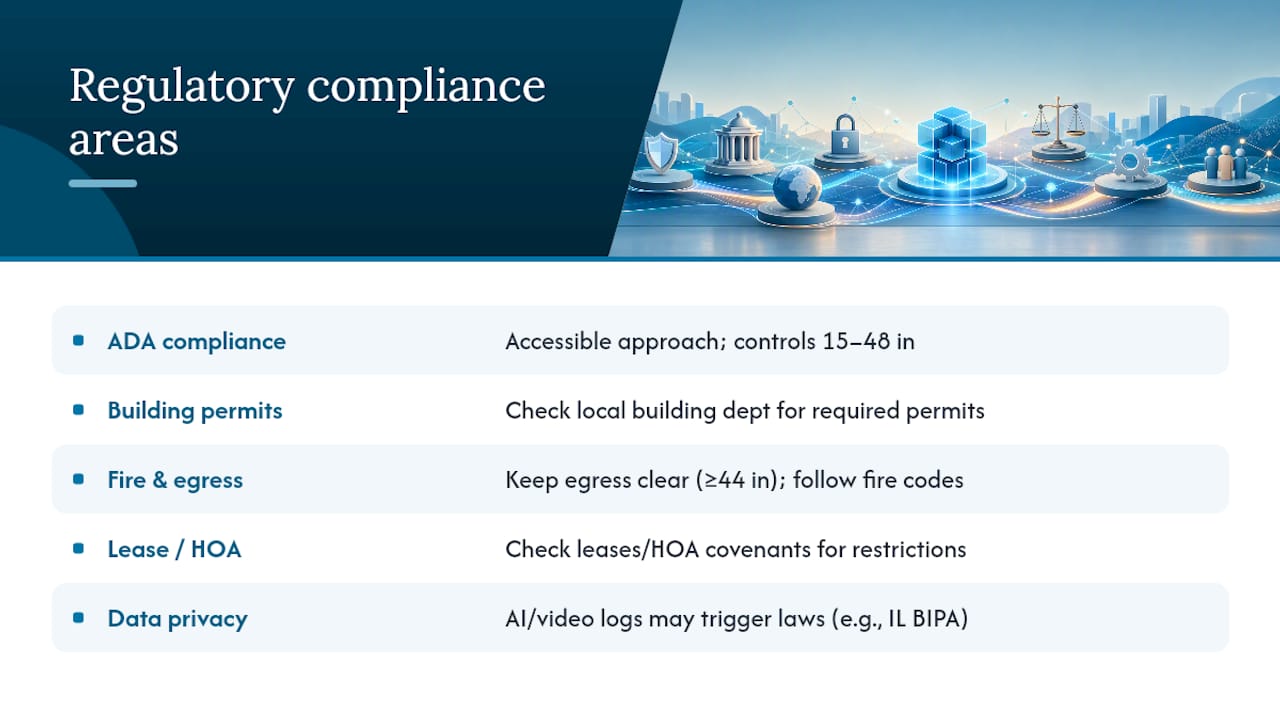
Package-management system installations in multifamily properties touch several regulatory areas that vary by state and municipality.
ADA compliance under the Americans with Disabilities Act requires that locker banks placed in common areas maintain accessible approach paths, reachable control heights (15–48 inches per ADA standards), and operable controls usable without tight grasping. Confirm compliance with your architect or a certified access consultant before finalizing placement.
Building permits are required in most jurisdictions for any permanent electrical installation or structural modification. A freestanding locker bank connected to a dedicated circuit typically requires an electrical permit; a package room with a new door or wall modification may require a building permit as well. Check with the local building department before procurement, not after.
Fire and egress codes govern placement in corridors and lobbies. Locker banks cannot obstruct egress paths or reduce corridor width below the minimum required by local fire code (typically 44 inches clear). Some jurisdictions require fire-rated enclosures for package rooms adjacent to mechanical spaces.
Lease and HOA agreements may restrict modifications to common areas. Review your ground lease, condo declaration, or HOA covenants before committing to a permanent installation.
Data privacy is a growing consideration. Systems with video surveillance, AI-powered label reading, and resident access logs may be subject to state biometric privacy laws (Illinois BIPA, Texas CUBI, Washington My Health MY Data) or general data-protection requirements. Confirm that your vendor’s data-handling practices align with the laws governing your properties’ states.
What regional deployments actually teach you
The scoring framework is sound, but three things consistently surprise teams during actual rollouts.
First, carrier behavior at go-live rarely matches what drivers do during the pilot. A pictorial SOP sent to every carrier’s local depot before launch, not just to the regional coordinator, cuts non-compliance events sharply in the first 30 days. Second, holiday-week volume spikes are almost always underestimated. Properties that look comfortably sized in October are overflowing by the second week of December. Size for 1.5× your measured peak-day volume, not your average. Third, the properties that score mid-range on the matrix (the Wave 2 group) are where the most interesting operational lessons emerge. They often have a single constraint, a wiring problem, a difficult carrier route, or a skeptical manager that a small targeted fix resolves before the wave arrives.
Pro Tip: Run a 30-minute tabletop exercise with your onsite manager before go-live. Walk through three scenarios: a carrier drops packages outside the locker, a resident cannot retrieve a package after hours, and the system goes offline. Teams that rehearse these scenarios handle the real events without escalating to regional.
These lessons feed directly back into the scoring model. After your first full wave, revisit the weights. If carrier compliance turned out to be the dominant failure mode at every property, raise its weight in the matrix for Wave 2 planning.
Locker Solutions supports your portfolio rollout from pilot to full deployment
Deploying package-management infrastructure across a regional portfolio is faster when you have a partner who has done the site surveys, the carrier coordination, and the capacity math before. Locker Solutions provides indoor and outdoor Luxer One® locker systems, refrigerated lockers, automated package rooms, and a fully managed package room service with nationwide installation and ongoing maintenance support. Every deployment includes automated resident alerts, video surveillance, AI-powered label reading, and PMS software integration, so your team gets the audit trail and the staff-hour savings from day one.
Request a site survey for your pilot property, a pilot proposal with a property-specific ROI model, or a portfolio-level rollout plan. Start at Locker Solutions for Apartments or contact the sales team directly to get your first scored property on the calendar.
Sources
External research sources:
- Multifamily Package Management Solutions Impact Resident Retention
- A Framework for Solving Multifamily’s Package Management Problem | Insights by Blueprint
- Building the Right Tech Stack: Using Market Data to Avoid Overbuilding - PropTech IQ
Locker Solutions internal resources:
Recommended
- How to Streamline Package Management for Multifamily Properties — Locker Solutions Blog
- Resident Packages: A 2026 Guide for Property Managers — Locker Solutions Blog
- Step by Step Package Management for Multifamily Properties — Locker Solutions Blog
- University Package Management: 2026 Guide for Admins — Locker Solutions Blog
Ready for a Luxer One® package locker quote?
Tell us your unit count and we'll send right-sized pricing with a fast response time.
Get my free quote