June 6, 2026
Resident Packages: A 2026 Guide for Property Managers
Discover how to streamline resident packages in 2026. Explore key solutions to enhance efficiency and satisfaction for property managers!

Resident package management is the process of receiving, securing, tracking, and distributing parcels delivered to multifamily residential tenants, and it has become one of the most operationally demanding functions in apartment management. Package volume has grown nearly 150% since 2015, and that growth is outpacing what traditional front-desk or locker-only systems can handle. The result is a familiar picture for most property managers: overwhelmed staff, frustrated residents, and mounting liability exposure. Solutions like Luxer One secure lockers, Traizr package management software, and Fetch off-site delivery have moved from novelty to necessity. This guide explains what works, what does not, and how to match the right system to your property.
How do modern resident package systems reduce staff workload?
The single most measurable benefit of automating resident packages is the reduction in staff time spent on parcel handling. At Stuyvesant Town, a 1,000-plus-unit property in New York City, automated package rooms cut full-time staff dedicated to package handling from 12 to just 2. That is not a marginal efficiency gain. It represents a fundamental shift in how labor is allocated across a property.
The mechanism behind that shift is automation at the point of intake and pickup. When a carrier deposits a parcel, the system logs it immediately, matches it to the correct resident, and fires off a notification without any staff involvement. Platforms like Traizr deliver instant email and text alerts with a unique QR code that residents use to retrieve their package independently. Resident wait times that once stretched to 30 minutes drop to seconds under this model.
- Carrier drops parcel at the designated intake point.
- System scans the barcode and matches it to the resident record.
- Resident receives an automated notification with pickup instructions.
- Resident retrieves the package using a QR code or PIN, with no staff interaction required.
- System logs the pickup with a timestamp, photo, and digital signature.
Pro Tip: If your property still has staff manually logging packages in a spreadsheet, calculate the hourly cost of that labor over a month. That number alone typically justifies the capital investment in an automated system within the first year.
The role of automation in apartment deliveries extends beyond labor savings. When staff are freed from package duty, they redirect time toward resident relations, maintenance coordination, and leasing activity. Those are functions that directly affect renewal rates and net operating income.

What features make package management secure and transparent?
Security in resident package management is not just about preventing theft. It is about creating a documented chain of custody that protects your property from liability claims and gives residents confidence in the system. A full audit trail covering who scanned the parcel at intake, when it was deposited, and who collected it with a photo and digital signature is the minimum standard for any credible system in 2026.
The core technology stack behind a secure workflow includes:
- Barcode scanning at intake: Every parcel is scanned on arrival and matched to a resident record, eliminating manual logging errors.
- Photo capture at deposit and pickup: Images document the parcel’s condition and confirm the correct unit assignment.
- Digital signature collection: Residents sign digitally at pickup, creating a timestamped record that resolves disputes quickly.
- Automated reporting: Software platforms generate parcel volume reports, dwell-time alerts, and compliance summaries without manual input.
- Driver management tools: Some platforms issue QR codes or PIN access to frequent carriers, creating accountability at the point of delivery.
The table below compares the accountability features of manual versus automated package intake:
| Feature | Manual intake | Automated intake |
|---|---|---|
| Parcel logging | Staff-entered, error-prone | Barcode-scanned, automatic |
| Resident notification | Phone call or posted notice | Instant text/email with QR code |
| Pickup verification | Paper log or verbal confirmation | Digital signature and photo |
| Dispute resolution | Relies on staff memory | Full audit trail with timestamps |
| Compliance reporting | Manual compilation | Automated software reports |
Package security in multifamily properties is increasingly scrutinized by residents who expect Amazon-level transparency. A system that cannot produce a timestamped photo of a parcel at intake is a liability waiting to materialize.
How can you handle resident preferences and oversized packages?
Resident expectations in 2026 are shaped by e-commerce standards. Residents expect instant notifications, after-hours access, and minimal staff barriers when retrieving their packages. A system that requires a resident to wait until the leasing office opens at 9 a.m. to collect a parcel delivered at midnight is not a system. It is an obstacle.
Oversized items compound the challenge. Furniture, appliances, and bulk retail orders regularly exceed the dimensions of standard lockers, and no locker bank solves that problem on its own. The comparison below shows how different delivery models handle the full range of parcel sizes:
| Delivery model | Best for | Oversized handling | Resident cost |
|---|---|---|---|
| Smart package room | High-volume urban buildings | Open shelving accommodates large items | Included in rent/fees |
| Electronic lockers | Mid-size suburban properties | Limited to locker dimensions | Included in rent/fees |
| Off-site third-party (e.g., Fetch) | Premium or space-constrained properties | Handled off-site, delivered to door | Per-delivery or monthly fee |
| Hybrid model | Mixed-use or large communities | Combines all three approaches | Varies |
Off-site delivery services like Fetch remove package volume from the property entirely, transferring liability to the service provider and eliminating on-site space constraints. The trade-off is resident acceptance of a fee, which works well at premium properties but faces resistance in price-sensitive communities.
Properties offering 24/7 independent pickup consistently report higher resident satisfaction and lease renewal rates. That data point should anchor every infrastructure decision you make about package handling.
Pro Tip: Before committing to a locker-only solution, audit your last 90 days of deliveries and count how many parcels were flagged as oversized or undeliverable. If that number exceeds 10% of total volume, a smart package room or hybrid model will serve your property better.
What criteria should guide your choice of package management solution?
Matching a package management solution to your property type is not a matter of preference. It is a matter of operational fit. Matching solution types to property tier based on unit count, demographics, and package volume produces significantly better outcomes than selecting a system based on upfront cost alone.
The key segmentation factors to evaluate before selecting a system are:
- Unit count and package volume: Properties with 300-plus units and high e-commerce activity need smart package rooms or hybrid systems. Properties under 150 units often manage well with a quality locker bank.
- Staffing model: If your property runs with minimal on-site staff, the system must be fully self-service. Any solution requiring staff intervention at pickup defeats the purpose.
- Resident demographics: Younger, tech-forward residents adapt quickly to QR code pickup. Senior communities may need simpler interfaces or supplemental staff support during transition.
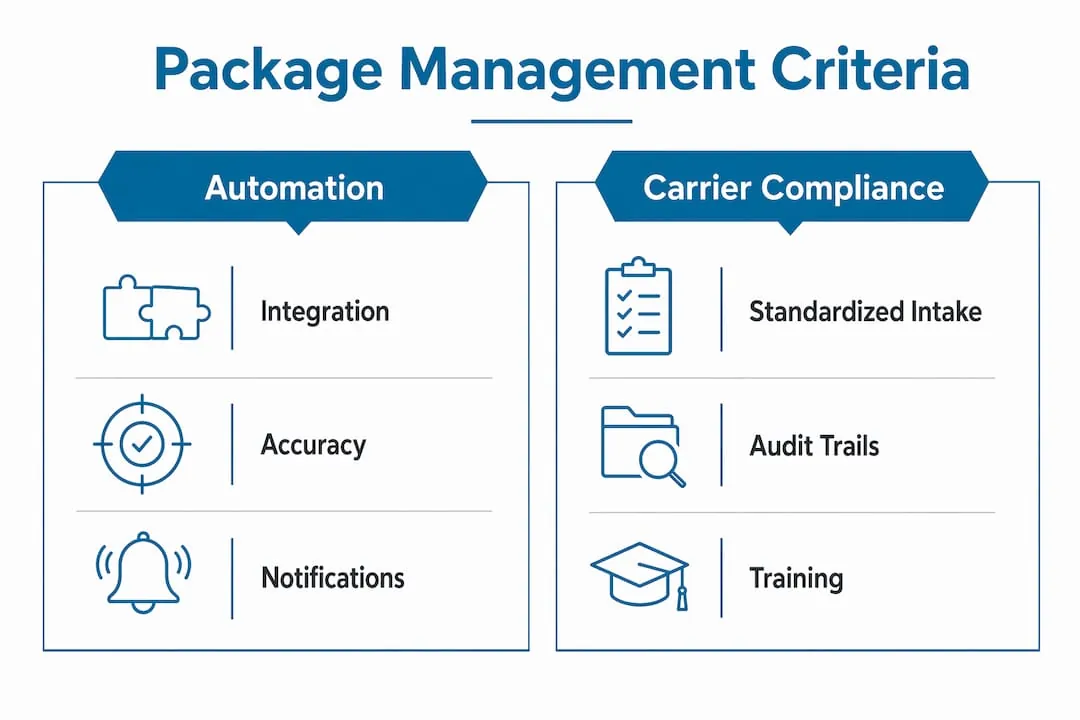
- Carrier compliance capability: 60% of property managers rank better carrier compliance as their top improvement priority. A system that cannot enforce carrier behavior at intake will underperform regardless of its hardware quality.
- Space availability: Smart package rooms require dedicated square footage. If your building lacks that space, outdoor weatherproof lockers or off-site delivery become the practical alternatives.
Carrier behavior determines intake success more than hardware does. Standardized carrier communication using pictorial SOPs, QR code access for frequent drivers, and predefined deposit workflows reduces delivery errors and non-compliance incidents. A carrier who does not know where to deposit a parcel will leave it in a hallway regardless of how sophisticated your locker system is.
Documenting your intake workflow and distributing it to every carrier servicing your property is not optional. It is the operational foundation that makes every other investment in package management pay off. You can learn more about secure parcel handling workflows that property managers use to reduce complaints and theft.
Key takeaways
Effective resident package management requires combining the right technology tier with carrier compliance enforcement and resident-centered access design.
| Point | Details |
|---|---|
| Automation cuts labor costs | Automated systems reduced package staff from 12 to 2 at a 1,000-plus-unit property. |
| Audit trails reduce liability | Digital signatures, photos, and timestamps protect staff and resolve disputes quickly. |
| Match solution to property tier | Unit count, volume, and demographics determine whether lockers, smart rooms, or off-site delivery fits best. |
| Carrier compliance is the weak link | 60% of managers cite carrier compliance as the top improvement priority in package intake. |
| 24/7 access drives renewals | Independent, round-the-clock pickup directly improves resident satisfaction and lease renewal rates. |
What we have learned from watching package management evolve
The properties that struggle most with resident packages are not the ones with bad technology. They are the ones that bought technology without fixing their carrier intake process first. We have seen properties install premium locker banks and still generate resident complaints because UPS and FedEx drivers were leaving parcels outside the locker room door. The hardware was fine. The workflow was broken.
The other pattern we see repeatedly is properties that underestimate how fast their package volume will grow. A system that handles today’s volume adequately may be overwhelmed within 18 months as e-commerce adoption continues to climb. Future-proofing means selecting a solution with expandable capacity, not just one that fits current demand.
Resident expectations are now set by Amazon Prime. That means same-day notification, frictionless pickup, and zero staff dependency. Properties that treat package management as a competitive amenity rather than a back-office function attract and retain residents more effectively. The audit trail and carrier compliance infrastructure that supports that experience also protects you legally. Those two outcomes reinforce each other, and that is the argument for investing in a well-designed system rather than patching together a manual process indefinitely.
Upgrade your property’s package handling with Luxer One
Managing resident packages at scale requires infrastructure that works without staff intervention and holds up under daily carrier traffic.
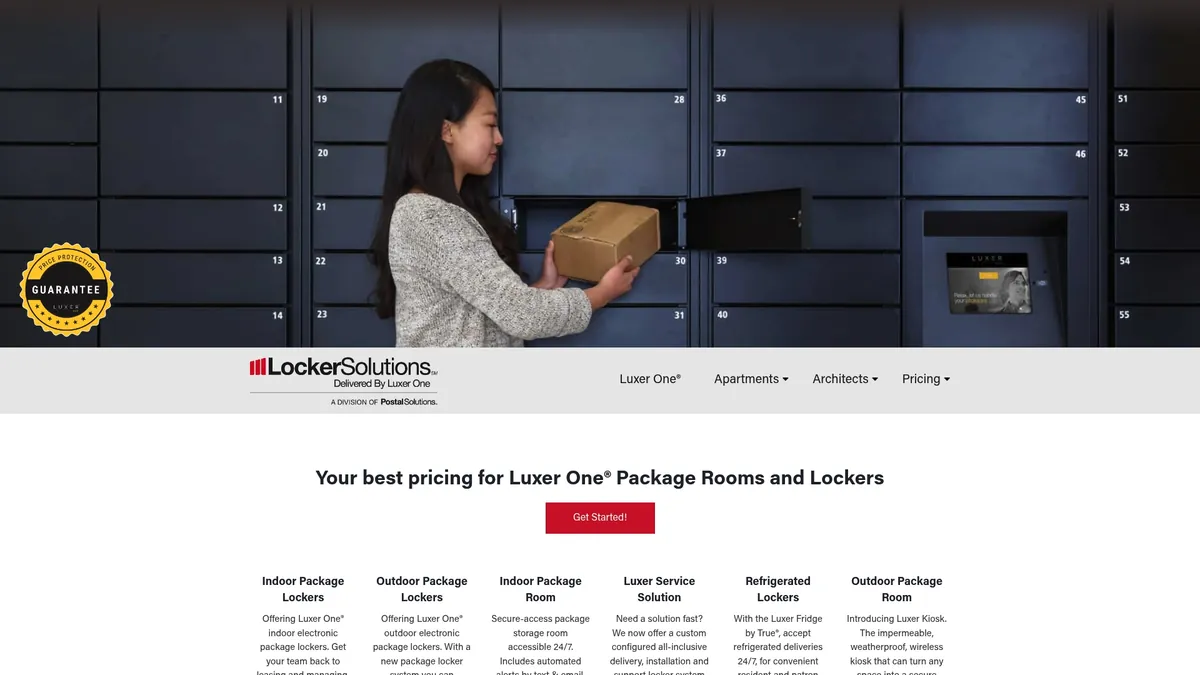
We offer the full Luxer One product line, including indoor and outdoor electronic package lockers, refrigerated units for grocery and meal kit deliveries, and automated package rooms designed for high-volume multifamily properties. Every system includes automated resident notifications, video surveillance, and a complete digital audit trail. Configurations are available for properties of all sizes, from boutique communities to large urban complexes. If you are ready to reduce staff workload and give residents the pickup experience they expect, explore the full range of Luxer One apartment solutions and request a consultation.
FAQ
What are resident packages in multifamily housing?
Resident packages are parcels delivered to tenants at multifamily residential properties, including apartments and condominiums. Managing them involves intake, secure storage, resident notification, and tracked pickup.
How do smart package rooms differ from standard lockers?
Smart package rooms use open shelving and automated access control to accommodate any parcel size, while standard lockers are limited to fixed compartment dimensions. Package rooms handle oversized items that lockers cannot accept.
Why does carrier compliance matter for package management?
Carrier compliance determines whether parcels reach the designated intake point correctly. 60% of property managers identify carrier compliance as their top improvement priority because driver errors at intake cause the majority of resident complaints.
What is the minimum audit trail a package system should provide?
A credible system must capture a barcode scan at intake, a photo of the parcel, a timestamp, and a digital signature at pickup. These records protect property staff from liability claims and resolve resident disputes without relying on memory.
How do you choose between lockers and a package room for your property?
Properties under 150 units with moderate package volume typically manage well with electronic lockers. Properties above 300 units, or those with high oversized item volume, benefit more from a smart package room or a hybrid model that combines lockers with open shelving and off-site delivery options.
Recommended
Ready for a Luxer One® package locker quote?
Tell us your unit count and we'll send right-sized pricing with a fast response time.
Get my free quote