October 6, 2026
When Outsourced Package Rooms Beat DIY for Multifamily Portfolios
A practical playbook for multifamily operators: decide when to outsource package rooms, run a 60–90 day pilot, and prioritize carrier compliance and...

Outsourcing your package room makes sense when your property lacks the floor space, staffing hours, or budget to keep pace with rising parcel volume, and prefers predictable service to building an in-house operation. If your community already has strong staffing and a compact resident base, a hybrid approach pairing lockers with light-touch on-site coverage often works just as well. Either way, the goal is the same: faster pickups and fewer complaints.
TL;DR:
- Outsourcing is most beneficial for properties with high package volume, limited space, or staffing constraints, where control and cost are key concerns.
- Hybrid models combining lockers with light-touch staffing often provide tailored solutions for varying building sizes and resident needs.
- Peak-season surges and oversized or refrigerated packages require specific handling plans, as these categories are common failure points for locker-only systems.
- Proper vendor evaluation should emphasize carrier compliance, overflow procedures, system integrations, and clear SLAs, not just cost.
- A staged pilot followed by detailed documentation allows properties to assess performance and tailor package handling strategies effectively.
Table of Contents
- What outsourced package room management actually covers
- Weighing outsourcing against an on-site package room
- Estimating cost and ROI without guesswork
- Building a vendor selection checklist for an RFP or pilot
- Handling exceptions without losing resident trust
- Why hybrid tiering often wins over an all-or-nothing choice
- How we approach deployment for managed package programs
- What portfolio teams should prioritize before signing anything
- A practical next step if you’re ready to evaluate options
- FAQ
- Sources
What outsourced package room management actually covers
Outsourced package room management is not one single service. It spans a few distinct models, and mixing up the terms leads to mismatched expectations during vendor conversations.
The broadest model is offsite third-party warehousing with last-mile re-delivery, where packages never touch the property until a courier brings them to residents’ doors. A more common model for multifamily is managed on-site sorting and staging, where a vendor’s staff visits daily (or several times a week) to log, shelve, and organize deliveries inside a dedicated room. Locker-managed programs sit in between: hardware stays on-site and automates intake and pickup, while a vendor handles software, notifications, and support remotely. Smart package room integrations combine shelving or cubbies with software that logs chain-of-custody electronically rather than relying on a staff member’s notebook.
Across these models, the recurring tasks look similar:
- Intake logging that records carrier, time, and package condition on arrival
- Labeling or re-labeling so misrouted or damaged items are easy to trace
- Resident notifications sent by text, e-mail, or app push the moment a package is scanned
- Pickup coordination, including PIN or QR-code access for self-service retrieval
- Periodic audits comparing logged packages against what residents report receiving
- Chain-of-custody documentation that protects both the property and the vendor if a package disappears
Most vendors tie these tasks into existing property management software (PMS), so a lease change or move-out automatically updates locker or room access. The strongest systems also integrate with existing access control, so the same credential that opens a resident’s building also opens the package room or locker bank. For a look at how these workflows typically connect intake, staging, and pickup in practice, see this workflow for secure parcel handling in multifamily properties.
Weighing outsourcing against an on-site package room
The decision rarely comes down to one factor. It’s a tradeoff between labor relief, control, and cost that shifts depending on property size and resident mix.
- Labor relief is the clearest benefit: outsourcing removes daily sorting and notification work from leasing staff, who are rarely hired or trained for logistics.
- Footprint removal matters for older buildings that never had a dedicated package room; offsite or locker-based models avoid the need to carve out new square footage.
- Liability transfer shifts some responsibility for lost or damaged packages to the vendor’s documented chain-of-custody process, rather than leaving the property exposed.
- Staffing consistency improves because a vendor’s trained team shows up on a schedule, instead of relying on whichever leasing agent is free that day.
- Visibility can suffer when packages leave the property for offsite re-delivery, since residents may wait longer and have less direct contact with staff if something goes wrong.
- Vendor dependency becomes a real risk if a provider’s support response times slip or if contract terms don’t clearly define overflow handling.
For properties keeping package handling in-house, the choice usually narrows to three formats: a staffed room (maximum control, highest labor cost), self-service lockers (lower ongoing labor, fixed capacity), or a smart package room (moderate labor, better scaling, but higher upfront investment). Each trades some control for lower cost or easier scaling, and the right fit depends on how much daily volume the property actually handles.
Estimating cost and ROI without guesswork
Before signing anything, build a simple model comparing what package handling costs today against what an outsourced fee structure would cost once implemented. The Harvard Business School Online framework for calculating project ROI applies well here: measure the baseline, estimate the investment, and track the return over a defined period.
Start with staff time. Multiply the hours per week a leasing team spends on package tasks, sorting, logging, answering pickup questions, by their fully loaded hourly rate (wages plus benefits). That weekly figure, annualized, is the cost outsourcing needs to beat.
- Track baseline staff hours spent on package tasks before comparing against any vendor proposal
- Compare that baseline against a vendor’s recurring fee plus any hardware or installation costs
- Factor in capex versus opex: buying lockers or a smart room is a capital expense with a multi-year payoff, while a managed service is an operating expense that avoids upfront cash outlay
- Account for peak-season overflow, since costs rise when package volume spikes beyond normal capacity
Pro Tip: Run a 12-month scenario that lines up your current labor cost month by month against projected outsourced fees plus likely overflow charges, then see which line stays flatter as volume grows.
Peak planning deserves special weight here. Vendor pricing models that charge per package or per unit can look affordable in slow months and expensive during a holiday surge, so ask any vendor how their fee structure behaves specifically during high-volume weeks, not just average ones.
Building a vendor selection checklist for an RFP or pilot
A good evaluation treats the vendor relationship like any other operations contract: documented criteria first, demos second. Insights by Blueprint’s 2026 framework for solving multifamily’s package management problem recommends matching the solution type to property profile (unit count, daily volume, available space, and resident demographics) and writing down selection criteria before requesting proposals, rather than deciding on gut feel during a sales call.
Use a questionnaire that covers:
- How the vendor trains carriers and drivers on property-specific delivery procedures
- What happens procedurally when a single-day delivery exceeds normal capacity
- Whether overflow packages are staged on-site, held offsite, or re-delivered later
- Which PMS, notification, and access control systems the vendor already integrates with
- How staff and resident training is handled during rollout
- What maintenance response times and service-level agreements (SLAs) look like in writing
- How incidents, like a missing or damaged package, get reported, tracked, and resolved
A pilot period works better than committing a whole portfolio at once. A reasonable sequence looks like this:
- Site survey: the vendor assesses available space, resident volume patterns, and existing carrier habits.
- Pilot period: a single property or building runs the service for 60 to 90 days while both sides track performance.
- Carrier onboarding: drivers receive instructions, access credentials, and any required training before go-live.
- SOP roll-out: standard operating procedures for exceptions, overflow, and disputes are documented and shared with on-site staff.
- KPI baseline and pilot review: compare pickup speed, incident counts, and resident complaints before and after, then decide whether to expand.
When drafting the contract itself, request specifics rather than general assurances: response windows for support tickets, maintenance SLAs in hours or days, an audit reporting cadence (weekly or monthly), and clear liability and insurance terms covering lost or damaged packages. A facilities-management case study on outsourced evaluation criteria illustrates how documented selection criteria and pilot structures apply well beyond package handling, into other outsourced property services.
Handling exceptions without losing resident trust
Every package program eventually runs into the items that don’t fit the standard workflow, and how those get handled determines whether residents trust the system.
- Oversized items that don’t fit lockers or standard shelving need a staging area and either scheduled hand-delivery or a process for carrier redelivery
- Refrigerated or perishable packages require either a dedicated refrigerated locker bank or a vendor policy for rapid hand-off before spoilage
- Missing or misdelivered items need a documented chain-of-custody trail so disputes can be resolved by checking logs rather than guesswork
- Carrier non-compliance, drivers skipping scan steps or bypassing access procedures, needs regular audits, clear driver instructions, and enforced PIN or QR access rather than a one-time training session
NMHC’s package delivery report found that oversized and refrigerated packages remain among the most common failure points for locker-only deployments, which is why any outsourced or hybrid program needs a specific plan for these categories rather than treating them as rare exceptions. Properties that skip this step tend to see complaints cluster around exactly these edge cases. For more on how security measures factor into exception handling, see this overview of package security for multifamily properties.
Why hybrid tiering often wins over an all-or-nothing choice

Few operators pick a single method and stick with it across an entire portfolio. Insights by Blueprint’s 2026 survey found that 70% of operators use a mix of smart lockers and managed rooms, averaging 2.4 intake methods per property, because volume, building layout, and resident demographics vary even within one portfolio.
A few rules of thumb help with tiering decisions:
- Smaller properties with light package volume often do fine with lockers alone, avoiding the cost of a managed service
- Mid-size properties with moderate volume and some spare square footage benefit most from a smart package room
- Larger properties or those with high daily volume tend to need managed on-site service, or a hybrid combining lockers for routine pickups with staffed support during peak weeks
- Properties lacking any dedicated space can start with offsite re-delivery while planning a permanent locker or room installation
Running a short pilot on one or two buildings before rolling a tier structure across a whole portfolio keeps the decision grounded in actual pickup data rather than assumptions.
How we approach deployment for managed package programs
We build managed package programs around the same checklist operators should expect from any vendor: a site survey, configuration suited to the property’s layout, carrier onboarding, staff training, and ongoing maintenance support. Our offerings include indoor and outdoor electronic lockers, refrigerated lockers for perishable deliveries, smart package room configurations, and unified credentialing across packages and building entry.
Our deployment sequence typically follows:
- A site visit to map available space, delivery patterns, and existing access control
- Hardware and software configuration matched to the building’s unit count and resident mix
- Carrier onboarding so drivers understand scan procedures and access points before go-live
- Staff and resident training covering pickup, notifications, and exception handling
- Ongoing maintenance support delivered by local teams rather than a remote call center
This structure reflects the same principles covered above: documented criteria, a defined rollout sequence, and a clear plan for exceptions rather than hoping they don’t happen. For a step-by-step look at how locker systems function once installed, see this guide on how parcel lockers work.
What portfolio teams should prioritize before signing anything
The biggest mistake in this decision isn’t picking the wrong vendor. It’s skipping the documentation step and deciding based on a sales pitch instead of a checklist. Write down your selection criteria before any vendor call, and weight carrier compliance and peak-capacity planning as heavily as price, because those two factors cause more service failures than any other variable.
Treat package handling as an amenity-linked metric tied to resident satisfaction and renewal decisions, not just a back-office chore. A property that gets pickup wrong during a holiday surge loses goodwill that a leasing team can’t easily win back. For multi-site owners, build a regional playbook with consistent SOPs and a reporting cadence, so one property’s exception-handling mistakes don’t repeat across the portfolio.
— Locker Solutions
A practical next step if you’re ready to evaluate options
If your property is outgrowing a card table in the leasing office or a locker bank that fills up by Wednesday, we offer a direct path that doesn’t require betting your whole budget on an unproven system. Our On-site Package Management service puts trained staff in your building on a schedule, handling intake, staging, notifications, and audits without you hiring or training anyone new.
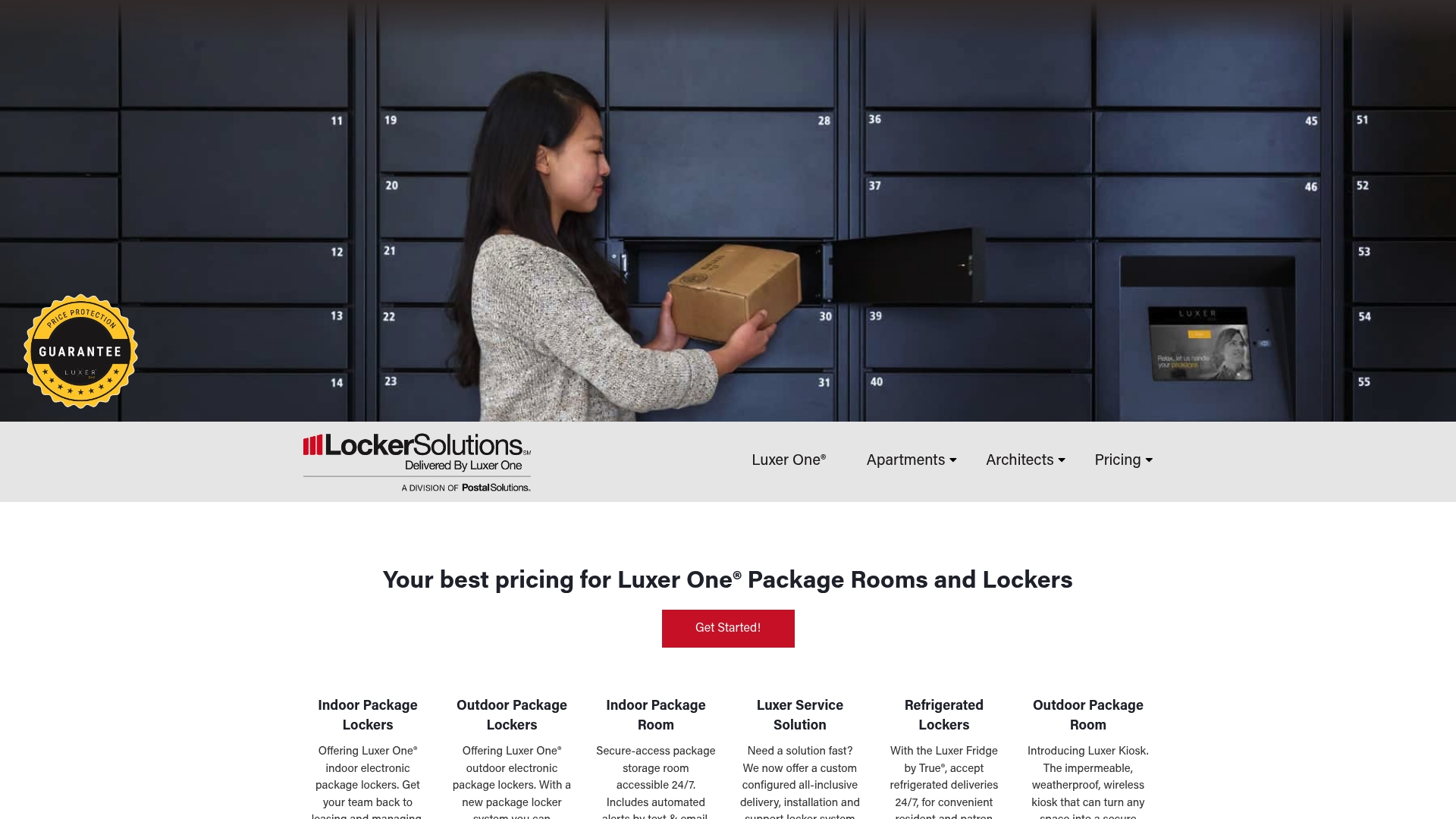
We also carry the hardware side for teams that want to combine options: indoor and outdoor parcel lockers, refrigerated lockers for perishables, Smart Package Room setups, and Luxer Access for unified building and package credentials. Every deployment starts with a site survey, so you know exactly what fits your layout before committing to anything.
- On-site Package Management: daily staffing for intake, staging, notifications, and audits
- Indoor and outdoor lockers: self-service pickup with PIN or QR access
- Refrigerated lockers: dedicated cold storage for perishable deliveries
- Unified credential system for building entry and package pickup
- Installation and maintenance support after go-live
Request a site survey to get a tailored assessment of what your property actually needs.
FAQ
What does outsourced package room management typically include?
It usually covers daily or scheduled intake logging, resident notifications, package staging, pickup coordination, and periodic audits, handled by a vendor’s trained staff rather than leasing office employees. Depending on the model, it may also include locker hardware, software integrations with your property management system, and chain-of-custody documentation for disputes.
Is outsourcing cheaper than running an in-house package room?
It depends on your current staff hours and package volume: outsourcing tends to save money when staff time spent on packages is high relative to rent-paying duties, while an on-site locker system can be cheaper for smaller properties with lighter volume. The only reliable way to know is to compare your current fully loaded labor cost against a vendor’s fee structure over a full year, including peak-season overflow.
How common is it for properties to use more than one package handling method?
Very common: a 2026 operator survey found that 70% of operators use a mix of smart lockers and managed rooms, averaging 2.4 intake methods across their properties. Mixing methods lets operators match the format to each building’s volume, space, and resident mix instead of forcing one solution portfolio-wide.
What should a vendor selection checklist include?
At minimum, ask how the vendor handles carrier compliance, peak-capacity surges, and overflow packages, along with what systems they integrate with and what maintenance SLAs they commit to in writing. Request documented audit reporting cadence and liability or insurance terms before signing, rather than relying on verbal assurances during a sales call.
How should properties handle oversized or refrigerated packages?
Oversized items generally need a staging area for scheduled hand-delivery or carrier redelivery, since they rarely fit standard lockers. Refrigerated or perishable packages need either dedicated refrigerated lockers or a vendor policy for fast hand-off, since NMHC’s package delivery report identifies these categories as common failure points for locker-only setups.
Sources
- A framework for solving multifamily’s package management problem
- NMHC | Package Delivery Survey
- How to calculate ROI for a project
Recommended
Ready for a Luxer One® package locker quote?
Tell us your unit count and we'll send right-sized pricing with a fast response time.
Get my free quote