September 29, 2026
Avoid Costly Rework: Condo Package Lockers for Property Managers
Procurement-focused guide for property managers choosing condo package lockers: sizing (including the 1:5 guideline), Division 10 rough-ins, ROI math, and...

For most condominium properties, a smart parcel locker bank, or a mixed locker plus package room approach for smaller properties, is the fastest way to recover staff time, cut parcel theft, and improve resident satisfaction. The right choice depends on sizing, placement, and how early you coordinate installation with your construction or renovation timeline. Get any of those three wrong and even a well-built system underperforms.
TL;DR:
- Proper sizing based on delivery throughput and peak season volume is crucial; underestimating needs can lead to costly retrofits and capacity issues.
- Integration with existing access control systems and clear carrier interface procedures are essential to maintain smooth delivery operations and resident convenience.
- Costs vary widely depending on locker capacity, climate rating, and features, with vendor quotes broken into hardware, software, and installation for accurate ROI calculation.
- Placement near high-traffic areas and careful planning for outdoor or indoor installation can reduce resident walking distance and protect lockers from environmental damage.
- Establishing clear policies for hold times, overflow handling, and carrier onboarding before launch ensures efficient operation during peak delivery periods.
Table of Contents
- How condo package locker systems work: carrier workflow and system components
- Operational benefits and measurable outcomes for property teams
- Costs and subscription models: hard numbers and how to build ROI
- Sizing and placement: getting the ratio and location right
- Technical and accessibility specs to require in RFPs
- Installation and pre-construction checklist: coordinating the build
- Operations, policies, and overflow strategies for peak periods
- Locker Solutions as a deployment partner: what to expect and what to request
- Locker Solutions’ perspective: lessons learned and common installation pitfalls
- How to get started with Locker Solutions
- Sources
- FAQ
How condo package locker systems work: carrier workflow and system components
A smart locker system starts the moment a carrier walks in the door. The driver scans the package barcode at the locker’s kiosk or hands it to on-site staff who scan it into the management software. The system then assigns an open, appropriately sized compartment and prints or displays a label with the assigned locker number, so the carrier never needs a code or key to complete the drop.
Once a package lands in a compartment, the resident gets a notification. Most systems send a text, an app push alert, or an email within seconds. The resident then retrieves the package using one of several access methods: a unique numeric code, a QR code scanned from their phone, or a credential tied to their existing building access card. Systems built on unified credentialing let residents use the same fob or app for their front door and their locker, which cuts down on the number of codes people have to remember.
Behind the scenes, several components work together:
- Locker hardware: the physical compartments, sized in tiers from small parcels to oversized bins, sometimes with refrigerated units for grocery deliveries.
- Management software (SaaS): the cloud platform that tracks occupancy, sends notifications, and logs every open and close event.
- Carrier interface: the touchscreen or scanning terminal that lets USPS, UPS, FedEx, and Amazon drivers assign packages without staff help.
- Resident app: the mobile tool residents use to view pending packages, get directions to their locker, and release the door remotely in some configurations.
- Property management system (PMS) integrations: links to leasing and accounting software so package activity ties back to a unit and resident record.
Integration matters more than most property teams expect going in. A locker system that plugs into your existing access control setup avoids the awkwardness of residents juggling a building fob, a locker code, and a separate visitor system. When you’re evaluating vendors, ask specifically how their carrier interface handles multiple carriers at once during a delivery surge, since that’s where cheaper systems tend to bottleneck.
Operational benefits and measurable outcomes for property teams
The business case for lockers rests on three things: staff time, security, and resident experience. Each one is measurable, and property teams that skip the measurement step tend to undersell the investment when it’s time to renew or expand.
Staff-time recovery is the easiest place to start. Before lockers, front-desk or maintenance staff typically log every incoming package by hand, store it, track down the resident, and hand it over at pickup, often multiple times a day during peak shopping periods. Smart package lockers reduce that daily handling burden by letting the carrier assign the locker directly, which frees staff hours that can be redirected to leasing tours, maintenance requests, or resident retention work.
Chain-of-custody logging is where lockers earn their security value. Every locker system timestamps who dropped a package and who picked it up, which means a “package never arrived” dispute has a digital trail instead of a staff member’s memory. Industry reporting ties this logging directly to reduced porch piracy and to fewer disputed lost-package claims against the property.
Key measurable outcomes to track once a system goes live:
- Pickup speed: how quickly residents retrieve packages after notification, which affects locker turnover and sizing needs.
- Notification reliability: whether alerts land within seconds consistently across carriers.
- Staff hours reallocated: the actual time no longer spent logging and storing packages by hand.
- Carrier friction reduction: fewer delivery delays caused by carriers unable to reach a resident or find secure drop space.
Smart package lockers reduce staff package-handling time and lower porch piracy incidents, according to industry coverage of multifamily locker deployments, a combination that matters most for properties handling high delivery volumes during holiday and back-to-school surges.
Carriers benefit too. A locker bank with a dedicated carrier interface means drivers don’t wait for a leasing office to open or a staff member to sign for a package, which speeds up the entire route and reduces missed-delivery attempts that otherwise become resident complaints.
Costs and subscription models: hard numbers and how to build ROI
Locker pricing varies by capacity, finish, and whether the unit is rated for outdoor exposure, so any number you get from a vendor should be treated as a starting point for negotiation, not a fixed catalog price. Property teams should ask vendors for a written quote broken into hardware, software, and installation rather than one bundled figure, since that breakdown is what makes proposals comparable across vendors.
The main cost components to expect in a proposal:
- Hardware: driven by the number of compartments, compartment size mix, and whether units need a weatherproof outdoor rating or refrigerated compartments for grocery deliveries.
- SaaS subscription: an ongoing fee that covers software updates, carrier interface maintenance, notification delivery, and usually customer support.
- Installation and electrical work: labor for mounting, running power and data lines, and any structural blocking required behind the locker face.
- Site prep differences: outdoor kiosks generally need weatherproofing, a concrete pad, and conduit runs, all of which add cost that indoor installs in an existing mailroom skip.
Financing structures also vary. Some vendors offer full financing so a property spreads hardware cost over a service term instead of paying it up front, which matters for properties managing capital budgets tightly year to year.
Building a simple ROI case doesn’t require complex modeling. Take staff hours currently spent per week on package handling, multiply by an hourly labor cost, and compare that recovered time against the subscription fee. Add in the reduced cost of resolving lost-package disputes, since package rooms and lockers both cut into the staff time spent chasing missing deliveries compared with unmanaged front-desk drop-off. For properties in competitive leasing markets, factor in retention value too: a locker amenity that shows up in the leasing tour is a small but real differentiator during renewal conversations.
Package rooms, as an alternative, generally carry a lower upfront infrastructure cost than a fixed locker bank because shelving is more flexible to install and reconfigure than dedicated compartments. That flexibility comes at the cost of individual accountability per package, which is why many mid-size properties land on a mixed model: a locker bank for daily logged pickups and a package room for overflow during surges.
Sizing and placement: getting the ratio and location right
Under-sizing is the single most common mistake property teams make with lockers, and it usually traces back to sizing based on door count instead of actual delivery throughput. A 150-unit building with a young professional demographic ordering online daily needs a very different locker count than a 150-unit building with a lower delivery volume, even though the door count is identical.
- Start with a vendor sizing calculator, but treat the output as a baseline, not a final number: confirm it against your property’s actual delivery volume and resident order habits.
- Apply throughput-based sizing rather than a flat ratio tied only to unit count, since delivery volume varies by resident demographic and season.
- Use the 1:5 parcel-locker guideline as a starting reference: industry guidance recommends one parcel locker compartment for every five tenant mailbox compartments as a baseline, an update from the older 1:10 standard that no longer reflects today’s delivery volumes.
- Confirm the final count with your local postmaster before locking in an order, since USPS 4C mailbox and parcel locker approvals run through the postmaster’s office and a mismatch here can delay mail service at move-in.
- Reassess after the first peak season: holiday-quarter volume often exposes undersizing that normal-month volume hides.
Placement decisions matter almost as much as the count. High-foot-traffic areas near the main entrance or elevator bank reduce the distance residents walk to retrieve packages, while proximity to a carrier-accessible entrance reduces delivery friction. Indoor installations skip weatherproofing costs and tend to feel more secure to residents, but outdoor kiosks let carriers drop packages after hours without needing a fob or staff escort, which matters for properties without 24-hour lobby access.
Lighting and camera coverage around the locker bank are not optional extras. A well-lit, well-monitored locker area deters the kind of tailgating and loitering that undermines the security benefit lockers are supposed to provide in the first place.

Pro Tip: Order your locker sizing study before finalizing floor plans, not after, since moving a planned locker location later in construction is far more expensive than adjusting it on paper.
When should you choose lockers over a package room, or a mix of both? Properties with high delivery volume and enough lobby or mailroom space for a dedicated bank do best with a full locker system. Smaller properties, or those with constrained common-area square footage, often do better with a package room that can flex its shelving as volume grows, and mid-size properties frequently land on a hybrid of both.
Technical and accessibility specs to require in RFPs
Before you sign a locker contract, your RFP should require specific technical documentation, not just a product brochure. Vendors that can’t produce these documents on request are usually not ready for a multifamily-scale install.
- Compartment depth verification: confirm the vendor’s rough-in drawings against the actual unit dimensions, since many locker banks require 15 to 19 inches of recessed depth plus structural blocking behind the mounting face for loaded banks.
- Power and data requirements: request the exact amperage, outlet count, and network drop specifications, along with cellular fallback options for locations where a hardwired network connection isn’t practical.
- Weatherproofing rating for outdoor kiosks: outdoor units need a documented weather rating covering temperature range, moisture exposure, and, in colder climates, cold-weather performance for the touchscreen and locking mechanisms. Details on outdoor-rated hardware are available on outdoor parcel kiosk specifications.
- ADA compliance documentation: locker installations must provide accessible compartments, clear floor space, and operable parts within reach ranges specified by the 2010 ADA Standards for Accessible Design, covering Sections 803 and 811 for storage and operable-part height.
- Refrigerated compartment specs: if your resident demographic relies heavily on grocery delivery, request refrigerated compartment temperature range, compressor noise ratings, and cleaning protocols, since refrigerated lockers are an emerging feature aimed at that specific use case.
Documenting ADA compliance requests in writing protects the property during inspection and gives your architect a clear reference point when finalizing common-area layouts. Ask the vendor to confirm which specific compartments meet accessible reach-range requirements rather than assuming the whole bank qualifies.
Installation and pre-construction checklist: coordinating the build
Locker installation problems almost always trace back to decisions made, or skipped, before framing ever starts. Treating locker rough-ins as a Division 10 deliverable, the same category as fire extinguisher cabinets and other specialty equipment, keeps the project on schedule.
- Request rough-in drawings and blocking plans from the vendor before framing begins, confirming mounting depth, weight load, and required structural blocking behind the wall.
- Confirm electrical drops and network runs at the same time as the rough-in review, since retrofitting power to a locker location after drywall is far more expensive than running it during framing.
- Start USPS 4C mailbox approval early: postmaster sign-off for 4C mailbox installations typically takes four to six weeks, and delays here can push back your entire mail service start date.
- Schedule vendor installation and commissioning to align with your occupancy date, building in buffer time for punch-list corrections before residents move in.
- Coordinate fire and life-safety clearances, including Knox box access where required and minimum aisle clearance around the locker bank, along with camera placement for the security coverage discussed earlier.
Treating locker and mailbox rough-ins as gating items on the construction schedule rather than an afterthought avoids the two most expensive outcomes: a delayed occupancy permit or a locker bank that has to be re-framed after the fact.
Pro Tip: Call your local postmaster before you finalize your mailbox and locker layout, since some post offices have location-specific requirements that generic vendor drawings don’t account for.
Operations, policies, and overflow strategies for peak periods
A locker system needs written operating policies before launch, not after the first holiday surge exposes gaps. Carrier onboarding is the first piece: give drivers clear signage and, where possible, a brief orientation on how the kiosk assigns compartments, since confused carriers slow down the entire drop-off process for everyone behind them.
Set policies on:
- Hold time limits: how many days a package sits in a locker before staff intervene, typically enforced through automated reminder notifications to residents.
- Oversized-item workflow: where packages too large for any compartment go, usually a staffed package room or a designated overflow shelf.
- Refrigerated-item pickup rules: shorter hold windows for grocery deliveries to avoid spoilage, with automated alerts sent sooner than for standard packages.
- Overflow procedures during surges: a documented plan for redirecting excess volume to a package room when the locker bank hits capacity during holiday weeks.
Track a small set of KPIs monthly rather than trying to monitor everything: average hold time before pickup, the percentage of residents picking up within the policy window, and locker occupancy rate during peak days. These three numbers tell you quickly whether your sizing decision was correct or whether you need to add capacity before the next surge.
Locker Solutions as a deployment partner: what to expect and what to request
Locker Solutions supports multifamily properties with indoor and outdoor parcel lockers, refrigerated compartments, smart package rooms, Luxer Access unified credentialing, white-glove installation, and ongoing on-site package management for properties that prefer a fully staffed solution.
Whatever vendor you evaluate, including Locker Solutions, request the same set of deliverables before signing:
- A sizing study based on your property’s unit count, resident demographic, and expected delivery volume, not a generic ratio.
- Rough-in drawings and blocking plans specific to the exact locker model being proposed.
- A written service-level agreement covering maintenance response times and software uptime.
- A maintenance agreement detailing what’s covered, what’s billable, and how quickly a broken compartment gets serviced.
Ask any prospective vendor to back up deployment-speed and financing claims in writing as part of the proposal, and request customer references specific to properties similar in size and delivery volume to yours. A proposal that can’t produce these documents on request is a proposal worth questioning.
Locker Solutions’ perspective: lessons learned and common installation pitfalls
The most common failure we see is not a bad locker choice. It’s late coordination. Properties that bring locker sizing into the conversation after floor plans are finalized end up retrofitting power, blocking, and mounting depth into spaces that were never designed for it, and that always costs more than doing it right the first time.
The second most common mistake is treating the 4C mailbox approval as a formality instead of a scheduling item. Postmaster sign-off takes real time, and it should start the same week as your locker rough-in review, not after.
Our practical advice: size for throughput, not door count, and reassess after your first peak season rather than assuming your initial estimate was right. For most properties, starting with a smaller pilot bank plus package-room overflow is more forgiving than committing to a large fixed installation before you’ve seen real delivery volume.
— Locker Solutions
How to get started with Locker Solutions
Getting a locker system right starts with an accurate sizing study, not a product catalog. Vendors may work with property teams on indoor and outdoor parcel lockers, refrigerated compartments, smart package rooms, unified access credentialing, and white-glove installation, backed by local support once the system is live.
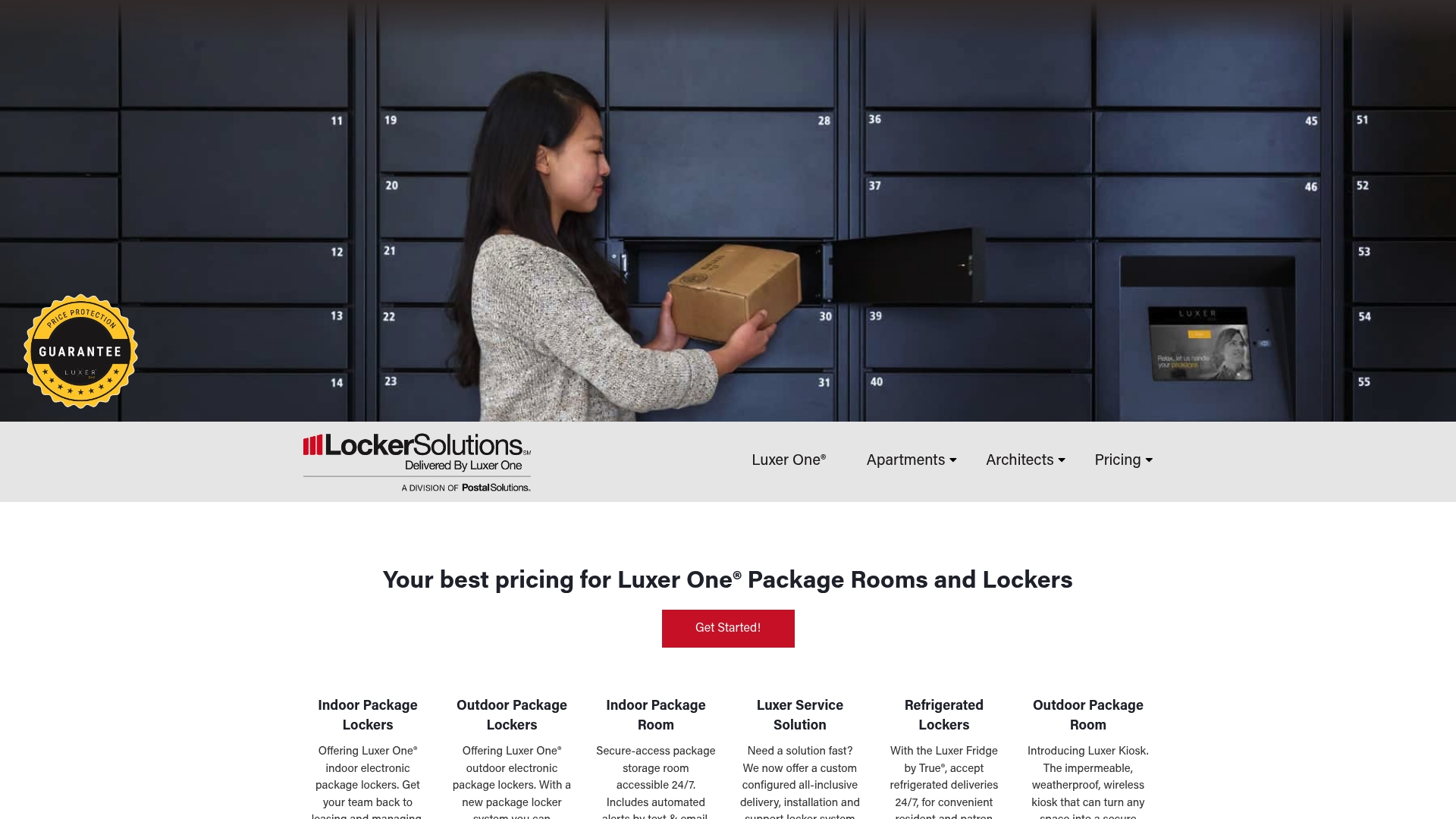
If you’re planning a new install or replacing an aging mailroom setup, here’s where to start:
- Request a sizing study based on your actual unit count and expected delivery volume rather than a generic ratio.
- Ask for rough-in drawings early enough to fold into your architect’s construction documents.
- Request a draft service-level agreement alongside any hardware quote, so maintenance response times are clear before you sign.
Start with the Locker Solutions product lineup to see the current range of indoor, outdoor, and refrigerated locker configurations available for your property.
Sources
For further reading, USPS 4C mailbox and parcel locker sizing guidance covers the current 1:5 ratio and postmaster approval process in detail. The 2010 ADA Standards for Accessible Design outline accessible compartment and operable-part requirements. Broader industry coverage of locker amenity trends and package-room cost tradeoffs rounds out the operational picture. For layered security context in shared residential spaces, see this condo security overview.
- Package Lockers Have Become a Real Amenity in Multi-Family. Here’s What to Know.
- Package Room Requirements for Multifamily: 4C Mailbox Specs and Package Room Buildout | Innergy Interiors
- What Package Wrangling Is Really Costing Your Team - Multifamily & Affordable Housing Business
FAQ
How do package lockers work at apartments?
A carrier scans the package at a kiosk, the system assigns an open compartment, and the resident gets a notification with a code or app link to retrieve it. Access typically uses a numeric code, a QR code, or a credential tied to the resident’s existing building access.
What is the best package lock box for apartments?
There is no single best system, since the right choice depends on delivery volume, available space, and climate. High-volume properties typically do best with a dedicated smart locker bank, while smaller or space-constrained properties often do better with a flexible package room or a mixed configuration.
How much does a parcel locker system cost?
Cost depends on locker capacity, indoor versus outdoor rating, and whether refrigerated compartments are included, and pricing is best obtained through a vendor quote broken into hardware, subscription, and installation. Locker Solutions provides pricing on request through a sizing consultation rather than a flat published rate, since every property’s configuration differs.
How long will a package stay in a locker?
Hold time depends on the property’s own policy, though most properties set automated reminder notifications well before any escalation to staff. Refrigerated compartments generally use shorter hold windows than standard compartments to avoid spoilage of grocery deliveries.
Recommended
Ready for a Luxer One® package locker quote?
Tell us your unit count and we'll send right-sized pricing with a fast response time.
Get my free quote