June 22, 2026
Package Room Setup Guide for Multifamily Properties
Discover how a package room enhances delivery efficiency in multifamily properties. Learn to set up a secure space for seamless package management.
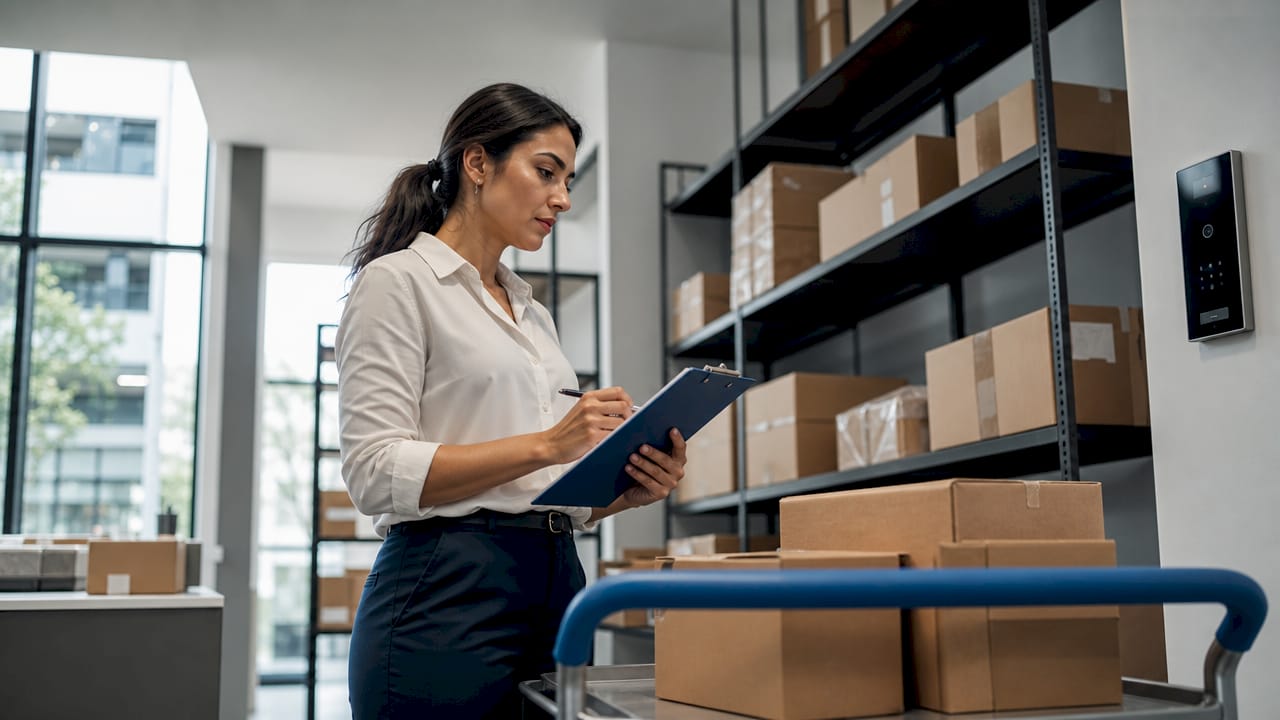
A package room is a dedicated, access-controlled shared space in a multifamily property where delivery carriers drop off packages and residents pick them up on their own schedule. Unlike a basic mailroom or a set of parcel lockers, a package room functions as a centralized secure package storage area that can handle any package size, from a small envelope to a large appliance box. The industry also refers to this space as a parcel room or package delivery area. For property managers dealing with rising delivery volumes and resident complaints about lost packages, a well-configured package room solves the problem at a fraction of the cost of a full locker bank.
What is a package room and how does it work?
A package room is a locked, shared room assigned exclusively to package intake and pickup. Carriers enter using a one-time or time-limited credential, drop packages on labeled shelves or designated floor zones, and leave. Residents receive an automated notification and retrieve their packages using their own access credential. No staff member needs to sign for deliveries or sort packages manually.
The key differentiator between a package room and a basic mailroom is access control. A mailroom typically handles mail and small parcels with staff involvement. A package room operates around the clock with no staff required, using technology to manage entry and accountability. Package rooms also differ from lockers in one critical way: there are no fixed compartment sizes. A resident receiving a flat-screen TV and a resident receiving a shoebox both use the same space.
This format makes package rooms especially practical for properties with high delivery volumes, limited budgets, or frequent oversized shipments. The package room setup guide from Locker Solutions outlines how these spaces fit into a broader multifamily package management strategy.
How does package room access control work?
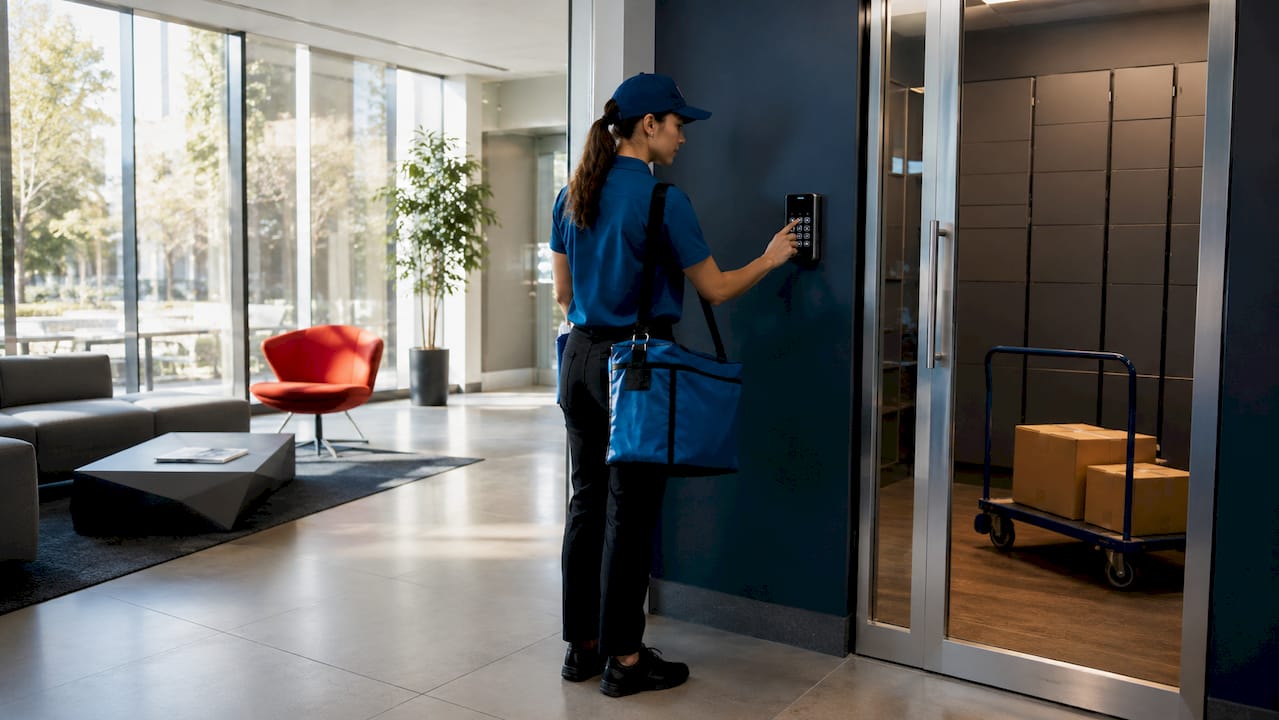
Access control is the single most important component of a functional package room. Modern package rooms use methods like key fobs, mobile apps, PIN codes via intercom, and face recognition rather than shared physical keys or static PINs. Each method has different security implications.
A shared physical key or static PIN is the weakest option. A shared key approach provides no audit trail, no per-user revocation, and no visibility into who entered the room or when. For any meaningful package volume or theft concern, this setup is inadequate.
The strongest setups use time-limited, expiring PIN codes or mobile credentials for carrier access. Time-limited PIN codes allow precise scheduling and full auditability for every delivery. When a UPS or FedEx driver uses a one-time code, the system logs the entry timestamp, the credential used, and the duration of access. That data is available to property managers in real time.
Package room security improves further when access control is combined with visitor management, event logging, and monitoring. The goal is not just to keep unauthorized people out. The goal is to know exactly who entered, when, and for how long.
Key access control methods and their tradeoffs:
- Key fob: Simple to deploy, but fobs can be lost or copied. Revocation requires physical collection.
- Mobile app credential: High security, easy revocation, and full audit trail. Requires residents to download an app.
- PIN via intercom: Convenient for carriers. Use expiring, single-use codes rather than static ones.
- Face recognition: Highest security and frictionless for residents. Higher hardware cost and setup complexity.
- Shared physical key: No audit trail, no revocation capability. Not recommended for package rooms handling significant volume.
Pro Tip: Issue carriers a unique, expiring PIN for each delivery window rather than a standing code. This limits exposure if a code is shared or written down, and it creates a clean log of every carrier entry.
Package room vs. package lockers: which is right for your property?
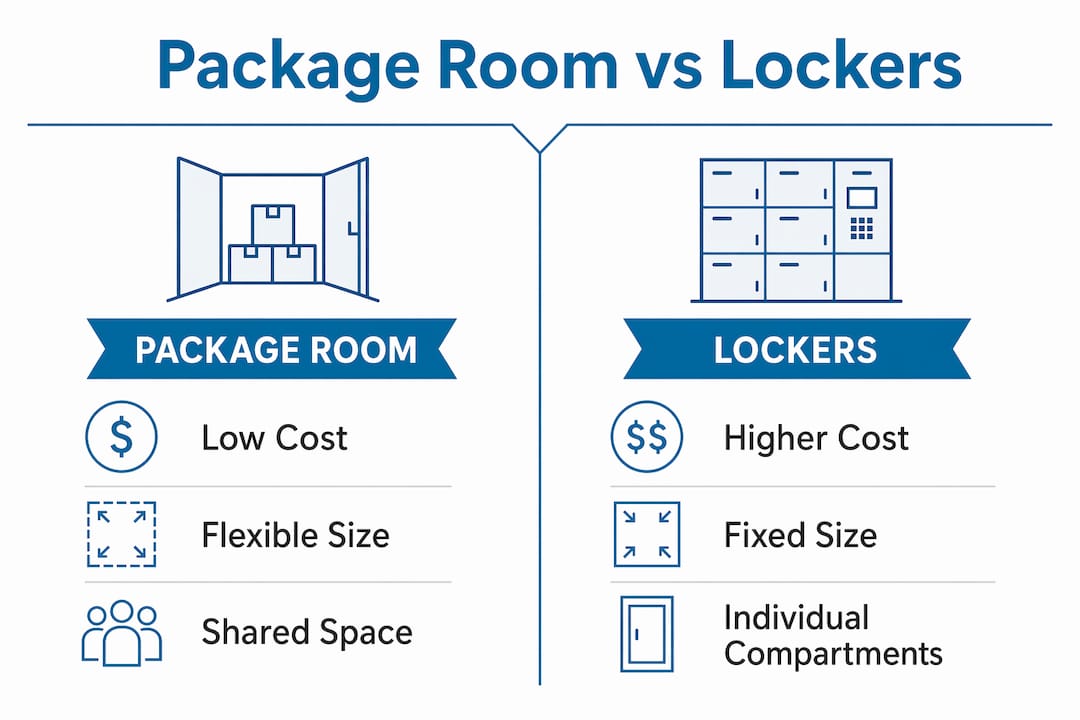
The cost difference between these two solutions is significant. Package room installation costs $1,500–$3,000, while package locker systems cost $6,900–$20,000. That gap matters for developers working within tight construction budgets or retrofitting older buildings.
The tradeoff is accountability. Lockers assign each package to a specific compartment, creating automatic per-package tracking. A package room stores everything in a shared space, which means organization and policy enforcement fall on the property team. Without clear shelf labeling, a zone system, and resident communication, a package room can become chaotic quickly.
Size flexibility is where package rooms win decisively. Package rooms handle packages of any size, while lockers are constrained by compartment dimensions. A property with residents who regularly receive furniture, sports equipment, or bulk grocery deliveries will hit locker capacity limits fast.
| Feature | Package room | Package lockers |
|---|---|---|
| Installation cost | $1,500–$3,000 | $6,900–$20,000 |
| Package size flexibility | Any size | Limited by compartment |
| Per-package accountability | Requires policy and organization | Built in by design |
| Staff involvement | Minimal with good access control | Minimal |
| Overflow handling | Native to the format | Requires overflow room or policy |
| Best fit | High volume, oversized packages, budget-conscious | Properties needing automated accountability |
Hybrid setups are worth considering for larger properties. A package room handles oversized items and overflow, while a locker bank manages standard parcels with automated tracking. Smart package rooms using AI and computer vision can triple spatial efficiency compared to lockers alone by placing packages adjacently regardless of size. That efficiency gain requires strict carrier adherence to intake workflows, which is a real operational challenge.
Pro Tip: Match your solution to your property profile. A 50-unit building with moderate delivery volume does not need a $15,000 locker bank. A 300-unit high-rise with daily bulk deliveries needs more than a single room with a key fob.
Operational best practices for managing package rooms
A well-designed room fails without clear policies. The following steps form the foundation of an effective package room operation:
-
Define carrier intake requirements. Specify exactly where carriers must place packages, how they access the room, and what happens if they bypass the intake process. Carrier non-compliance is one of the most common failure modes in package room operations. Drivers who leave packages outside the room or skip the check-in process undermine the entire system.
-
Set a clear hold policy. Stanford Mail and Package Services holds packages on shelves for 10 days and in lockers for 7 days, then moves unclaimed packages to shelves for 3 more days before returning them to the sender. Perishable packages are disposed of after 3 days if unclaimed. Adopt a similar tiered policy for your property and communicate it clearly to residents at move-in.
-
Organize the space with zones and signage. Divide the room into labeled sections by unit number range or alphabetically by resident last name. Use floor tape, shelf labels, and wall signage. A resident should be able to find their package in under 60 seconds without asking anyone for help.
-
Automate resident notifications. Send an alert the moment a package is logged in the room. Include the package location if your system supports it. Residents who know their package is waiting pick it up faster, which reduces dwell time and prevents overflow.
-
Handle perishables separately. Refrigerated deliveries need a dedicated cold storage area or a refrigerated locker. A standard package room cannot safely hold grocery or meal kit deliveries for more than a few hours without temperature control.
-
Audit the room regularly. Review entry logs weekly. Flag packages that have exceeded your hold policy. Contact residents directly before returning packages to sender. A short follow-up message reduces disputes and improves resident satisfaction.
-
Plan for overflow. Even a well-run package room fills up during peak delivery periods like the winter holidays. Designate a secondary overflow area in advance, and update your access control system to include it. Residents and carriers need to know where to go when the primary room is full.
Design considerations for an efficient package room
Physical layout determines how well the room functions under real delivery conditions. The right design reduces confusion for carriers, speeds up resident pickup, and minimizes the chance of packages being misplaced.
Key design principles for property managers and developers:
- Size the room to your unit count. A general rule is to allocate one to two cubic feet of shelf space per unit. A 200-unit property needs meaningful shelf depth and floor space to avoid constant overflow.
- Use adjustable shelving. Fixed shelves cannot accommodate the range of package sizes residents receive. Adjustable wire shelving units allow reconfiguration as delivery patterns change.
- Place the room near the building entrance. Carriers need quick, direct access. Residents need a convenient pickup location. A room near the lobby or parking entrance serves both groups better than a basement storage area.
- Integrate access control hardware at the door. The access control reader, camera, and intercom should be installed at the entry point, not inside the room. This ensures every entry is logged before anyone crosses the threshold.
- Add interior lighting and a camera. Good lighting reduces errors. An interior camera creates a visual record of every package interaction, which is useful for resolving theft or damage disputes.
- Label everything. Use large, clear shelf labels visible from the doorway. Color-code zones by unit number range. Reduce the time any person spends inside the room.
For detailed layout guidance, Locker Solutions publishes a resource on designing efficient package rooms for multifamily properties that covers shelf configurations, traffic flow, and technology integration.
Key Takeaways
A package room delivers the most value when access control, clear policies, and physical organization work together as a single system.
| Point | Details |
|---|---|
| Access control is non-negotiable | Use time-limited PINs or mobile credentials. Shared keys provide no audit trail and no revocation capability. |
| Cost advantage over lockers | Package rooms cost $1,500–$3,000 to install versus $6,900–$20,000 for locker systems. |
| Size flexibility is the core strength | Package rooms accept any package size, making them ideal for properties with frequent oversized deliveries. |
| Carrier compliance drives outcomes | Carrier non-compliance is the leading operational failure mode. Design intake workflows that detect and address it. |
| Policies must be explicit and communicated | Define hold durations, overflow procedures, and perishable handling before the room opens. |
What most package room guides get wrong
After working with multifamily properties across a wide range of sizes and configurations, one pattern stands out: most properties invest in the room and ignore the workflow. They install a door reader, add some shelves, and assume the system will run itself. It does not.
The room is infrastructure. The workflow is the product. Carriers who skip the intake process, residents who leave packages unclaimed for two weeks, and staff who do not audit the entry logs all create the same outcome: a disorganized room that residents stop trusting. At that point, the property has spent money on a space that generates complaints instead of solving them.
The properties that get this right treat carrier compliance as a vendor management problem, not a technology problem. They write carrier compliance requirements into their delivery agreements. They review entry logs and flag anomalies. They communicate hold policies at lease signing, not after a resident’s package goes missing.
Technology matters, but it is a multiplier on good operations, not a replacement for them. A unified access control system from Locker Solutions gives you the audit trail and credential management tools you need. What you do with that data is the real differentiator.
— Locker Solutions
Locker Solutions for your multifamily package management needs
Property managers who want a complete package management setup without building it from scratch have a direct path forward with Locker Solutions.
Locker Solutions offers Luxer One® monitored package rooms, indoor and outdoor locker banks, refrigerated lockers, and access control systems designed specifically for multifamily residential properties. Each solution includes automated resident alerts, video surveillance, and secure carrier access. For properties that need full-service support, the package room management service handles intake workflows, resident communication, and ongoing operations. Whether you are outfitting a new development or upgrading an existing building, Locker Solutions configures each setup to match your unit count, delivery volume, and budget.
FAQ
What is the difference between a package room and a parcel locker?
A package room is a shared, access-controlled space where all packages are stored together, while a parcel locker assigns each package to a dedicated compartment. Package rooms handle any size package and cost significantly less to install.
How much does it cost to set up a package room?
Package room installation typically costs $1,500–$3,000, compared to $6,900–$20,000 for a package locker system. The lower cost makes package rooms a practical choice for budget-conscious properties or buildings with oversized delivery needs.
What access control method works best for a package room?
Time-limited PIN codes or mobile app credentials are the most effective options. They provide full entry logs, per-user revocation, and precise scheduling for carrier access windows.
How long should packages be held in a package room?
A tiered hold policy works best. Stanford Mail and Package Services holds packages for 10 days on shelves before returning them to the sender, with perishables disposed of after 3 days if unclaimed. Multifamily properties should adopt a similar structure and communicate it clearly to residents.
What causes package rooms to fail operationally?
Carrier non-compliance is the leading cause. When delivery drivers bypass the intake process or leave packages outside the designated area, the system loses accountability. Properties must design workflows that detect and address non-compliance directly with carriers.
Recommended
Ready for a Luxer One® package locker quote?
Tell us your unit count and we'll send right-sized pricing with a fast response time.
Get my free quote