November 17, 2026
Key Fobs vs. Mobile Credentials: Which Is Better for Apartments?
Key fobs or mobile credentials for your apartment community? How they compare on move-ins, lost credentials, guest access and audit trails, and how to run both.
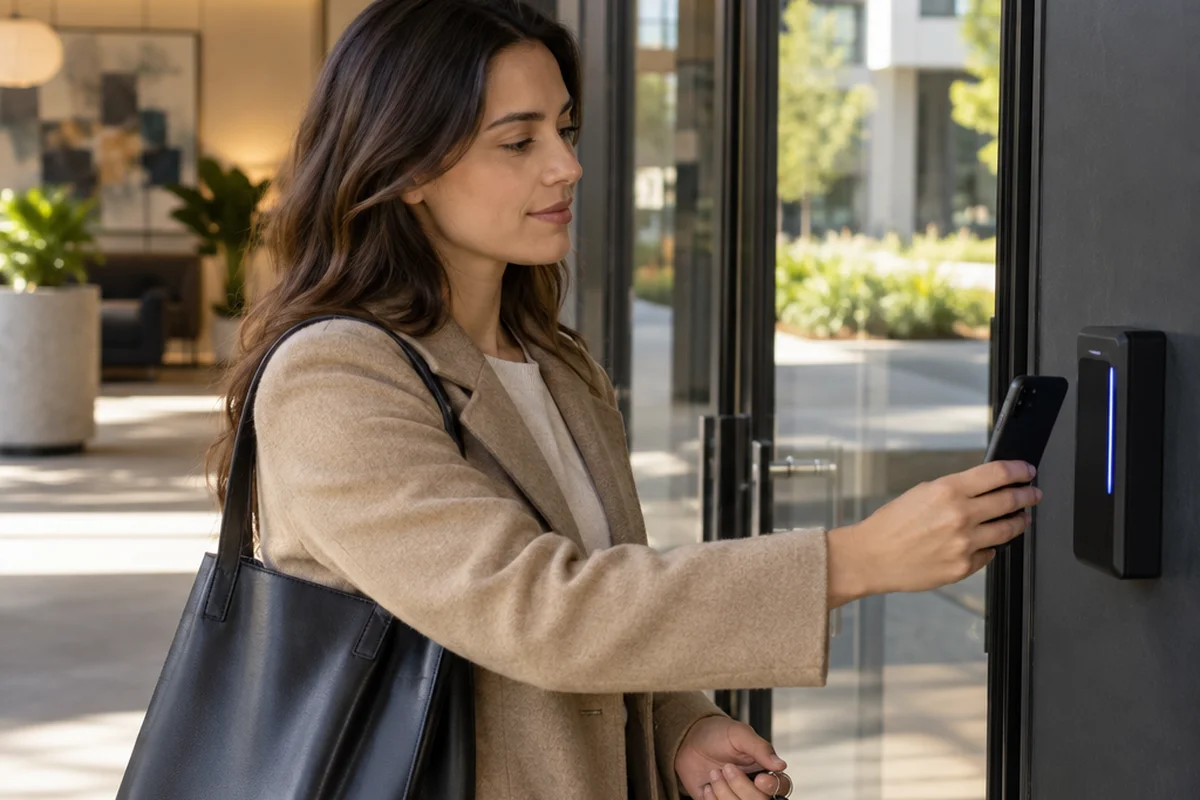
Most apartment communities that moved past metal keys started with key fobs. Now more residents want to use their phones, and operators are deciding whether to switch, keep fobs, or run both. Here is how they compare on the tasks your team handles every week.
How each credential type works
Key fobs and access cards
A key fob is a small physical credential that a resident taps at a reader. Access cards work the same way. Both are familiar, need no setup on the resident's side, and suit residents who would rather not use a phone to get in. They also fit properties that already run a card program.
Mobile credentials
A mobile credential turns the resident's smartphone into the key. With Luxer Access, residents can unlock doors through the resident app or add a building credential to Apple Wallet or Google Wallet and tap their phone at the reader. Wallet credentials work at HID Signo readers, which also support Bluetooth and NFC. Apple Wallet and Google Wallet credentials work even when the resident's phone has no cell or internet signal, which helps in underground parking garages and stairwells. The same app also handles intercom calls, guest codes, package notifications and each resident's own access history.
Luxer Access supports both side by side, along with PIN codes, QR codes and facial recognition, all managed from one cloud dashboard. Residents choose the credential that works for them, and properties can mix credential types across a community.
Move-in and move-out provisioning
This is where the biggest workflow difference shows up, and it depends less on the credential than on the system behind it.
With PMS integration, Luxer Access reads the rent roll and keeps the resident list current. When a resident is added in the PMS, their credentials activate automatically. When a move-out is triggered, access deactivates across connected doors without a separate manual step. Integrations include Yardi, RealPage, Entrata, AppFolio, MRI and others, and bulk onboarding is available for large move-in periods.
- Fobs: access rights can be set up automatically, but someone still has to hand a physical fob to the resident, record which fob went to which unit, and decide whether to collect it at move-out.
- Mobile: there is no physical item to hand over or track. The credential follows the lease cycle in software, so move-in day does not hinge on a key pickup at the office.
For both types, deactivation at move-out happens in software. Once access is revoked, an unreturned fob no longer opens doors, and no rekeying is needed.
Lost fobs and lost phones
Lost credentials are routine at most communities. Luxer's own FAQ says a property manager can revoke a lost fob or phone credential instantly from the dashboard and issue a new one right away.
The difference is in what comes next. A replacement fob has to come out of inventory and reach the resident in person. A mobile credential has no physical item to replace, although the resident still needs a working phone to use it. At the unit door, every lock has a PIN code backup, so a resident has a fallback while a new credential is set up.
Guest and vendor access
Fobs are a weak tool for visitors. A lent fob shows up in the log as the resident's credential, not the person who used it, and it may not come back.
The resident app gives residents better options. From the app, a resident can generate a visitor pass or a temporary PIN and share it digitally. When a visitor arrives at the intercom, the resident can see them on video and unlock the door remotely. Visitor credentials expire automatically after a set period.
On the property side, the dashboard supports scheduled access for vendors and recurring visitors, plus automated workflows for deliveries and guests. Those staff tools work no matter which credential a resident carries. Resident-issued guest passes do require the app. If you are also weighing an intercom upgrade, our guide on how to choose a video intercom for an apartment building covers that side of visitor entry.
Audit trails
Luxer Access keeps an audit trail of every access event. Managers can pull door activity history, tampering events, and resident and staff access logs, and they can filter records by time, door or credential. Multi-property operators get logs across locations, with role-based permissions so regional managers see their portfolio and on-site staff see only their building. Residents can also view their own access history in the app.
One caveat applies to every credential type. A log records which credential opened a door. It does not prove who was holding it. A lent fob or a shared PIN still appears under the original owner, so keep that in mind for any credential that is easy to hand to someone else.
Running both during a transition
Most communities will not move every resident to mobile on the same day, and they do not have to. Luxer Access supports fobs and cards alongside mobile and Wallet credentials, managed from the same dashboard. The platform is modular, so you can start with part of the property and expand over time. A practical transition plan usually looks like this:
- Assess what you have. In many cases existing door hardware can be integrated, but compatibility depends on current wiring, locks and other systems, so each property needs its own assessment.
- Pick your starting doors. Luxer Access can control main entrances, amenity spaces, parking garages and gates, elevators, maintenance doors and individual units.
- Offer mobile and keep fobs available. Residents who prefer their phone can switch, and residents who prefer a fob keep one.
- Plan the data move. Luxer provides implementation support and can help migrate resident data from another access control system, with a process designed to minimize disruption during switchover.
- Train staff on one workflow. Provisioning, revocation and audit work from the same dashboard for both credential types.
We handle the site walk, installation and staff training.
So which is better?
For most operators the answer is both, on one system. Mobile credentials remove the physical handoff and put guest tools in residents' hands. Fobs remain a dependable option for residents who do not want to use a phone. What matters more than the credential is the platform behind it. When both types sit on one platform tied to your PMS, provisioning, revocation and audit work the same way whatever the resident carries. For a closer look at the full setup, see our page on keyless entry for apartments.
Ready to plan a fob and mobile rollout for your property? Book a site walk with our team. Our team handles the project, backed by Luxer's 24/7 support.
FAQ
Do residents need a smartphone to use Luxer Access?
No. A smartphone can be a resident's primary credential through the app, Apple Wallet or Google Wallet, but key fobs, access cards and PIN codes are also available for residents who prefer them.
What happens to a resident's fob at move-out?
With PMS integration, access is removed automatically when the lease ends or the move-out is processed. An unreturned fob stops working once its access is revoked, so no rekeying is needed.
Can a lost fob or phone credential be turned off right away?
Yes. A property manager can revoke the lost credential from the dashboard without being on-site and issue a new one so the resident is not locked out for long.
Can we run fobs and mobile credentials at the same time?
Yes. Luxer Access supports fobs and cards alongside mobile and Wallet credentials, and all of them are managed from one dashboard.
Does Luxer Access work with our property management software?
Luxer Access integrates with major PMS platforms, including Yardi, RealPage, Entrata, AppFolio and MRI, so move-ins and move-outs can update credentials automatically.
Ready for a Luxer One® package locker quote?
Tell us your unit count and we'll send right-sized pricing with a fast response time.
Get my free quote