July 7, 2026
California Building Code for Lockers: A Developer's Guide
Discover what is California building code for lockers. Learn essential requirements to ensure compliance, avoid costly redesigns, and pass inspections.
The California Building Code (CBC), defined as Part 2 of Title 24, sets mandatory requirements for locker installations in multifamily residential buildings, covering accessibility, seismic anchoring, and environmental standards. Architects, developers, and contractors working on California multifamily projects must understand these rules before schematic design begins. The CBC is based on the 2021 IBC with California-specific amendments, and its accessibility chapters 11A and 11B apply directly to locker room layouts. Alongside the CBC, CALGreen (Title 24, Part 11) adds sustainability requirements that affect bicycle locker design. Getting these three layers right from the start prevents costly redesigns and failed inspections.
What is California building code for lockers?
California locker regulations are governed primarily by the CBC, which sets accessibility and safety standards for locker installations in multifamily residential and commercial buildings. The 2025 California Access Compliance Advisory Reference Manual provides the most current interpretation of these rules. Seismic anchoring requirements under California Administrative Code Title 2 add a second compliance layer specific to earthquake safety. CALGreen then adds a third layer for bicycle storage lockers. Contractors and architects who treat these three frameworks as separate checklists, rather than an integrated design problem, consistently run into conflicts during permit review.
The CBC does not regulate locker dimensions in isolation. It governs the space around lockers, the routes leading to them, and the structural connection between lockers and the building itself. That distinction matters because a locker that fits perfectly in a room can still fail inspection if the aisle in front of it is too narrow or the anchoring method does not meet seismic standards.
What accessibility standards apply to lockers under the CBC?
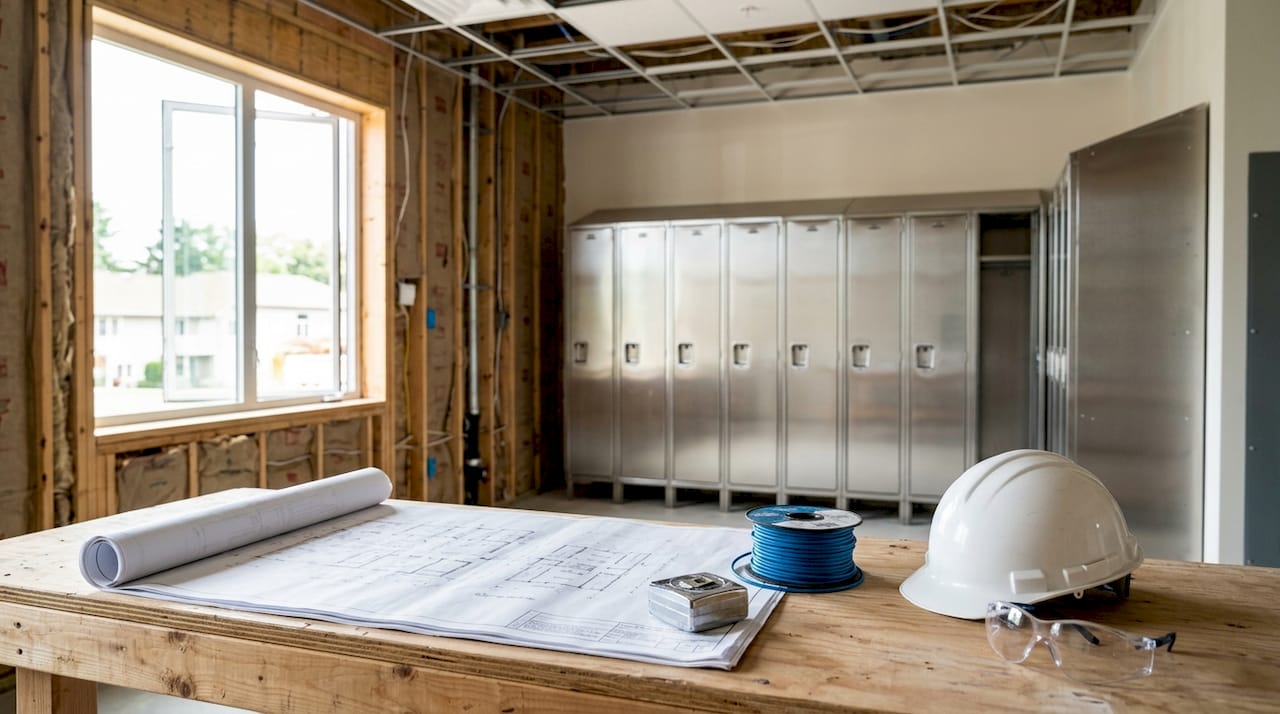
At least 5% of lockers must be accessible under ANSI A117.1, the standard incorporated by reference into the CBC. That minimum applies to the total number of lockers in a facility, not just one locker room. Accessible lockers must be reachable within the forward or side reach ranges defined by ANSI A117.1, which set maximum heights for operable parts and storage areas.
CBC Chapters 11A and 11B govern the spatial requirements that surround accessible lockers:
- Aisle width: Accessible routes adjacent to lockers require a minimum clear width of 36 inches, with 60-inch passing spaces where two wheelchair users may need to pass.
- Turning space: A 60-inch diameter turning circle or T-shaped turning space is required within the locker room.
- Bench requirements: Locker rooms serving accessible lockers must include a bench with a seat height between 17 and 19 inches, positioned on an accessible route.
- Reach range: Forward reach to locker controls cannot exceed 48 inches above the floor; side reach cannot exceed 54 inches.
- Door clearance: Locker room entry doors must provide at least 32 inches of clear opening width, with compliant maneuvering clearance on both sides.
Pro Tip: Place accessible lockers near the locker room entrance rather than at the back. This reduces the accessible route length and simplifies compliance with turning space requirements.
Maximizing locker density without accounting for these clearances is the most common design error in California multifamily projects. Title 24 accessibility rules govern required accessible routes more strictly than locker footprint size. A locker room that fits 40 units but fails to provide a compliant turning radius will not pass inspection regardless of how well the lockers themselves are specified.
How does the California Building Code address seismic safety for locker installations?
Lockers in California must be seismically anchored per Title 2, Section 2-2312 of the California Administrative Code. This requirement applies to freestanding and wall-mounted locker units in multifamily residential buildings. The Certified Seismic Installation Program (CSIP) provides a compliance pathway that many California jurisdictions recognize during permit review.
Seismic anchoring for lockers typically involves the following methods:
- Floor anchoring: Bolting locker bases directly to a concrete slab or structural subfloor using anchor bolts rated for seismic loads.
- Wall anchoring: Attaching the top or rear of locker banks to structural walls using seismic clips or angle brackets.
- Row anchoring: Connecting adjacent locker units to each other to distribute lateral forces across the entire bank rather than concentrating stress on individual units.
- Back-to-back anchoring: Securing two rows of lockers together at the top when they share a common back panel, a method that improves stability without requiring additional wall connections.
The materials used matter as much as the method. Steel lockers with welded frames perform better under seismic loads than units with mechanical fasteners at every joint. Specifying locker units with continuous welded construction simplifies CSIP compliance documentation.
Pro Tip: Engage a structural engineer during schematic design to confirm anchor bolt spacing and embedment depth. Retrofitting seismic anchors after installation is significantly more expensive than specifying them correctly from the start.
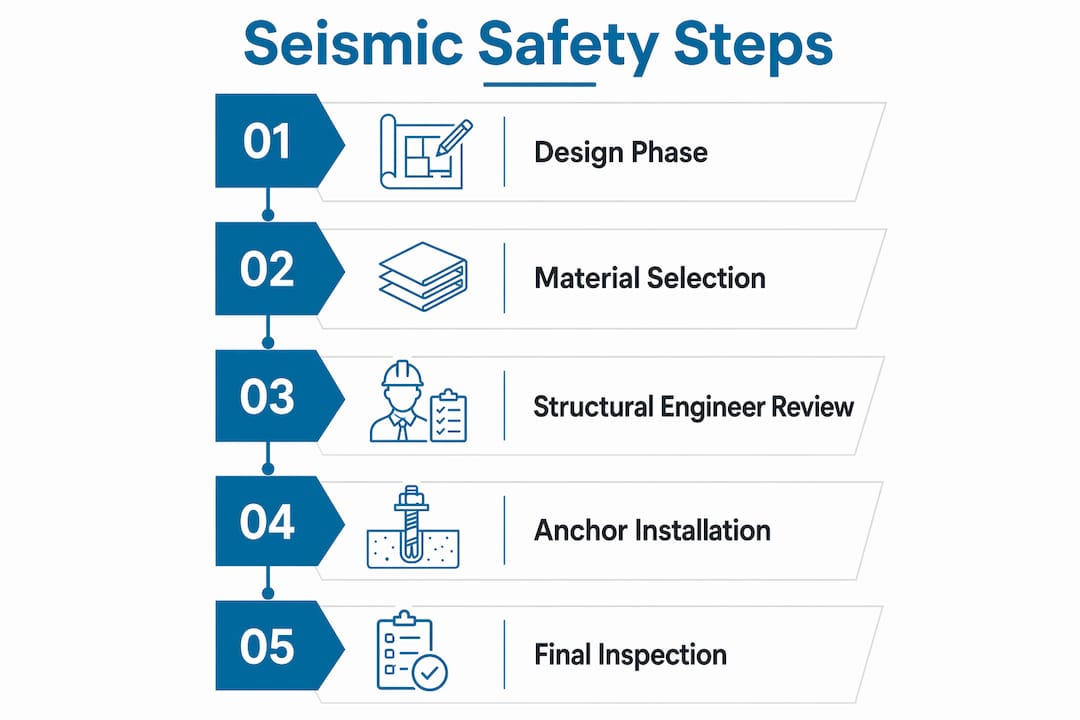
Early integration of seismic safety into the design process also affects locker placement. Units positioned near exterior walls or in areas with limited structural backing require additional engineering review. Planning for seismic anchoring at the same time as accessibility clearances prevents conflicts between anchor bolt locations and accessible route dimensions.
What are CALGreen requirements for bicycle locker storage?
CALGreen (Title 24, Part 11) classifies bicycle lockers as Class I long-term parking. Class I bike storage must provide full weather and theft protection for the entire bicycle frame and wheels, not just the frame or wheel alone. This distinction separates bike lockers from standard bike racks, which qualify only as Class II short-term parking.
The difference between Class I and Class II parking has direct design consequences:
- Class I (long-term) requirements: Enclosed or locked storage protecting the full bicycle, weather protection from rain and UV exposure, and security against theft of the entire unit.
- Class II (short-term) requirements: Fixed racks near building entrances that allow locking of the frame and one wheel, with no weather protection required.
- Quantity thresholds: CALGreen sets minimum quantities of each class based on building occupancy and square footage, which architects must calculate during the programming phase.
- Location requirements: Class I bicycle lockers must be accessible to residents without passing through the building’s main lobby in most multifamily configurations.
| Parking class | Storage type | Weather protection | Security level |
|---|---|---|---|
| Class I | Enclosed locker or room | Required (full coverage) | Locked, individual access |
| Class II | Exterior rack | Not required | Frame and wheel lock only |
Bike lockers in multifamily projects qualify as Class I long-term parking, a detail designers frequently overlook when specifying outdoor amenity areas. A standard bike rack placed near a building entrance satisfies Class II requirements but does not substitute for Class I lockers. Both classes are typically required in the same project.
Common compliance challenges with California locker codes
Planning locker room layouts without prioritizing circulation spacing early in design is the leading cause of inspection failures in California multifamily projects. Developers often approve a locker count during programming without verifying that the planned room dimensions can accommodate the required accessible routes, turning spaces, and door clearances simultaneously.
Privacy law adds a compliance dimension that surprises many project teams. California Labor Code 435 absolutely prohibits audio or video recording inside locker rooms or changing rooms. Violations are classified as misdemeanors regardless of whether signage is posted. This prohibition affects smart locker systems that include cameras for package verification or access logging.
“California law enforces nearly absolute employee and resident privacy in locker rooms, forbidding surveillance where other common areas permit monitoring. Smart locker systems with integrated cameras must be designed so that camera coverage stops at the locker room boundary, not inside it.”
The practical implication for smart locker installations is significant. Camera placement must be limited to areas outside the locker room itself, such as corridors or building entrances. Access logs and electronic audit trails are permitted because they do not constitute audio or video recording. Architects specifying smart lockers should confirm camera field-of-view boundaries during design development, not during construction.
Standardizing locker specifications across multifamily projects reduces complexity and produces consistent compliance with moisture resistance, access control, and maintenance requirements. Developers managing multiple properties benefit from a single specification that has already been reviewed for CBC and CALGreen compliance, rather than re-engineering each project from scratch. This approach also simplifies maintenance contracts and replacement part procurement across a portfolio. A space-efficient locker configuration strategy developed at the portfolio level saves time on every subsequent permit application.
Key Takeaways
California locker code compliance requires integrating CBC accessibility rules, seismic anchoring standards, and CALGreen bicycle storage requirements from the earliest stage of multifamily design.
| Point | Details |
|---|---|
| CBC governs locker installations | Title 24, Part 2 sets accessibility, seismic, and spatial rules for all multifamily locker rooms. |
| 5% accessible locker minimum | At least 5% of lockers must meet ANSI A117.1 reach range and bench requirements. |
| Seismic anchoring is mandatory | California Administrative Code Title 2, Section 2-2312 requires floor or wall anchoring for all locker banks. |
| Bike lockers are Class I parking | CALGreen requires enclosed, weather-protected bicycle lockers as long-term parking in multifamily buildings. |
| Surveillance inside locker rooms is illegal | California Labor Code 435 prohibits audio or video recording in locker rooms, affecting smart locker camera placement. |
What we have learned from California locker code projects
Working with multifamily developers and architects across California, the clearest lesson is this: code compliance for lockers is almost never a locker problem. It is a coordination problem. The locker unit itself is rarely the issue. The failures happen in the space around it, in the route leading to it, and in the structural connection beneath it.
The teams that get it right bring their code consultant into the conversation during schematic design, not during permit review. By the time a set of drawings reaches the building department, the accessible route dimensions, seismic anchor locations, and camera exclusion zones should already be resolved. Trying to fix these issues after the locker room layout is set forces expensive compromises.
Balancing locker density with accessibility clearances is a real tension in multifamily projects where every square foot carries a cost. The answer is not to reduce the accessible locker count. The answer is to design the room around the accessible route first, then fill in the remaining locker count. That sequence consistently produces compliant layouts without sacrificing capacity.
On privacy: the prohibition under Labor Code 435 is absolute, and the smart locker industry has not always kept pace with that reality. Any locker system that includes a camera must be specified with a clear understanding of where that camera points. Locker Solutions designs its systems with this boundary in mind, keeping video verification outside the protected space.
— Locker Solutions
How Locker Solutions supports California code compliance
Locker Solutions works directly with architects, developers, and contractors on multifamily projects across California, providing locker systems built to meet CBC accessibility requirements, seismic anchoring standards, and CALGreen bicycle storage classifications.
The Luxer One® product line includes outdoor parcel lockers engineered for weatherproof performance and seismic installation, along with indoor locker systems configured for accessible route compliance. Locker Solutions also offers access control solutions designed specifically for multifamily properties, with audit trail logging that satisfies security requirements without triggering Labor Code 435 restrictions. Every installation comes with documentation to support permit applications and inspections. Contact Locker Solutions to review your project’s locker specifications against current California code requirements.
FAQ
What is the California Building Code for lockers?
The California Building Code (CBC), Part 2 of Title 24, governs locker installations in multifamily residential buildings, covering accessibility under Chapters 11A and 11B, seismic anchoring under California Administrative Code Title 2, and bicycle locker standards under CALGreen (Title 24, Part 11).
How many lockers must be accessible under California law?
At least 5% of lockers in a facility must be accessible, meeting ANSI A117.1 reach range requirements and including a compliant bench within the locker room.
Are bicycle lockers required in California multifamily buildings?
CALGreen requires Class I long-term bicycle parking, which includes enclosed, weather-protected bicycle lockers, in multifamily residential developments. The quantity required depends on building occupancy and square footage.
Can security cameras be installed inside locker rooms in California?
California Labor Code 435 prohibits audio or video recording inside locker rooms under any circumstances. Camera systems must be positioned outside the locker room boundary, and violations are classified as misdemeanors.
What seismic anchoring is required for lockers in California?
California Administrative Code Title 2, Section 2-2312 requires locker banks to be anchored to the floor or structural walls using methods that meet seismic load ratings. Compliance with the Certified Seismic Installation Program (CSIP) is a recognized pathway for satisfying this requirement.
Recommended
- Space-Efficient Locker Configuration: A Developer’s Guide — Locker Solutions Blog
- Single Door Locker Guide for Multifamily Properties — Locker Solutions Blog
- Smart Lockers for Property Managers: 2026 Guide — Locker Solutions Blog
- Preventive Maintenance for Lockers: A Facility Manager’s Guide — Locker Solutions Blog
Ready for a Luxer One® package locker quote?
Tell us your unit count and we'll send right-sized pricing with a fast response time.
Get my free quote