July 1, 2026
Space-Efficient Locker Configuration: A Developer's Guide
Discover what is space-efficient locker configuration and learn how to maximize storage capacity while enhancing usability in your projects.

Space-efficient locker configuration is defined as the strategic arrangement of locker units to maximize storage capacity within a limited footprint while preserving full usability and code-compliant access. For property developers, facility managers, and architects working on multifamily residential properties, this concept goes far beyond picking a locker size. It requires understanding tier configurations, circulation zones, assembly methods, and how residents actually move through a space. The right configuration can double storage density without adding square footage. The wrong one creates bottlenecks that frustrate residents and generate maintenance headaches from day one.
What is space-efficient locker configuration, and why does it matter?
Space-efficient locker configuration is the practice of selecting locker types, arranging units, and planning surrounding space so that every square foot of a locker area delivers maximum storage value. The industry recognizes several standard configuration families: Z-lockers, tier lockers, and ultra-slim automated systems. Each solves a different spatial problem, and choosing the wrong one for a given space is one of the most common and costly mistakes in multifamily facility planning.
The core principle is density without dysfunction. A locker bank that packs in 40 compartments but creates a 600mm aisle is not space-efficient. It is a liability. True efficiency accounts for the locker footprint, the door swing, the standing zone in front of each unit, and the maintenance clearance behind the bank. All four factors consume real space, and all four must be planned together.
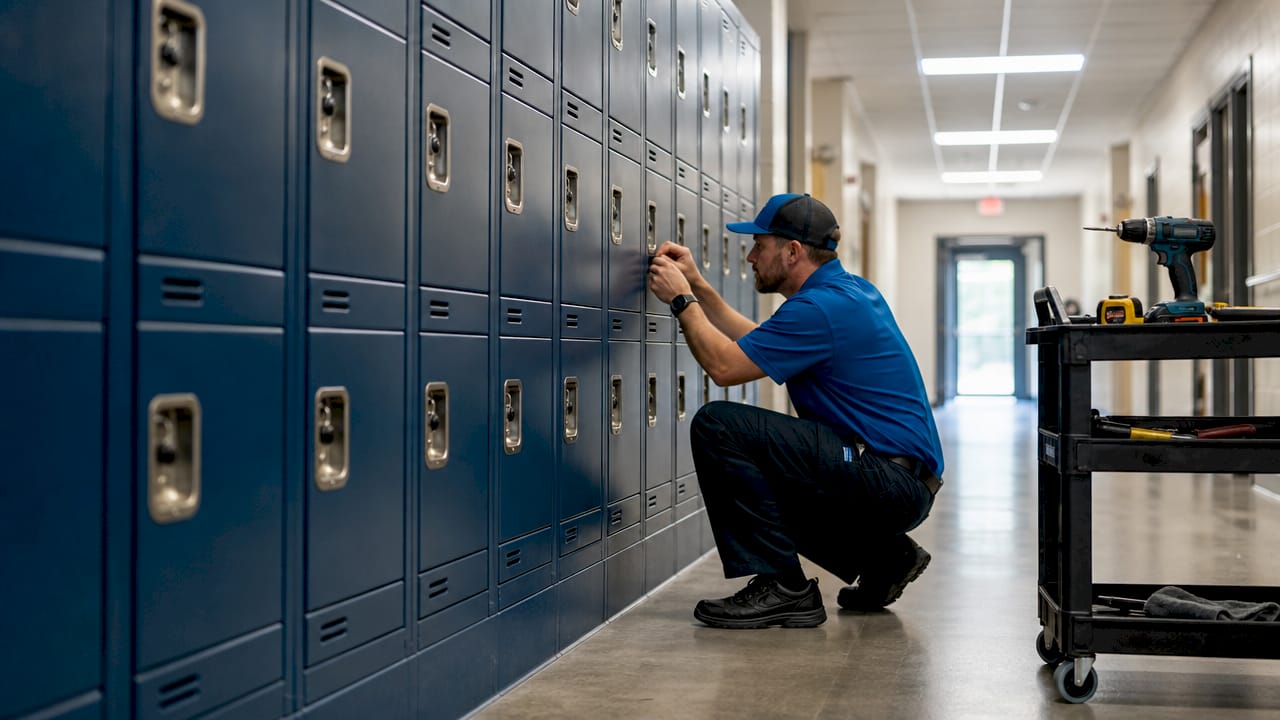
Property developers who treat locker selection as a product purchase rather than a spatial planning exercise consistently underperform on resident satisfaction scores. The best locker configuration aligns with actual user behavior and room flow, not just the highest compartment count per square meter.
Key locker types for space-saving design
Z-lockers: vertical split storage
Z-locker configurations split one locker column into two interlocking compartments, creating a Z-shaped interior profile. This design is ideal for storing long items such as coats or sports equipment without requiring a full-height single compartment. Z-lockers typically measure 800mm wide by 500mm deep. That footprint delivers two usable compartments per column, effectively doubling storage density compared to a single-tier unit of the same width.
Z-lockers work well in compact changing rooms, laundry areas, and corridor installations where ceiling height is available but floor space is limited. The interlocking design means neither compartment is a simple rectangle, so they are best suited for properties where residents store mixed-length items rather than uniform packages.
Tier lockers: maximum vertical density
4-tier and 6-tier locker units are the workhorses of high-density storage. 12-door steel units can occupy under 0.4 square meters of floor space while providing individual compartments for a dozen users. That density makes tier lockers the standard choice for package rooms and mail areas in multifamily buildings where parcel volume is high and floor space is constrained.
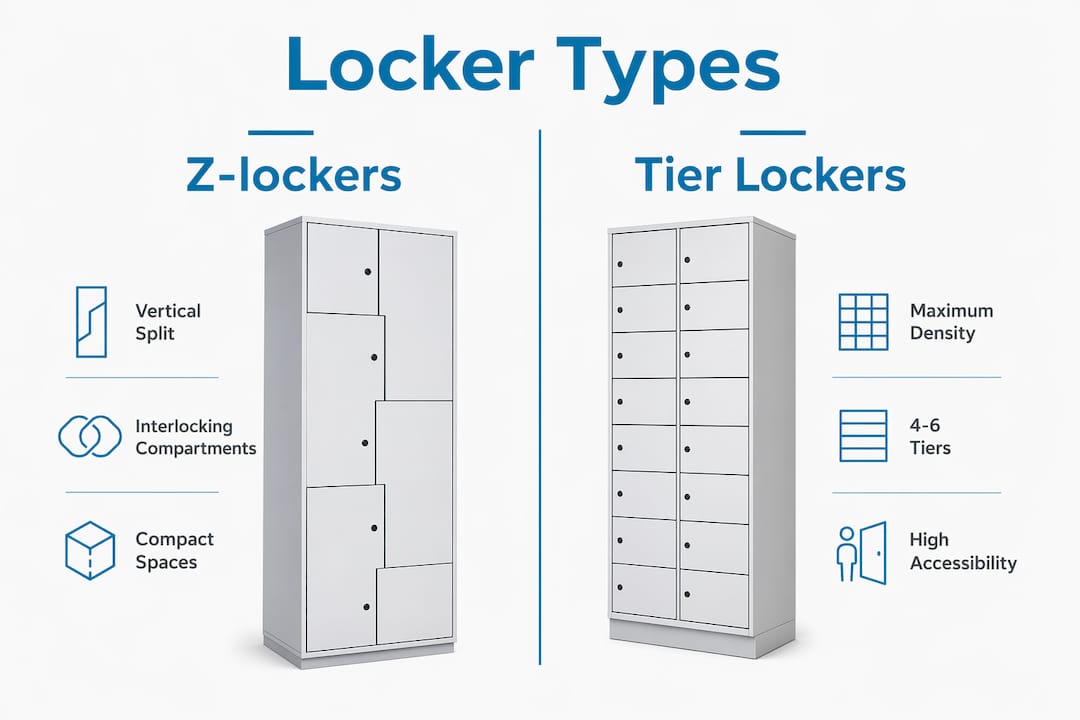
The trade-off is accessibility. Users needing frequent, quick access benefit from more tiers of smaller lockers. Long-term storage favors fewer, larger compartments. A 6-tier configuration places the top row above eye level for many residents, which reduces usability for older adults or anyone with limited reach. Architects should account for the resident demographic before specifying tier count.
Ultra-slim automated lockers: narrow corridor solutions
Ultra-slim automated locker systems have depths under 25 cm, making them the only viable option for narrow corridors and alcoves where traditional lockers physically cannot fit. Configurations from 4 to 24 cells per column enable high-density storage without obstructing circulation paths. These systems are electronically controlled, which eliminates the need for physical keys and reduces staff intervention.
Pro Tip: Choose locker type based on two variables: the average size of items residents will store, and how often they access those items. High-frequency, small-item storage calls for tier lockers. Occasional, large-item storage calls for Z-lockers. Corridor installations with tight clearances call for ultra-slim systems.
| Locker type | Typical footprint | Compartments per column | Best use case |
|---|---|---|---|
| Z-locker | 800mm W x 500mm D | 2 | Long items, changing rooms, laundry areas |
| 4-tier locker | 300mm W x 450mm D | 4 | Package rooms, mail areas |
| 6-tier locker | 300mm W x 450mm D | 6 | High-density package storage |
| Ultra-slim automated | Under 250mm D | 4–24 | Narrow corridors, compact alcoves |
How do you design a locker layout for maximum space efficiency?
Layout design is where most space-efficiency gains are either captured or lost. The locker units themselves account for only part of the equation. The surrounding space determines whether the installation actually functions.
Building codes and safety guidelines require minimum 1200mm aisle clearance in front of locker banks. That clearance is not optional. It exists to prevent bottlenecks during peak access times and to meet accessibility standards. Architects who shave this dimension to fit more units create compliance problems and resident complaints simultaneously.
The standing zone concept is equally critical and far less understood. The standing zone is the area a user physically occupies while accessing a locker, including the space needed to open a door, retrieve an item, and step back. Ignoring the standing zone produces locker installations that look efficient on a floor plan but create congestion in practice. Two residents accessing adjacent lockers simultaneously should not collide.
Vertical layout versus horizontal layout is a genuine design decision, not a default. Vertical banks maximize compartments per linear meter of wall. Horizontal banks spread units across a wider wall section, which can reduce the height of the top tier and improve accessibility. The right choice depends on ceiling height, wall availability, and resident demographics.
Practical layout principles for multifamily locker areas:
- Maintain 1200mm minimum aisle width at all times, measured from the open door face, not the closed door face.
- Position locker banks so door swings do not conflict with adjacent units or corridor traffic.
- Avoid placing locker banks directly opposite each other in corridors narrower than 2400mm.
- Plan lighting above locker banks so upper tiers are visible without a flashlight.
- Leave 100mm between the end of a locker bank and a perpendicular wall to account for wall irregularities.
Pro Tip: Plan maintenance access and ventilation clearances before finalizing the layout. Facility managers should allow a 20–30mm gap behind locker banks for ventilation and leave wall-to-wall installations 100mm short to compensate for wall irregularities. These hidden space costs protect long-term functionality.
How do assembly method and modularity affect space efficiency?
The way lockers are assembled and delivered has a direct impact on installation cost, flexibility, and long-term space management. This factor is routinely overlooked during specification.
Knockdown lockers ship flat-packed, reducing shipping volume by 60–70% compared to factory-assembled units. Each unit requires roughly 20–30 minutes of on-site assembly. The payoff is significant: knockdown units can be relocated more easily than welded assemblies, which matters when a property’s package volume grows and the locker area needs reconfiguration. For multifamily developers managing multiple properties, knockdown lockers also reduce freight costs substantially.
Modular locker systems take this further. Space efficiency is moving toward modular, adaptable systems that allow on-site customization for fluctuating storage needs. A modular bank can be extended by adding columns, reconfigured by swapping tier inserts, or relocated to a different area of the property without replacing the entire installation.
| Assembly type | Shipping volume | On-site labor | Relocatability | Best for |
|---|---|---|---|---|
| Factory-assembled | High | Minimal | Difficult | Permanent, fixed installations |
| Knockdown | 60–70% lower | 20–30 min per unit | Moderate | Multi-property developers, phased builds |
| Modular | Low to moderate | Moderate | High | Properties with changing storage needs |
Material choice intersects with assembly method. Steel lockers are durable and weld-friendly, which suits factory assembly. Wood and composite lockers are lighter and easier to handle on-site, which suits knockdown configurations. Steel is the standard for multifamily package rooms because it resists tampering and holds up under high daily use.
Real-world applications in multifamily residential properties
Multifamily properties present a specific set of spatial constraints: shared corridors, mail rooms, package areas, and amenity spaces that must serve dozens or hundreds of residents efficiently. The following use cases show how configuration choices translate into real outcomes.
-
Corridor package installations. Ultra-slim automated lockers with depths under 25 cm fit into corridor alcoves and recessed wall sections without reducing the usable walkway width. Properties using this approach can add package capacity without dedicating a separate room.
-
Compact laundry and changing rooms. Z-lockers in laundry rooms allow residents to store bags, coats, and long items vertically. The 800mm width per column fits standard laundry room layouts, and the interlocking compartments serve two residents per column.
-
Dedicated package rooms with high-tier lockers. Automated package rooms using 6-tier locker banks maximize unit density in a fixed room footprint. A 10-square-meter room configured with 6-tier units along three walls can serve a property of 100 or more units, depending on average daily parcel volume.
-
Outdoor parcel stations. Weatherproof locker banks positioned near building entrances reduce lobby congestion. Ultra-slim and standard-depth units both work in covered outdoor areas, provided the installation accounts for drainage and thermal expansion.
-
Amenity room overflow storage. 4-tier lockers in gym or pool amenity rooms give residents secure storage for equipment without consuming floor space needed for fitness equipment. The locker configuration for amenity spaces should prioritize accessibility over density, since residents access these lockers while carrying equipment.
Key Takeaways
Space-efficient locker configuration requires treating the locker area as a spatial planning problem, not a product selection task, with configuration type, aisle clearance, standing zones, and assembly method all determining real-world performance.
| Point | Details |
|---|---|
| Configuration type drives density | Z-lockers, tier lockers, and ultra-slim systems each solve a different spatial problem. |
| Aisle clearance is non-negotiable | Minimum 1200mm in front of locker banks is required for code compliance and usability. |
| Standing zones prevent congestion | Plan the space a resident occupies while accessing a locker, not just the locker footprint. |
| Knockdown units add flexibility | Flat-packed lockers reduce shipping volume by 60–70% and can be relocated as needs change. |
| Modular systems future-proof the investment | Adaptable configurations allow property managers to reconfigure storage without full replacement. |
What facility managers get wrong about locker planning
After working with property developers and facility managers across multifamily residential projects, the pattern is consistent. The locker decision gets made late, gets delegated to procurement, and gets evaluated on price per compartment. That approach produces installations that look fine on paper and fail in practice within 18 months.
The most common mistake is vertical stacking without considering user access frequency. A 6-tier bank in a package room sounds efficient. If the top two tiers are inaccessible to a meaningful portion of residents, those compartments sit empty while lower tiers overflow. The result is a system that appears to have capacity but functionally does not.
The second mistake is ignoring the standing zone. I have walked locker rooms where the aisle technically met the 1200mm code requirement, but the standing zone of one resident opening a locker reduced the effective passage width to under 600mm. That is a congestion point waiting to happen during morning peak hours.
The third mistake is treating the locker installation as permanent from day one. Multifamily properties change. Package volumes grow. Resident demographics shift. A modular system specified at the outset costs roughly the same as a fixed system but gives the facility manager the ability to reconfigure without a capital project. That flexibility has real financial value over a 10-year property lifecycle.
The right approach is to treat locker selection as a spatial layout problem. Map circulation paths, door swings, and standing zones before specifying a single unit. The locker type follows the spatial analysis. Not the other way around.
— Locker Solutions
Locker Solutions for multifamily space efficiency
Property developers and facility managers working on multifamily projects need locker configurations that fit the building, serve the residents, and hold up under daily use.
Locker Solutions provides Luxer One® package lockers, automated package rooms, and weatherproof kiosk systems configured for multifamily residential properties of every size. Each installation is planned around your specific floor plan, resident volume, and access requirements. Custom configurations are available for indoor, outdoor, refrigerated, and corridor applications. The team handles site assessment, configuration design, installation, and ongoing maintenance support. Explore locker options for apartments or review the full guide to automated package rooms to find the configuration that fits your property.
FAQ
What is a space-efficient locker configuration?
A space-efficient locker configuration is the arrangement of locker units to maximize storage capacity within a limited footprint while maintaining code-compliant aisle clearance and full usability. It involves selecting the right locker type, tier count, and layout for the specific space and user behavior.
How many tiers should a locker have for a package room?
4-tier and 6-tier locker units deliver the highest storage density for package rooms, with 12-door steel units fitting under 0.4 square meters of floor space. The right tier count depends on the height of the ceiling and the reach ability of the resident population.
What is the minimum aisle width in front of lockers?
Building codes and safety guidelines require a minimum 1200mm aisle clearance in front of locker banks. This measurement applies to the space in front of an open door, not a closed one.
When should ultra-slim lockers be used?
Ultra-slim automated lockers with depths under 25 cm are the correct choice for narrow corridors, recessed alcoves, and any space where standard-depth lockers would obstruct circulation. They support 4 to 24 cells per column, making them viable for high-density corridor installations.
What is the advantage of knockdown lockers over factory-assembled units?
Knockdown lockers reduce shipping volume by 60–70% and can be relocated more easily than welded factory-assembled units. They require roughly 20–30 minutes of on-site assembly per unit, but offer greater flexibility for properties that expect to reconfigure storage over time.
Recommended
- Apartment locker setup guide: maximize efficiency now - Luxer One Locker Solutions
- Choosing the Right Locker Company for Multifamily Properties — Locker Solutions Blog
- Energy-Efficient Package Locker Systems for Apartments — Locker Solutions Blog
- Single Door Locker Guide for Multifamily Properties — Locker Solutions Blog
Ready for a Luxer One® package locker quote?
Tell us your unit count and we'll send right-sized pricing with a fast response time.
Get my free quote